

Grammar


Tenses


Present

Present Simple

Present Continuous

Present Perfect

Present Perfect Continuous


Past

Past Simple

Past Continuous

Past Perfect

Past Perfect Continuous


Future

Future Simple

Future Continuous

Future Perfect

Future Perfect Continuous


Parts Of Speech


Nouns

Countable and uncountable nouns

Verbal nouns

Singular and Plural nouns

Proper nouns

Nouns gender

Nouns definition

Concrete nouns

Abstract nouns

Common nouns

Collective nouns

Definition Of Nouns

Animate and Inanimate nouns

Nouns


Verbs

Stative and dynamic verbs

Finite and nonfinite verbs

To be verbs

Transitive and intransitive verbs

Auxiliary verbs

Modal verbs

Regular and irregular verbs

Action verbs

Verbs


Adverbs

Relative adverbs

Interrogative adverbs

Adverbs of time

Adverbs of place

Adverbs of reason

Adverbs of quantity

Adverbs of manner

Adverbs of frequency

Adverbs of affirmation

Adverbs


Adjectives

Quantitative adjective

Proper adjective

Possessive adjective

Numeral adjective

Interrogative adjective

Distributive adjective

Descriptive adjective

Demonstrative adjective


Pronouns

Subject pronoun

Relative pronoun

Reflexive pronoun

Reciprocal pronoun

Possessive pronoun

Personal pronoun

Interrogative pronoun

Indefinite pronoun

Emphatic pronoun

Distributive pronoun

Demonstrative pronoun

Pronouns


Pre Position


Preposition by function

Time preposition

Reason preposition

Possession preposition

Place preposition

Phrases preposition

Origin preposition

Measure preposition

Direction preposition

Contrast preposition

Agent preposition


Preposition by construction

Simple preposition

Phrase preposition

Double preposition

Compound preposition

prepositions


Conjunctions

Subordinating conjunction

Correlative conjunction

Coordinating conjunction

Conjunctive adverbs

conjunctions


Interjections

Express calling interjection

Phrases

Sentences


Grammar Rules

Passive and Active

Preference

Requests and offers

wishes

Be used to

Some and any

Could have done

Describing people

Giving advices

Possession

Comparative and superlative

Giving Reason

Making Suggestions

Apologizing

Forming questions

Since and for

Directions

Obligation

Adverbials

invitation

Articles

Imaginary condition

Zero conditional

First conditional

Second conditional

Third conditional

Reported speech

Demonstratives

Determiners


Linguistics

Phonetics

Phonology

Linguistics fields

Syntax

Morphology

Semantics

pragmatics

History

Writing

Grammar

Phonetics and Phonology

Semiotics


Reading Comprehension

Elementary

Intermediate

Advanced


Teaching Methods

Teaching Strategies

Assessment
Cultural issues and schools Conclusion
المؤلف:
Sue Soan
المصدر:
Additional Educational Needs
الجزء والصفحة:
P43-C3
2025-03-31
1423
Cultural issues and schools Conclusion
The intention of the provision of any education service is to grant all learners access to academic intervention and thus hopefully to academic achievement. Educators teaching learners from various cultural backgrounds thus need to look at them all as individuals and to adapt community practice and policies so that everyone can feel included and valued. Igoa (1995) developed an approach to teach immigrant children that encompasses their cultural, academic and psychological needs. Figure 1, entitled ‘The Threefold Intervention’, illustrates the areas of intervention Igoa focuses on around the circle that represents the whole child. She writes:
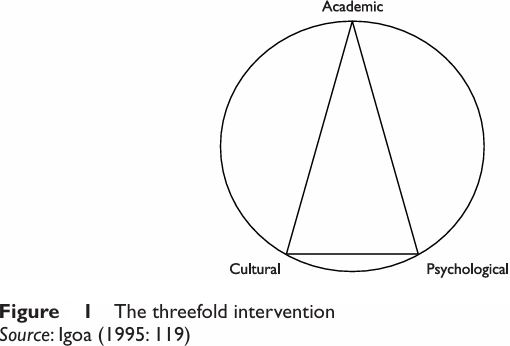
When the child feels in balance with these 3 aspects of herself or himself, the child in school is fully alive… Sometimes I focus on the cultural, then the psychological, then both, but I always keep the academic clearly in focus, so the child understands the importance of school. (ibid.: 119)
This example is just one possible approach, but it is one that focuses on all the needs of the individual, and not primarily on their cultural group background.
Finally, therefore, we have hopefully illustrated the need for schools and educators to create positive conditions for learning, where culture, climate and interpersonal relationships, through the revision of policies and practices undergo substantial changes: ‘The very climate of schools needs to undergo a critical transformation in order to make it clear that students of diverse backgrounds are expected and encouraged to learn’ (Nieto, 1999: 101).
Key issues
It is anticipated that you will now:
■ have an understanding of what culture is;
■ understand the need to value learners language and cultures;
■ recognize the importance of having high expectations of all learners, whatever their cultural background;
■ be able to recognize in a classroom where issues for learners from other cultures may cause difficulties;
■ be aware of the need for policies and practices in a school to reflect the cultural diversity of all its different populations.
الاكثر قراءة في Teaching Strategies
اخر الاخبار
اخبار العتبة العباسية المقدسة
الآخبار الصحية

قسم الشؤون الفكرية يصدر كتاباً يوثق تاريخ السدانة في العتبة العباسية المقدسة
"المهمة".. إصدار قصصي يوثّق القصص الفائزة في مسابقة فتوى الدفاع المقدسة للقصة القصيرة
(نوافذ).. إصدار أدبي يوثق القصص الفائزة في مسابقة الإمام العسكري (عليه السلام)


