Hyponymy and the has-relation
These two semantic relations should not be confused: hyponymy is about categories being grouped under superordinate terms (for example, tandems, ATBs, tourers and racers are kinds of bicycle; and bicycles, unicycles and tricycles are kinds of cycle), but the has-relation concerns parts that prototypical members of categories have (for instance, a prototype cycle has wheel(s), a frame, handlebars and pedals; a prototype bicycle has these parts too and also has a chain). Of course, a bicycle does not have tandems, and a chain is not a kind of bicycle, as someone who confused the has relation and hyponymy might think!
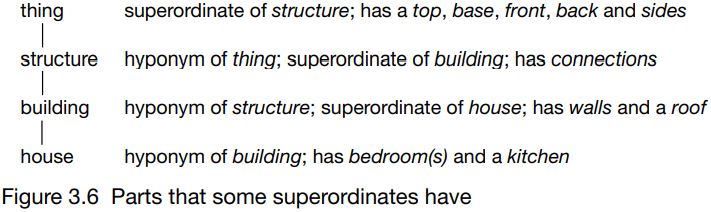
There is nonetheless a link between the two relations: hyponyms “inherit” the parts that their superordinates have (Miller and Fellbaum 1991: 206). If a prototype superordinate has certain parts then prototype members of that superordinate’s hyponyms also have those parts. The information in Figure 3.6 can be used to illustrate this.
At the bottom of the hierarchy in Figure 3.6, a prototypical house has a kitchen and at least one bedroom. A prototypical house also has the parts that its prototypical superordinates have: walls and a roof (because prototypical buildings have those), connections between the parts (“inherited” from structure, one of its higher-level superordinates) and a top, base, front, back and sides (inherited from thing). What has just been said is not offered as a full account of the parts linked to house by the has-relation; for instance, prototypes in the building category also have doors and floors, and prototype houses have those too, by inheritance
In (3.7) a person (in the sense of a person’s body, something that I later labelled person2) was said to have a head, a torso, arms, legs, genitals and a skin. Except for arms and legs, all of these are parts tied to animal1 by the has-relation. A prototypical person2 has these parts because of being one kind of animal1. (You might find it useful to look back to Figure 3.5 to remind yourself of which senses of animal and person were given which subscripts.)
With reference to Figure 3.5, a prototypical tool has a handle, and prototypical members of hyponyms of tool have handles too, by inheritance. In this way prototypical saws have handles; prototypical garden tools, such as rakes, have handles; prototypical kitchen utensils, such as spatulas and egg whisks, have handles. A non-prototypical kitchen utensil, such as a mixing bowl, however, need not have a handle.
For an example from nature, consider the tree name oak. Part of the meaning of this word comes via the has-relation: a prototypical oak has acorns. A prototypical oak also has a trunk, but this is by inheritance from tree; and, inherited from plant, a prototypical oak has leaves.
Note that the inheritance discussed here passes down through hyponymy. It does not pass down to parts of parts. A prototype in the hand category has a palm and fingers, but that does not lead us to expect prototype palms to have their own palm and fingers!
As a final point about interactions between the has-relation and hyponymy, it must be pointed out that part words can enter directly into superordinate and hyponym relations. Wrists, knuckles, knees and ankles are hyponyms of the superordinate joint. Limb is a superordinate for arm and leg. Lid is a hyponym of top – it is the ‘top of a container’.








