One way in which the study of basic conceptual meaning might be helpful would be as a means of accounting for the “oddness” we experience when we read sentences such as the following:
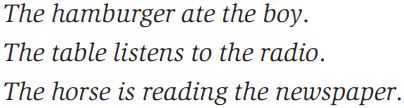
We should first note that the oddness of these sentences does not derive from their syntactic structure. According to the basic syntactic rules for forming English sentences, we have well-formed structures.

This sentence is syntactically good, but semantically odd. Since the sentence The boy ate the hamburger is perfectly acceptable, we may be able to identify the source of the problem. The components of the conceptual meaning of the noun hamburger must be significantly different from those of the noun boy, thereby preventing one, and not the other, from being used as the subject of the verb ate. The kind of noun that can be the subject of the verb ate must denote an entity that is capable of “eating.” The noun hamburger does not have this property and the noun boy does.
We can make this observation more generally applicable by trying to determine the crucial element or feature of meaning that any noun must have in order to be used as the subject of the verb ate. Such an element may be as general as “animate being.” We can then use this idea to describe part of the meaning of words as either having (+) or not having (−) that particular feature. So, the feature that the noun boy has is “+animate” (= denotes an animate being) and the feature that the noun hamburger has is “−animate” (= does not denote an animate being).
This simple example is an illustration of a procedure for analyzing meaning in terms of semantic features. Features such as “+animate, −animate,” “+human, −human,” “+female, −female,” for example, can be treated as the basic elements involved in differentiating the meaning of each word in a language from every other word. If we had to provide the crucial distinguishing features of the meanings of a set of English words such as table, horse, boy, man, girl, woman, we could begin with the following diagram.
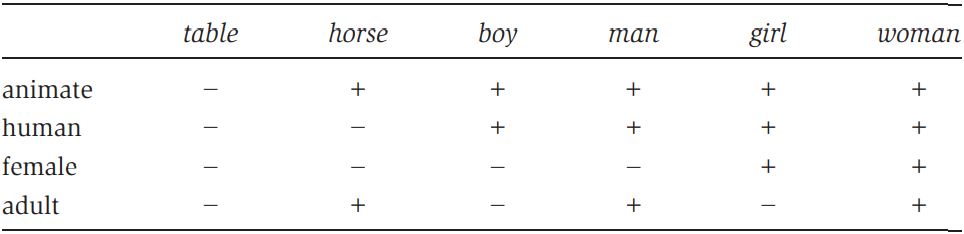
From a feature analysis like this, we can say that at least part of the meaning of the word girl in English involves the elements [+human, +female, −adult]. We can also characterize the feature that is crucially required in a noun in order for it to appear as the subject of a particular verb, supplementing the syntactic analysis with semantic features.

This approach would give us the ability to predict which nouns make this sentence semantically odd. Some examples would be table, horse and hamburger, because none of them have the required feature [+human].
The approach just outlined is a start on analyzing the conceptual components of word meaning, but it is not without problems. For many words in a language it may not be as easy to come up with neat components of meaning. If we try to think of the components or features we would use to differentiate the nouns advice, threat and warning, for example, we may not be very successful. Part of the problem seems to be that the approach involves a view of words in a language as some sort of “containers” that carry meaning components. There is clearly more to the meaning of words than these basic types of features.








