Words and clitics
A difficulty associated with describing English is that the orthography relates not to the present-day language, but to what it was like some centuries ago; for example, knee used to be pronounced with an initial k. One way in which how the language is written may mislead concerns word spaces. Sometimes, what is written as a word is not pronounced with separate stress (as a word must be), but is rather a clitic. This is a syllable, generally with a reduced vowel, which is attached to a preceding word (it is then an enclitic) or to a following word (a proclitic).
About sixty of the most common grammatical elements have two forms. They can carry stress and then function as an independent word; for example, and can be pronounced /æ´nd/, as in /kæ´ts æ´nd d´c gz/, cats AND dogs (with stress on the and). But and typically reduces to  , which is then a proclitic to the following word, as in /kæ´ts
  , cats and dogs (‘=’ indicates a clitic boundary). Indeed, in some places (New Zealand is a prime example) people may write this as cats ’n’ dogs. But generally, the conjunction is written and, whether pronounced as /æ´nd/or as
  .
.
Most clitics include the central vowel  , called schwa. For example, preposition to has stressed form /tu´:/ but reduces to proclitic
  before a consonant, as in
 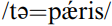 , to Paris; definite article the has stressed form / ðı´:/ but reduces to proclitic /ð e=/ before a consonant, as in /ð e=mæ´n/, the man; modal verb would has stressed form /wu´d/ but can reduce to enclitic
  , as in
  , He would go.
The grammatical elements which can be clitics are as follows:
(1) Nominal determiners a, an, the and some can be proclitics.
(2) Eight monosyllabic prepositions are generally proclitics—for, of, to, at, from, till, than and as (and by is sometimes a proclitic). Note that other monosyllabic prepositions are never clitics; these include, in, on, up, through.
(3) Conjunctions and, but, or and nor are typically proclitics, as is relator that when it introduces a relative clause or a complement clause (but not that when it is a demonstrative).
(4) Possessor modifying pronouns are often proclitics—your, his, her, its, our, their and my. (Pronouns are listed in Table 2.1.)
(5) Some series II (subject) pronouns may be proclitics—she, he, we, it, and you.
(6) Series I pronouns can be enclitics when following a verb or preposition (in stressed form)—me, you, him, her, it, us and them. For instance 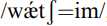 , Watch him!
(7) A number of auxiliary and copula verb forms can be enclitics—is, am, was, were, has, have, had, will, would, shall, should, can, could and must.
A few auxiliaries can be proclitics—be, been and (just in interrogative use) do. For example  , Do we go now?
The behavior of the verb are, /a´:(r)/ is fascinating. It becomes an enclitic  after a pronoun as subject, as in
  , They’re coming. And it becomes a proclitic
  to the following word when the subject is not a pronoun, as in
  , The boys are clever.
(8) There,  , can become a proclitic
  when in subject function before a copula in stressed form, as in
  , There IS an ant there.
(9) The negator not,  , can take on enclitic form /=nt/, or be reduced further to /=n/.
There are portions of the grammar which appear to be without explanation when considered in terms of the conventional orthography. But, once the role of clitics is acknowledged, there is a simple and natural explanation. One example of this concerns phrasal verbs. One can say either The police brought the criminal in or The police brought in the criminal, with in either following or preceding the O NP the criminal. However, when the O is a pronoun, the preposition can only follow it; one can say The police brought him in, but not *The police brought in him.








