Further notes on English Phrase Structure
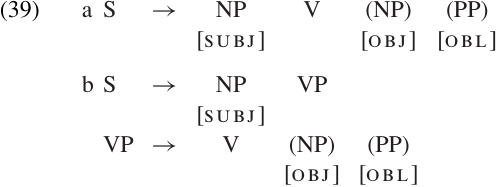
The simple PS rules we have assumed up to now generate only “flat” clause structures, with the verb and all of its complements being immediate daughters of S as shown in (39a). This kind of analysis seems to be correct for many languages, e.g. Malayalam (Mohanan1982). In English, however, and in a number of other languages, there is good reason to believe that the subject NP is not a sister of V. Rather, the verb, its object, and oblique arguments form a constituent labeled VP, and it is this VP which is a sister to the subject NP. The VP analysis for English is shown in (39b).
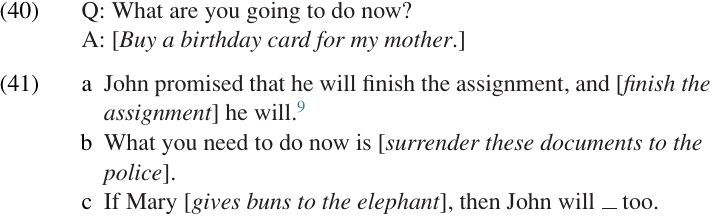
The evidence which supports a VP constituent for English is fairly complex, and we will not consider it in detail here.8 A few of the relevant patterns are illustrated in (40–41). These examples show that the combination of V +OBJ (+ OBL) can function as a sentence fragment in answer to a question (40), and can be re-ordered or deleted as a unit (41). These are some of the classic tests for constituency.
Because the VP analysis for English is so widely assumed. However, we will continue to assume a flat clause structure for other languages, because we will not have time to examine the evidence for constituency in each individual language. In general, we prefer to assume the simplest possible structure consistent with the language-specific evidence. With respect to Phrase Structure, this means assuming a flat clause structure unless we find specific evidence supporting a VP constituent in a particular language.
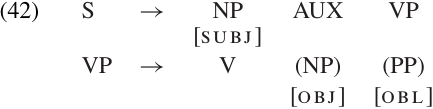
Another question that arises in the analysis of English is the position of the auxiliary verb (AUX). Here the evidence is slightly more ambiguous, and several different analyses have been proposed over the years. Without going into the details of the debate, we will assume that the AUX in English is a daughter of S, a sister to both the VP and the subject NP, as shown in (42).
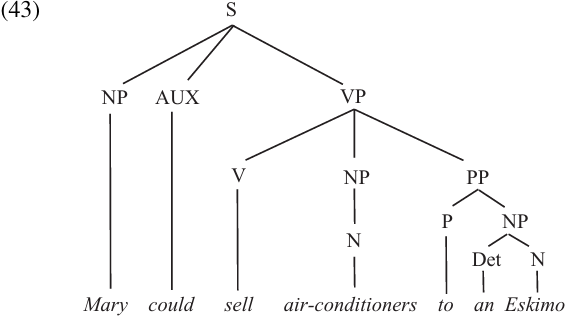
Based on these assumptions, we would assign the structure shown in (43) to a basic clause like Mary could sell air-conditioners to an Eskimo.
8. See Radford (1988, Analyzing word structure); and Kroeger (2004, Analyzing word structure) for a discussion of the kinds of evidence which support this claim.
9. From Radford (1988:101).








