Tree diagrams: representing the constituents of a clause
Phrase Structure diagrams
An important part of our task in analyzing the grammatical structure of a sentence is to identify: (a) the constituent parts from which the sentence is formed; and (b) the order in which these constituents occur. For example, the sentence in (25) consists of three constituent parts: a noun phrase followed by a verb followed by another noun phrase.
(25) Anjing itu |makan | tulang besar.
dog that eat bone big
‘That dog is eating a big bone.’
Even for very simple sentences like this one, a purely verbal description is a bit tire some to interpret. The vertical lines inserted between the constituents in (25) are helpful, but for more complex structures this approach rapidly proves to be in adequate. Moreover, constituent structure is HIERARCHICAL–each constituent of a larger unit may itself be composed of smaller constituents. In sentence (25), for example, each noun phrase is composed of two words. So, it is not enough to list the immediate constituents of the sentence in the correct order. Each of these constituents must in turn be analyzed as to its sub-constituents and their linear order, and so on down to the word level.
The most commonly used method of representing information about constituency and linear order is the TREE DIAGRAM. A simple tree diagram is shown in (26). This tree contains three NODES. The top-most node, A, is the MOTHER of the two lower nodes, B and C. B and C are DAUGHTERS of the same mother, and so we refer to them as SISTER nodes. Straight lines are used to connect mothers to their daughters.
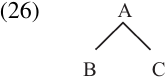
When a tree of this kind is used to represent the structure of a grammatical unit (e.g. a phrase or sentence), the mother node represents the larger unit, while the daughter nodes represent its constituents (or sub-parts). The linear order of the constituents is shown by the left-to-right order of the corresponding nodes. The lines from mother to daughter represent the part-whole relationship. So a partial interpretation of the diagram in (26) could be stated as in (26’):
(26’) Unit A is composed of two constituent parts, B and C, which occur in that order.
This interpretation of (26) treats the labels at each node of the tree diagram (A, B, and C) simply as names, or a handy way of referring to the individual units. In fact, the labels in a diagram of this kind are not names for specific units, but are used to indicate the class (or CATEGORY) of each unit. So, a more adequate interpretation of the diagram in (26) would be something like the following:
(26’’) A unit of category A is composed of two constituent parts, one of category B and the other of category C, occurring in that order.
When tree diagrams are used to represent linguistic structure, the node labels provide two kinds of information about each unit: (i) its SYNTACTIC CATEGORY (e.g. Noun, Verb, etc.); and (ii) its “size,” or level in the grammatical hierarchy (word, phrase, clause, etc.). The list in (27) shows the category symbols that are generally used (we will introduce a few others later). A simple tree structure using these labels is given in (28). This tree represents a prepositional phrase which consists of two parts, a preposition followed by a noun phrase. The noun phrase, in turn, is composed of a determiner followed by a noun.
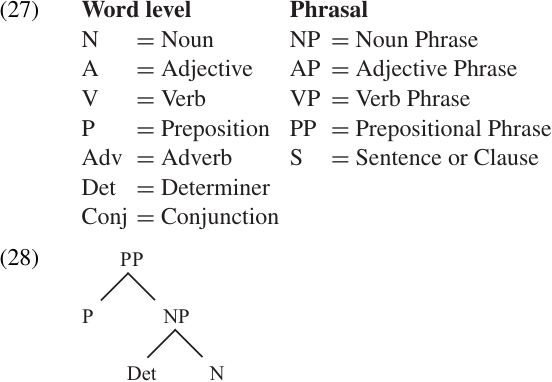
But, as far as we can tell from the tree in (28), this prepositional phrase contains no words. Obviously, we need a way to represent the actual words that make up the phrase, in addition specifying their part of speech. We will represent words as daughters of nodes which bear lexical (word-level) category labels, as shown in (29).
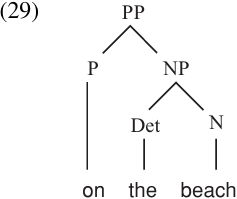
Nodes which contain specific lexical items such as on, the, and beach will never themselves have daughters; they mark the bottom end of the tree structure. Nodes of this type, which do not dominate any other node, are called TERMINAL NODES. Lexical items such as on, the, and beach are TERMINAL ELEMENTS, and the sequence of terminal elements at the bottom of a tree (e.g. on the beach) is called the TERMINAL STRING.
We say that a non-terminal node DOMINATES all of its daughter nodes, the daughters of its daughters, daughters of its “grand-daughters,” etc. A mother IMMEDIATELY DOMINATES its own daughters. This terminology gives us a way to define constituents in terms of tree structure:
(30) A CONSTITUENT is a string of words which is
EXHAUSTIVELY DOMINATED by some node.
The phrase “exhaustively dominated” means that the node in question dominates all the terminal elements which are part of the string but no terminal elements which are outside of the string. This definition tells us how constituents are represented in a Phrase Structure diagram, but it is important to remember that the linguistic facts are the primary reality. In analyzing the structure of a sentence, the constituents of the sentence must first be identified on the basis of linguistic criteria. After we have identified the constituents in this way we can draw a tree of the appropriate shape to represent them.
Following standard usage, we will use the symbol “S” to represent both “sentence” and “clause,” as indicated in (27). The highest node in the tree diagram of a sentence will normally be labeled S. This is because the sentence is itself a grammatical constituent, and so all the words in the sentence must be exhaustively dominated by a node of the appropriate category. Of course, a single sentence can contain several clauses, in which case the highest S in the tree will dominate several other S nodes.
The top-most node in any tree diagram is called its ROOT NODE, while the terminal nodes at the bottom of the tree are sometimes called LEAVES. In the case of a sentence, S is the root node and the individual words are the leaves. So, we might say that a Phrase Structure tree is upside down, with its root at the top, its leaves at the bottom, and its branches in between.








