Phrase Structure rules
We pointed out that speakers of a language do not memorize sentences. Rather, they construct them using a set of rules (their “internal grammar”). The task of the linguist is to discover these rules. Analyzing the structure of specific sentences is an important step, but we cannot stop there. We need to identify a set of rules that could produce these structures and, ultimately, all other possible sentence patterns in the language.
An important feature of the Phrase Structure diagrams introduced above, and a major reason why they are so useful to the linguist, is that there is a direct and regular relationship between the arrangement of the tree structure and a particular set of rules. Moreover, the rules needed to produce Phrase Structure trees are of an especially simple type. They are known as PHRASE STRUCTURE RULES (PS rules), and have the following form:
(32) A → B C
Each Phrase Structure rule defines a possible combination of mother and daughter nodes. The mother is shown to the left of the arrow, the daughters to the right. The rule in (32) says that a node labeled “A” may immediately dominate two daughters labeled “B” and “C”, in that order. Notice that there is no conditioning environment stated in this rule. In order to limit the complexity of the terminal strings which the rules can generate, we require them to be CONTEXT FREE. For the same reason, each rule has only one symbol on the left side of the arrow.
The specific relationship between tree structures and rules is this: each node of a Phrase Structure tree must be permitted (or LICENSED) by a Phrase Structure rule in order to be legal. The rule in (32) will license a sub tree of the form shown in (26). To license (or “generate”) the prepositional phrase structure in (28), we would need the rules shown in(33).
(33) PP → P NP
NP → Det N
Now, in order to generate the complete prepositional phrase shown in (29), we need rules to insert the terminal elements (lexical items), i.e. to “hang leaves on the tree.” One way of doing this might be to write Phrase Structure rules like the following: 1
(34) P → {on, in, at, over, under,...}
N → {beach, house, boy, girl, cat...}
Det → {the, a, an, this, that,...}
But the LEXICON of a language, i.e. the speaker’s “mental dictionary,” is much more than just a list of words. As we will see in Lexical entries and well-formed clauses, the lexical entry for each word must include various kinds of phonological, semantic, morphological, and syntactic information. So, if we used the kinds of rules shown in (34), we would actually have to list each word of the language twice– once in the word’s lexical entry, and once more in a special rule that “hangs the leaves” of a particular category.
Rather than adopting the approach shown in (34), we will assume that there is a general rule of LEXICAL INSERTION which will license a word of any given category to appear as the only daughter of a node which bears the corresponding lexical category label. (The word’s category will be specified in its lexical entry.) The rule of lexical insertion is similar to an ordinary Phrase Structure rule in that it defines a possible combination of mother and daughter nodes. The crucial difference is that the daughter node in this case is a real word, rather than an abstract category symbol. The rule could be stated roughly as in (35):
(35) Lexical Insertion
Any lexical category (N, V, etc.) may have a single daughter node which is a specific lexical item of the same category.
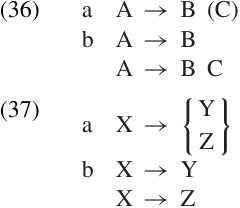
In most languages there are at least some phrasal categories that can be expanded in more than one way (i.e. that allow some variation in the string of daughters which they dominate). For this reason, it is normal for grammars to contain more than one Phrase Structure rule with the same element on the left side of the arrow. In this situation, certain notational devices (abbreviations) can be used to combine two or more Phrase Structure rules. Parentheses () are used to mark optional elements, and curly braces {} are used to mean “either–or.” Thus the single rule in (36a) is equivalent to the pair of rules in (36b); and the single rule in (37a) is equivalent to the pair of rules in (37b):
To summarize, a tree diagram is used to represent the structure of a particular sentence. The general word order patterns of the language are captured in the Phrase Structure (PS) rules. In order for a particular tree structure to be considered grammatical, each combination of mother and daughters in that tree must be licensed by one of the PS rules in the grammar. As we will see, a small number of PS rules can generate a very large number of different trees.
1. As explained below, the braces {} in this rule indicate that various alternatives are available: one element of the set within the braces is to be selected each time the rule is applied.








