Well-formedness conditions
Elements that are listed in the subcategorization of the verb (e.g. subjects, objects, etc.) are often referred to as the COMPLEMENTS of the verb. The constraints that we need to formulate will basically ensure that each clause contains the right number and type of complements.
The “right number” means neither too few nor too many. A clause will have too few complements if it lacks one which is required by the verb’s subcategorization set. In that case, we would say that the clause is not COMPLETE. A clause will have too many complements if it contains one which is not listed in the verb’s subcategorization set. In that case, we would say that the clause is not COHERENT. To these two conditions we will add a third, namely that the Grammatical Relation of each complement must be UNIQUE in its clause. In other words, there cannot be two subjects, two primary objects, etc. in a single clause.
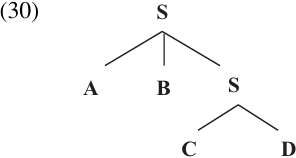
As we will see, many languages allow one clause to be embedded within another (i.e. one S may dominate another). For this reason, in order to determine whether a given clause contains the “right number” of complements, we need to be more precise about what it means for two elements to belong to the same clause. We will say that two elements are CLAUSE-MATES if the smallest clause that contains either one of them contains the other as well. To restate this definition in terms of tree structure, we say that X and Y are clause-mates if the smallest S which dominates X also dominates Y, and vice versa. For example, A and B are clause-mates in (30), as are C and D. But A and C are not clause-mates, and neither are A and D, B and C, or B and D.
Our three well-formedness conditions can now be expressed as in (31).1 These conditions do not apply to adjuncts, of course, because adjuncts by definition are not part of the subcategorization of the verb.
(31) WELL-FORMEDNESS CONDITIONS
a COMPLETENESS: every Grammatical Relation which is obligatory in the subcategorization of a
verb V must be assigned to a clause-mate of V.
b COHERENCE: every (non-adjunct) Grammatical Relation which is assigned to a clause-mate of
V must be allowed in the subcategorization of V.
c UNIQUENESS: no Grammatical Relation may be assigned more than once by a single verb.
In order to be considered grammatical, each sentence must conform not only to the PS rules of the language but also to these three well-formedness conditions. In other words, we define a grammatical (or WELL-FORMED) clause structure as being one in which: (a) every combination of mother and daughters is licensed by a PS rule; and (b) the well-formedness conditions are satisfied.
1. See Kaplan and Bresnan (1982) for a more rigorous formulation.








