

Grammar


Tenses


Present

Present Simple

Present Continuous

Present Perfect

Present Perfect Continuous


Past

Past Simple

Past Continuous

Past Perfect

Past Perfect Continuous


Future

Future Simple

Future Continuous

Future Perfect

Future Perfect Continuous


Parts Of Speech


Nouns

Countable and uncountable nouns

Verbal nouns

Singular and Plural nouns

Proper nouns

Nouns gender

Nouns definition

Concrete nouns

Abstract nouns

Common nouns

Collective nouns

Definition Of Nouns

Animate and Inanimate nouns

Nouns


Verbs

Stative and dynamic verbs

Finite and nonfinite verbs

To be verbs

Transitive and intransitive verbs

Auxiliary verbs

Modal verbs

Regular and irregular verbs

Action verbs

Verbs


Adverbs

Relative adverbs

Interrogative adverbs

Adverbs of time

Adverbs of place

Adverbs of reason

Adverbs of quantity

Adverbs of manner

Adverbs of frequency

Adverbs of affirmation

Adverbs


Adjectives

Quantitative adjective

Proper adjective

Possessive adjective

Numeral adjective

Interrogative adjective

Distributive adjective

Descriptive adjective

Demonstrative adjective


Pronouns

Subject pronoun

Relative pronoun

Reflexive pronoun

Reciprocal pronoun

Possessive pronoun

Personal pronoun

Interrogative pronoun

Indefinite pronoun

Emphatic pronoun

Distributive pronoun

Demonstrative pronoun

Pronouns


Pre Position


Preposition by function

Time preposition

Reason preposition

Possession preposition

Place preposition

Phrases preposition

Origin preposition

Measure preposition

Direction preposition

Contrast preposition

Agent preposition


Preposition by construction

Simple preposition

Phrase preposition

Double preposition

Compound preposition

prepositions


Conjunctions

Subordinating conjunction

Correlative conjunction

Coordinating conjunction

Conjunctive adverbs

conjunctions


Interjections

Express calling interjection

Phrases

Sentences


Grammar Rules

Passive and Active

Preference

Requests and offers

wishes

Be used to

Some and any

Could have done

Describing people

Giving advices

Possession

Comparative and superlative

Giving Reason

Making Suggestions

Apologizing

Forming questions

Since and for

Directions

Obligation

Adverbials

invitation

Articles

Imaginary condition

Zero conditional

First conditional

Second conditional

Third conditional

Reported speech

Demonstratives

Determiners


Linguistics

Phonetics

Phonology

Linguistics fields

Syntax

Morphology

Semantics

pragmatics

History

Writing

Grammar

Phonetics and Phonology

Semiotics


Reading Comprehension

Elementary

Intermediate

Advanced


Teaching Methods

Teaching Strategies

Assessment
Underlined Points
المؤلف:
BARBARA MINTO
المصدر:
THE MINTO PYRAMID PRINCIPLE
الجزء والصفحة:
176-10
2024-09-28
1515
Underlined Points
Another popular approach to showing the hierarchy of ideas is to underline the entire statement of the support points below the Key Line level (Exhibit 57). Lower level support points are also stated in their entirety and underlined, but are distinguished by form and indentation.
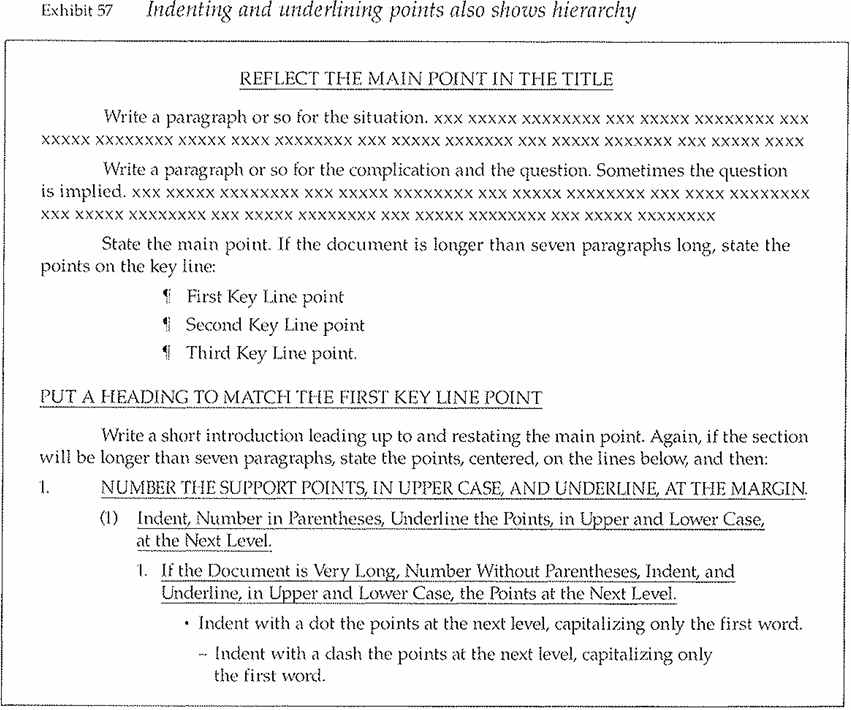
This form is rather ugly on the page. The advent of computers has led many people to write the major points in bold type, and leave the underlining to lower level support points, which at least makes for a more attractive page.
1. NUMBER THE SUPPORT POINTS, IN UPPER CASE, AND UNDERLINE AT THE MARGIN.
(1) Indent, Number in Parentheses, Underline the Points, in Upper and Lower Case, at the Next Level.
1. If the Document is Very Long, Number Without Parentheses, Indent, and Underline, in Upper and Lower Case, the Points at the Next Level.
Either way, the stated purpose of the format is to provide speed and ease in reading. The theory is that the reader should be able to zip through if he wishes, reading only the major points, and in that way comprehend the entire message easily. While this may be lovely for the reader, it can be a bit difficult for the writer, because it imposes some strict rules on him.
1. You must be absolutely disciplined in applying question/answer logic. Points below must directly answer the question raised by the point above, and no more. There is no room in this format for graceful liaisons of language or attempts at amplification. Such things destroy the clean, stark presentation of the logic. If you must amplify or give background, you will have to do so in the introductory or concluding paragraphs to each section.
2. You must be careful to word the points so that they stale their message as sparsely as possible. It destroys the ease with which the logic can be comprehended if the reader must wade through 30 words before he grasps the point. If you find yourself with more than a dozen words, or more than one subject and predicate, think again.
3. You must be totally ruthless in limiting your points to the outline of your deductive or inductive argument. Most people disregard this requirement and simply list points, ignoring the niceties of either induction or deduction. You know that there are never more than four points in a chained deductive argument, and never more than five in an inductive one. If you find yourself going beyond, the likelihood is that you have overlooked an opportunity to group, and should rethink what you are saying.
الاكثر قراءة في Writing
اخر الاخبار
اخبار العتبة العباسية المقدسة
الآخبار الصحية

قسم الشؤون الفكرية يصدر كتاباً يوثق تاريخ السدانة في العتبة العباسية المقدسة
"المهمة".. إصدار قصصي يوثّق القصص الفائزة في مسابقة فتوى الدفاع المقدسة للقصة القصيرة
(نوافذ).. إصدار أدبي يوثق القصص الفائزة في مسابقة الإمام العسكري (عليه السلام)


