

Grammar


Tenses


Present

Present Simple

Present Continuous

Present Perfect

Present Perfect Continuous


Past

Past Simple

Past Continuous

Past Perfect

Past Perfect Continuous


Future

Future Simple

Future Continuous

Future Perfect

Future Perfect Continuous


Parts Of Speech


Nouns

Countable and uncountable nouns

Verbal nouns

Singular and Plural nouns

Proper nouns

Nouns gender

Nouns definition

Concrete nouns

Abstract nouns

Common nouns

Collective nouns

Definition Of Nouns

Animate and Inanimate nouns

Nouns


Verbs

Stative and dynamic verbs

Finite and nonfinite verbs

To be verbs

Transitive and intransitive verbs

Auxiliary verbs

Modal verbs

Regular and irregular verbs

Action verbs

Verbs


Adverbs

Relative adverbs

Interrogative adverbs

Adverbs of time

Adverbs of place

Adverbs of reason

Adverbs of quantity

Adverbs of manner

Adverbs of frequency

Adverbs of affirmation

Adverbs


Adjectives

Quantitative adjective

Proper adjective

Possessive adjective

Numeral adjective

Interrogative adjective

Distributive adjective

Descriptive adjective

Demonstrative adjective


Pronouns

Subject pronoun

Relative pronoun

Reflexive pronoun

Reciprocal pronoun

Possessive pronoun

Personal pronoun

Interrogative pronoun

Indefinite pronoun

Emphatic pronoun

Distributive pronoun

Demonstrative pronoun

Pronouns


Pre Position


Preposition by function

Time preposition

Reason preposition

Possession preposition

Place preposition

Phrases preposition

Origin preposition

Measure preposition

Direction preposition

Contrast preposition

Agent preposition


Preposition by construction

Simple preposition

Phrase preposition

Double preposition

Compound preposition

prepositions


Conjunctions

Subordinating conjunction

Correlative conjunction

Coordinating conjunction

Conjunctive adverbs

conjunctions


Interjections

Express calling interjection

Phrases

Sentences


Grammar Rules

Passive and Active

Preference

Requests and offers

wishes

Be used to

Some and any

Could have done

Describing people

Giving advices

Possession

Comparative and superlative

Giving Reason

Making Suggestions

Apologizing

Forming questions

Since and for

Directions

Obligation

Adverbials

invitation

Articles

Imaginary condition

Zero conditional

First conditional

Second conditional

Third conditional

Reported speech

Demonstratives

Determiners


Linguistics

Phonetics

Phonology

Linguistics fields

Syntax

Morphology

Semantics

pragmatics

History

Writing

Grammar

Phonetics and Phonology

Semiotics


Reading Comprehension

Elementary

Intermediate

Advanced


Teaching Methods

Teaching Strategies

Assessment
Writing
المؤلف:
George Yule
المصدر:
The study of language
الجزء والصفحة:
211-16
4-3-2022
1774
Writing
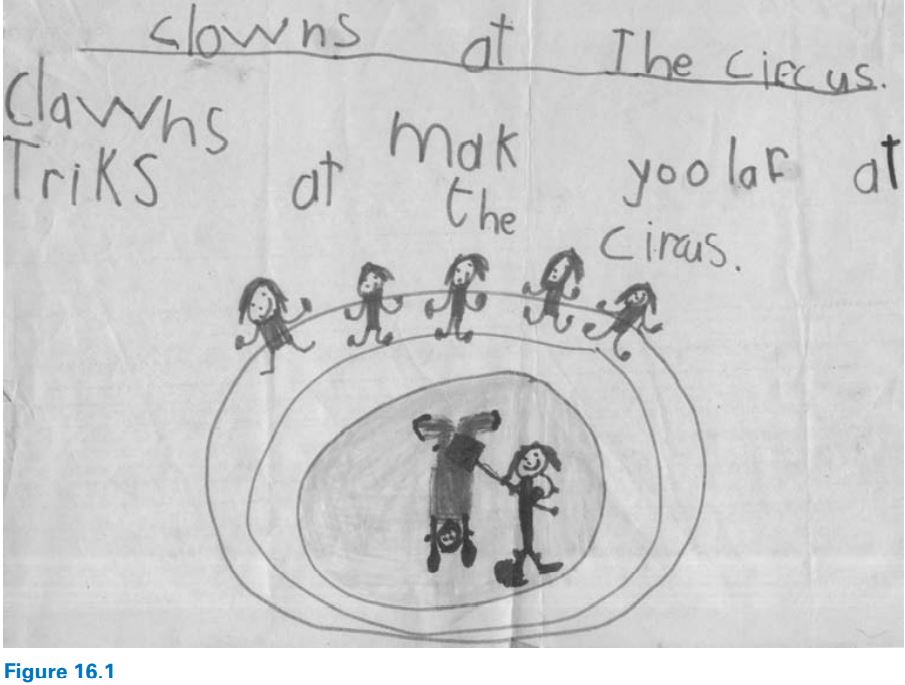
The five-year-old child whose skills in symbolic representation are displayed here seems to be already familiar with some of the basic elements of writing. The sequence of letters goes from left to right, each letter is distinct from the next and generally well formed, and each word is separated from the next by larger spaces. The occasional spelling “mistake,” a traditional problem in written English, cannot disguise the fact that this child has already learned how to write.
We can define writing as the symbolic representation of language through the use of graphic signs. Unlike speech, it is a system that is not simply acquired, but has to be learned through sustained conscious effort. Not all languages have a written form and, even among people whose language has a well-established writing system, there are large numbers of individuals who cannot use the system.
In terms of human development, writing is a relatively recent phenomenon. We may be able to trace human attempts to represent information visually back to cave drawings made at least 20,000 years ago, or to clay tokens from about 10,000 years ago, which appear to have been an early attempt at bookkeeping, but these artifacts are best described as ancient precursors of writing. The earliest writing for which we have clear evidence is known as “cuneiform,” marked on clay tablets about 5,000 years ago. An ancient script that has a more obvious connection to writing systems in use today can be identified in inscriptions dated around 3,000 years ago.
Much of the evidence used in the reconstruction of ancient writing systems comes from inscriptions on stone or tablets. If those ancients were using other elaborate scripts on wood, leather or other perishable materials, we have lost them. But working from the inscriptions we do have, we can trace the development of one writing tradition, lasting a few thousand years, with which humans have sought to create a more permanent record of what was going on.
الاكثر قراءة في Writing
اخر الاخبار
اخبار العتبة العباسية المقدسة
الآخبار الصحية

قسم الشؤون الفكرية يصدر كتاباً يوثق تاريخ السدانة في العتبة العباسية المقدسة
"المهمة".. إصدار قصصي يوثّق القصص الفائزة في مسابقة فتوى الدفاع المقدسة للقصة القصيرة
(نوافذ).. إصدار أدبي يوثق القصص الفائزة في مسابقة الإمام العسكري (عليه السلام)


