

Grammar


Tenses


Present

Present Simple

Present Continuous

Present Perfect

Present Perfect Continuous


Past

Past Simple

Past Continuous

Past Perfect

Past Perfect Continuous


Future

Future Simple

Future Continuous

Future Perfect

Future Perfect Continuous


Parts Of Speech


Nouns

Countable and uncountable nouns

Verbal nouns

Singular and Plural nouns

Proper nouns

Nouns gender

Nouns definition

Concrete nouns

Abstract nouns

Common nouns

Collective nouns

Definition Of Nouns

Animate and Inanimate nouns

Nouns


Verbs

Stative and dynamic verbs

Finite and nonfinite verbs

To be verbs

Transitive and intransitive verbs

Auxiliary verbs

Modal verbs

Regular and irregular verbs

Action verbs

Verbs


Adverbs

Relative adverbs

Interrogative adverbs

Adverbs of time

Adverbs of place

Adverbs of reason

Adverbs of quantity

Adverbs of manner

Adverbs of frequency

Adverbs of affirmation

Adverbs


Adjectives

Quantitative adjective

Proper adjective

Possessive adjective

Numeral adjective

Interrogative adjective

Distributive adjective

Descriptive adjective

Demonstrative adjective


Pronouns

Subject pronoun

Relative pronoun

Reflexive pronoun

Reciprocal pronoun

Possessive pronoun

Personal pronoun

Interrogative pronoun

Indefinite pronoun

Emphatic pronoun

Distributive pronoun

Demonstrative pronoun

Pronouns


Pre Position


Preposition by function

Time preposition

Reason preposition

Possession preposition

Place preposition

Phrases preposition

Origin preposition

Measure preposition

Direction preposition

Contrast preposition

Agent preposition


Preposition by construction

Simple preposition

Phrase preposition

Double preposition

Compound preposition

prepositions


Conjunctions

Subordinating conjunction

Correlative conjunction

Coordinating conjunction

Conjunctive adverbs

conjunctions


Interjections

Express calling interjection

Phrases

Sentences


Grammar Rules

Passive and Active

Preference

Requests and offers

wishes

Be used to

Some and any

Could have done

Describing people

Giving advices

Possession

Comparative and superlative

Giving Reason

Making Suggestions

Apologizing

Forming questions

Since and for

Directions

Obligation

Adverbials

invitation

Articles

Imaginary condition

Zero conditional

First conditional

Second conditional

Third conditional

Reported speech

Demonstratives

Determiners


Linguistics

Phonetics

Phonology

Linguistics fields

Syntax

Morphology

Semantics

pragmatics

History

Writing

Grammar

Phonetics and Phonology

Semiotics


Reading Comprehension

Elementary

Intermediate

Advanced


Teaching Methods

Teaching Strategies

Assessment
Alphabetic writing
المؤلف:
George Yule
المصدر:
The study of language
الجزء والصفحة:
216-16
4-3-2022
2034
Alphabetic writing
If you have a set of symbols being used to represent syllables beginning with, for example, a b sound or an m sound, then you are actually very close to a situation in which the symbols can be used to represent single sound types in a language. This is, in effect, the basis of alphabetic writing. In principle, an alphabet is a set of written symbols, each one representing a single type of sound or phoneme. The situation just described is what seems to have occurred in the development of the writing systems of Semitic languages such as Arabic and Hebrew. Words written in these languages, in everyday use, largely consist of symbols for the consonant sounds in the word, with the appropriate vowel sounds being supplied by the reader (or rdr).
This type of writing system is sometimes called a consonantal alphabet. The early version of Semitic alphabetic script, originating in the writing system of the Phoenicians, is the basic source of most other alphabets to be found in the world. Modified versions can be traced to the East into Iranian, Indian and South-East Asian writing systems and to the West through Greek. The basic order of letter symbols, with “A” representing a consonant in the first “ABCD…,” was created about three thousand 216 The Study of Language years ago by the Phoenicians and continues to be used as our primary ordering device for lists in everything from dictionaries to telephone books.
The early Greeks took the alphabetizing process a stage further by also using separate symbols to represent the vowel sounds as distinct entities, and so created a remodeled system that included vowels. This change resulted in the Phoenician consonant “alep” becoming a symbol for a vowel sound as A (called “alpha”) to go with existing symbols for consonant sounds such as B (called “beta”), giving us singlesound writing or an “alphabet.” In fact, for some writers on the origins of the modern alphabet, it is the Greeks who should be given credit for taking the inherently syllabic system from the Phoenicians and creating a writing system in which the single-symbol to single-sound correspondence was fully realized.
From the Greeks, this revised alphabet passed to the rest of Western Europe through the Romans and, along the way, underwent several modifications to fit the requirements of the spoken languages encountered. As a result, we talk about the Roman alphabet as the writing system used for English. Another line of development took the same basic Greek writing system into Eastern Europe where Slavic languages were spoken. The modified version, called the Cyrillic alphabet (after St. Cyril, a ninthcentury Christian missionary), is the basis of the writing system used in Russia today.
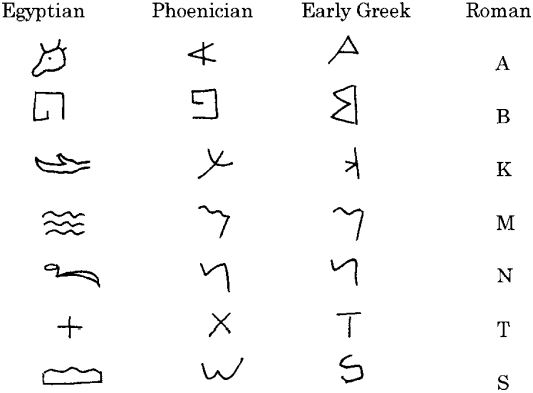
The actual form of a number of letters in modern European alphabets can be traced from their origins in Egyptian hieroglyphics. The examples in the accompanying illustration are based on Davies (1987).
الاكثر قراءة في Writing
اخر الاخبار
اخبار العتبة العباسية المقدسة
الآخبار الصحية

قسم الشؤون الفكرية يصدر كتاباً يوثق تاريخ السدانة في العتبة العباسية المقدسة
"المهمة".. إصدار قصصي يوثّق القصص الفائزة في مسابقة فتوى الدفاع المقدسة للقصة القصيرة
(نوافذ).. إصدار أدبي يوثق القصص الفائزة في مسابقة الإمام العسكري (عليه السلام)


