Collective Nouns
Typically, words that identify more than one person, place, or thing are made plural in the English language. One "dog" becomes many "dogs." Collective nouns, however, are an exception. This unique class of nouns denotes a group of people, animals, objects, concepts, or ideas as a single entity. Once you review a few examples, you'll know exactly what these nouns are all about.
Comparing Countable, Mass, and Collective Nouns
Things start to sound really technical when we discuss countable, mass, and collective nouns. Let's clear some of that up right now.
Countable nouns, also known as count nouns, can be counted by a number or quantified by size. They appear in both singular and plural form. Examples include "three" puppies and "a hundred" love notes.
Mass nouns are also referred to as uncountable or non-count nouns. They signify unbounded amounts, such as of liquids, small objects, and abstract or immeasurable concepts. For example, "water," "rice," and "education" can all be considered mass nouns. A noun is considered a mass noun when its use can't be counted, modified, or quantified in a relevant manner.
Collective nouns are a subset of count nouns because they refer to a group of countable nouns as a single collective unit. For example, there are 12 eggs in a dozen and 52 cards in a deck.
Common Collective Nouns
There are many types of nouns that refer to units or groups in a collective sense. Here are some common examples:
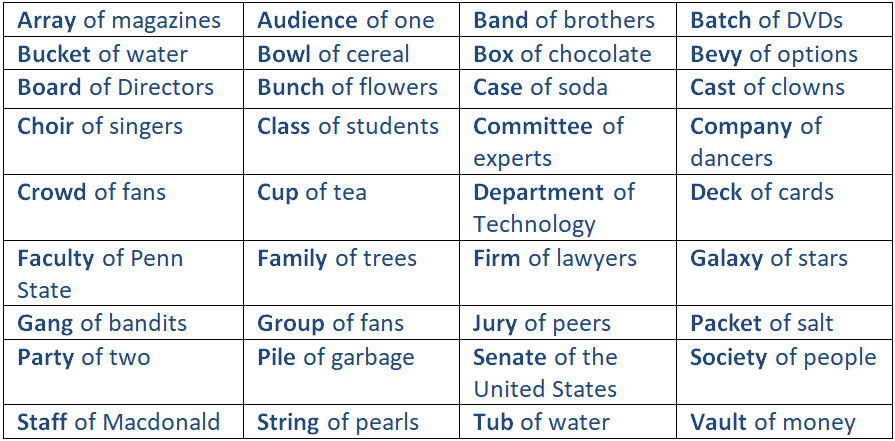
Note that, when group nouns are acting as individuals rather than a whole, it's appropriate to add or replace words to create references to the individuals. For example, you might add the word "members" after collectives like board or committee, or inserting "players" for "team" or "students" for "class."
Collective Nouns for Animal Groups
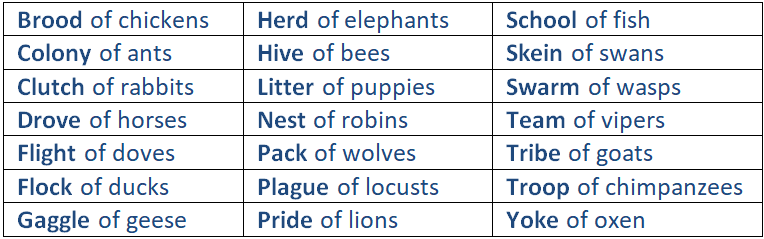
Next, there are unique collective nouns to identify a specific group of animals, be they mammals, birds or insects. Common collective animal nouns include:
Using Collective Nouns Correctly
Nouns in the collective class can be used in either the singular or plural form, depending on the context of the sentence. For example, "family" is a collective noun because it refers to more than one person sharing a relationship. However, you can also use this in its plural form to refer to several "families."
Using collective nouns in sentences can be confusing because it's sometimes difficult to discern whether to use plural or singular verbs and pronouns. To use verbs and pronouns correctly, identify whether the collective noun refers to the group working as individuals or collectively in unison.
When the unit is acting in unison, it is appropriate to use the singular form.
When the members of the unit are acting as individuals, it is appropriate to use plural forms of verbs and pronouns.
Example Sentences
Consider these two sentences and how they illustrate whether the singular or plural forms are appropriate.
The class waits (singular verb) for its (singular pronoun) teacher quietly.
Here, the class is referred to as a unit acting in unison; the students are all doing the same thing at the same time.
The class begins (plural verb) their (plural pronoun) homework assignments while they (plural pronoun) wait (plural verb) for their (plural pronoun) teacher.
The class of students are a unit, but are acting as individuals; they are each doing their own homework assignments.
The Collective Whole
Gradual shifts in the ways words are used have contributed to the formation of this special class of nouns. To help you remember, there are a variety of online and printable worksheets, quizzes, and activities focused on collective nouns. To further test your knowledge, take a look at this Collective Noun Worksheet.








