Collective Nouns
A collective noun is a noun that represents a collection of individuals, usually people, such as:
a team (for example: eleven football players)
a family (for example: mother, father and two children)
a crew (for example: 100 sailors)
Here are some more collective noun examples. As you see, collective nouns can consist of a few people or tens, hundreds or thousands of people:
committee, jury, senate, company, audience, police, army
Most collective nouns are groups of people, but some refer to animals or objects, for example
animals: a herd of cows, a flock of sheep
objects: a fleet of ships, a convoy of trucks
Proper Nouns as Collective Nouns
Many collective nouns are common nouns, but they can also be proper nouns when they are the name of a company or other organization with more than one person, for example Microsoft. Here are some more examples of collective nouns that are proper nouns:
-Sony, Apple, CNN, the BBC, the United Nations, WHO, Thai Air, Interpol, the FBI, Cambridge University, Manchester United
?Is a Collective Noun Singular or Plural
Each of the collective nouns above is a single "thing". But it consists of more than one individual. So the question arises: is a collective noun singular or plural?
To which the answer is: it depends. A collective noun can be singular OR plural, depending on how you see the individuals in the group.
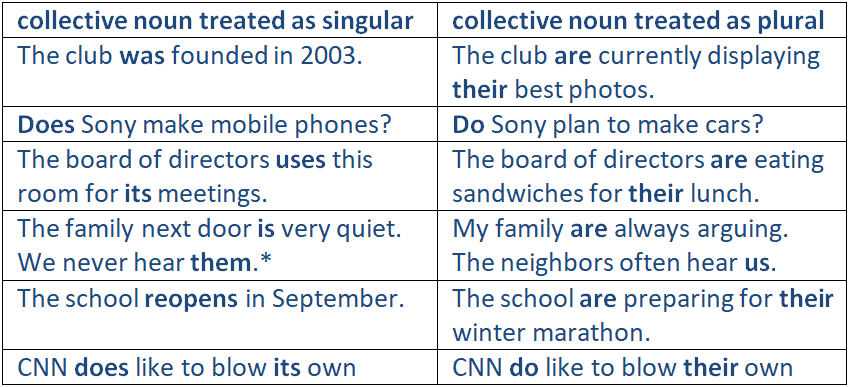
If you see the individuals acting together, as a whole, then you probably treat the collective noun as singular (with singular verbs and singular pronouns), for example:
The jury has delivered its conclusion to the judge.
If you see the individuals acting individually, then you probably treat the collective noun as plural (with plural verbs and plural pronouns), for example:
The jury have not reached a conclusion because they are still arguing among themselves.
British and American Differences
Note that as a general rule:
British English tends to treat collective nouns as plural
American English tends to treat them as singular
So in the example above, American English speakers might use a singular verb with jury and rephrase the rest of the sentence to avoid a logical absurdity:
The jury has not reached a conclusion because its members are still arguing among themselves.
However, even in American English, it is acceptable to use a plural verb if you really wish to emphasize the individuality of the collective noun members.
The San Francisco crowd were their usual individualistic selves.
In American English it is also possible to use a plural pronoun with a singular verb, as in:
The family next door is very quiet. We never hear them.
In all varieties of English, the collective noun police is always treated as plural:
The police are coming.
The police were the first on the scene.
The police have issued their report.
A Collective Noun Can Itself Be Singular and Plural
In most cases a collective noun can itself be plural. In other words, you can have more than one collective noun. For example, in a game of football there are TWO teams. In a street there are many families. In such cases, a plural verb is automatically used, as in these examples:
The many ships' crews in port at the time were constantly fighting.
The two companies have been negotiating for over a week.
Finally, here are some more example sentences...