The surface structure of passives
In general, transformational accounts of passive constructions analyse the passive predicate as a verb which is preceded by an auxiliary be and followed by a prepositional phrase by NP. This is by no means a necessary conclusion. Instead, we could analyse the passive predicate as an AP—in which case what we have been calling the passive verb would be labeled an adjective.
The claim that passive predicates are adjectives is supported in part by the considerable overlap in distribution of adjectives and passive predicates. Consider the following parallelism of structure:
(1)
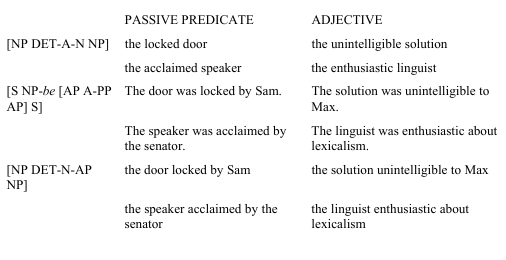
Under an analysis which distinguishes passive predicates from adjectives, it is an accident that both appear in the same surface positions—and furthermore are moved there by the same transformation, Modifier Shift.
It is worth noting that, by analysing passive predicates as adjectives, we can avoid ad hoc explanations of the special status of “passive verbs” as opposed to active verbs. That is, for verbs like hit and mention, both a lexical subject and a lexical object are obligatory unless they are passivized:
(2)
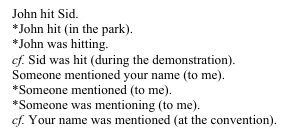
The passive predicate, like most adjectives, directly governs only one surface argument— other surface arguments being directly governed by prepositions—whereas the active predicate usually governs two (usually obligatorily). Thus, in terms of semantic function, passive predicates function like adjectives rather than verbs. Analysing passive predicates as adjectives accounts for this fact—since, in the phrase-structure rule that expands AP, PP complements of adjectives are optional. In this way, the problem of the unrecoverability of the wh-phrase deletion rule never arises.
Additional support for this analysis comes from examples where there is a clear morphological distinction between adjectives and passive predicates:
(3)
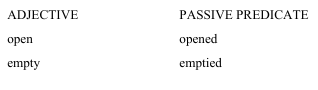
If both forms could not occur in the same syntactic contexts, then there would be some justification for assuming a categorical distinction—i.e., labeling one an adjective and the other a verb. This is clearly not the case. Compare 1 with the following:
(4) a.
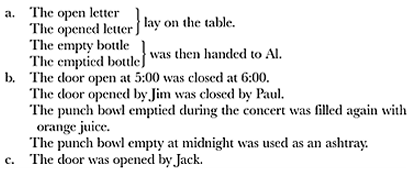
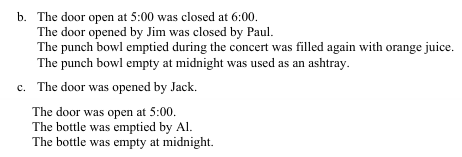
Even when there is a clear morphological distinction between adjectives and passive predicates, there is no syntactic motivation for making the distinction a categorical one.
It could nonetheless be argued that passive predicates are not adjectives because they do not occur in constructions where we usually find adjectives; e.g.,
(5)
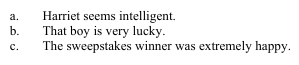
While it is true that passive predicates usually cannot occur as the complement of seem, or take degree modifiers like very and extremely, it is also a fact that certain adjectives may not occur in these constructions either:
(6)
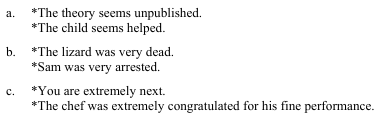
The constructions NP seem A, NP be very A, and NP be extremely A which analyse 6a-c are syntactically well-formed. Thus it seems appropriate to rule out 6 on the basis of the internal semantic structure of lexical items rather than their external syntactic form. In other words, certain adjectives may not co-occur with seem or degree modifiers because the conjunction of the two results in semantic anomaly. Given the present state of our knowledge about the world, it is inappropriate to talk about the degree to which one congratulates someone for something. Since events are not conceived of in terms of degrees, predicates referring to events will not take degree modifiers—although they can take frequency modifiers:
(7)
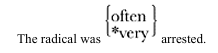
It is also inappropriate to speak of the degree of a temporal sequence (e.g., next, former, previous) or of an absolute condition (e.g., dead).
An explanation of the anomaly of 6a is somewhat more elusive. It appears that the adjectival complement of seem must describe a quality or condition which is accessible to direct observation. This follows from the fact that, given the sentences John seems sick and John seems to be sick, the former is inappropriate in a context where the speaker is reporting something that he has not directly observed. Thus 6a is anomalous because we cannot tell that a theory is unpublished, or that a child is helped, from direct observation of the theory or the child. This stands in sharp contrast with non-anomalous cases like The theory seems consistent and The child seems overdressed, where the quality of consistency and the condition of being overdressed are accessible to direct observation. Semantic distinctions also account for cases like 8, where the two distinct morphological forms of 3 do not occur in the same syntactic frames:
(8)
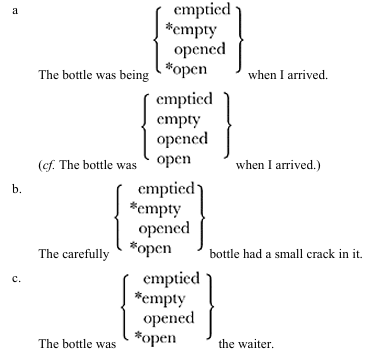
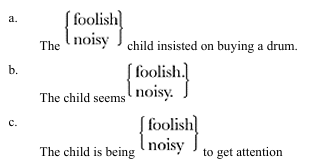
Here 8a shows that the morphological distinction between the two forms correlates with the semantic distinction stative/non-stative to the extent that only one form can co-occur with progressive aspect. It follows naturally that the stative adjectives empty and open do not take manner adverbs like carefully (8b), or agentive by-phrases (8c), whereas the non-stative forms emptied and opened can. These data show that the morphological difference between the pairs of 3 reflects a semantic distinction, but not necessarily a categorial one. Moreover, there are adjectives like foolish and noisy which can function as either statives (9b) or non-statives (9c):
(9)
Passive predicates also demonstrate this sort of ambiguity; e.g.,
(10)
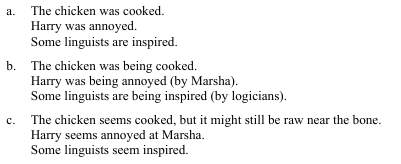
Thus there is no justification for claiming a categorial distinction for 3, but a semantic distinction for the adjectives in 6. It is worth noting that, in German, this distinction between stative and non-stative is clearly reflected in the use of the auxiliaries werden and sein. For German, the following paradigm holds:
(11)
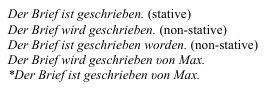
Thus for German there is little reason to analyse geschrieben as a verb when it occurs with werden, but as an adjective when it occurs with sein. The adjectival character of geschrieben is readily apparent in such constructions as der geschriebene Brief and der υon Max geschriebene Brief. The adjectival character of passives in French, Spanish, Rumanian, and Russian manifests itself in the fact that, like adjectives in those languages, passives are inflected to agree in number and gender with their surface subjects.
The decide on class of verbs poses another problem for the analysis that claims passive predicates are adjectives, because the great majority of English adjectives are not associated with specific prepositions. Even so, the adjectival analysis can be argued on the grounds that some English adjectives do take specific prepositional adjuncts; e.g.,
(12)
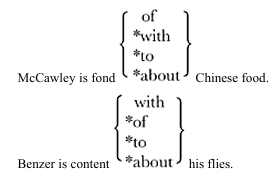
Furthermore, adjectives with prepositional adjuncts do occur prenominally, as in the uncalled for reprisals, the most talked about film of the year, or the agreed upon sum. Those instances where adjectives with prepositional adjuncts do not occur in prenominal position are part of the more general problem posed in n. 18.
The most serious drawback to analysing passive predicates as adjectives involves double-object verbs such as give. For these verbs, passives may be followed directly by NP; e.g.,
(13)
The turtle was given an ear of corn.
If given is an adjective here, then the phrase-structure rule that expands AP must allow for an optional NP complement. The rule would look something like
(14)
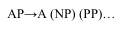
Even though this might seem unusual, there are other instances in English which suggest that this expansion is necessary. In addition to 12 above, consider the following:
(15)

Assuming that fond of and content with are directly dominated by the node A, then the examples in both 12 and 15 contain surface structures which can be filtered by 14—in which case they could conceivably be generated by the base rules. (Note that only predicate adjectives take NP complements.) Thus, with a few minor adjustments—which seem to have some independent motivation—the analysis of passive predicates as adjectives creates no major problems.
One of the strongest arguments against directly generating passive sentences with the phrase-structure rules of the base involves the restrictions on the selection of the passive auxiliary be+en. The argument (cf. Chomsky 1957) is based on the assumption that a phrase-structure grammar contains the following rules:
(16)

Here C is expanded as context-sensitive verb agreement morphemes, and M as the various modal auxiliaries. Given 16, the choice of be+en in the AUX—which must result in the generation of a passive sentence—is very heavily restricted, and is therefore unique among the AUX-phrase elements. The selection of be+en must be subject to the three ad-hoc restrictions in 17 if the grammar is to account for 18:
(17)

(18)

Since mirror-image selectional restrictions are handled by a redundancy rule in the lexicon (see above), the additional argument that the choice of be+en in a phrase structure grammar requires stating selectional restrictions twice does not apply.
The argument concerning the passive auxiliary is, of course, viable only if be+en is generated as an element of the AUX phrase. Given that passives are adjectives, however, the auxiliary be can only be analysed as the copula, because all predicate adjectives take a copular verb. Under this analysis, the passive be would be considered a main verb rather than an element of the AUX. Thus the need for the ad-hoc restrictions of 17 disappears: 18a is ruled out because occurred as an adjective does not exist in English; 17b is blocked because the adjective praised is not marked as taking NP complements; and 18c is starred because no verb in English takes two non-conjoined agents.








