Pronouns and proper names as phrasal categories
We cited the criterion of mutual substitutability, or sameness of distribution, as an important kind of evidence for establishing that two phrases belong to the same category. But this principle leads us into an apparent contradiction, or paradox, in that certain lexical items seem to have the distribution of phrases. Specifically, we noted that a proper name like Ahmad can be replaced by an entire phrase, and the same is true for pronouns. This fact presents a challenge to our proposed distinction between word-level and phrase-level categories, because in traditional grammar the term “phrase” refers to a unit consisting of more than one word. Pronouns and proper names are not thought of as “phrases” in this traditional sense.
Let us consider this problem in more detail. What Phrase Structure rules might we write to generate the following intransitive clauses?
(39) I collapsed.
John collapsed.
The old school house collapsed.
These three clauses are identical in structure. Many other similar examples could be found to show that the subject of a clause may be expressed as a pronoun, a proper name, or a common noun phrase, without affecting the basic structure of the clause. We could express this fact using the Phrase Structure rule in (40). (For simplicity we will only consider intransitive clauses here.)
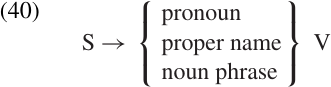
In the same way, the object of a preposition can be a pronoun, a proper name, or a common noun phrase, as illustrated in (41). Again, we could build this set of alternatives into the Phrase Structure rule which generates our prepositional phrase as in (42).
(41) behind me
behind John
behind the old school house
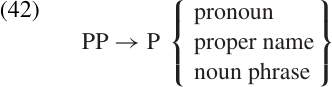
But notice that the material inside the braces in (42) is exactly the same as in (40). Moreover, the same set of alternatives will show up in many other Phrase Structure rules as well. In almost every position where a name can occur, we can substitute a pronoun or a common noun phrase. If we had to list all of these alternatives in every rule that mentions one of these positions, there would be a large amount of redundancy in the rules. We would obviously be missing an important generalization.
In order to avoid this massive redundancy, we will use the symbol “NP” in all the rules which would otherwise have to refer to a choice between pronoun, proper name, or common noun phrase, as in (43). That is, we will use the term “Noun Phrase” (NP) to refer to any unit which can appear in a “name-like” position in the Phrase Structure, whether it consists of one word or many.1
(43) S → NP V
PP → P NP
One way of accounting for the kinds of words that can function as noun phrases in the grammar (as illustrated in (39) and (41)) might be to treat pronouns and proper names as special sub-categories of Noun. The Phrase Structure rules that expand NP could specify different expansions for each of these sub-categories. However, this approach seems to ignore the true function of pronouns.
Traditional grammars state that a pronoun “takes the place of a noun,” but in fact pronouns replace whole NPs, as seen in (44).2 As these examples illustrate, pronouns have a very different distribution from common nouns. Pronouns are never modified by determiners or (in normal usage) adjectives; they function on their own as complete NPs. Semantically, too, they are more similar to NPs than to simple nouns. For these reasons, it makes better sense to assume that they actually belong to the category NP, rather than N.
(44) a The quick red fox jumped over the lazy brown dog.
b *The quick red she jumped over the lazy brown him.
c She jumped over him.
Proper names, when they refer to a specific individual, are similar to pronouns in that they have the distribution of NPs and are not modified by determiners or adjectives. In the unusual cases where they do take such modifiers, as in (45), one could argue that they are in fact being used as common nouns rather than names.
(45) a It is very confusing to have three Pauls in the same office.
b You are the first Emily I have ever met.
c The Skinners have always wanted a Joy.
Again, we could treat proper names as a sub-class of nouns, using some lexical feature such as [– common] to distinguish them from other nouns. However, to be consistent it seems preferable to treat them in the same way we treat pronouns, i.e. as lexical items belonging to category NP.
We will assume, then, that pronouns and proper names are lexical items whose lexical entry specifies that they belong to category NP, rather than N. This means that they may appear in tree diagrams as immediate daughters of an NP node.
1. Similar arguments can be made for phrases of other categories. For example, in English (and many other languages) we recognize that adjective phrases can some-times consist of just a single adjective.
2. See also Radford (1988:78–79); and Bickford (1998:54–55).








