Grammar
Tenses
Present

Present Simple
Present Continuous
Present Perfect
Present Perfect Continuous
Past
Past Simple
Past Continuous
Past Perfect
Past Perfect Continuous
Future
Future Simple
Future Continuous
Future Perfect
Future Perfect Continuous
Parts Of Speech
Nouns
Countable and uncountable nouns
Verbal nouns
Singular and Plural nouns
Proper nouns
Nouns gender
Nouns definition
Concrete nouns
Abstract nouns
Common nouns
Collective nouns
Definition Of Nouns
Animate and Inanimate nouns
Nouns
Verbs
Stative and dynamic verbs
Finite and nonfinite verbs
To be verbs
Transitive and intransitive verbs
Auxiliary verbs
Modal verbs
Regular and irregular verbs
Action verbs
Verbs
Adverbs
Relative adverbs
Interrogative adverbs
Adverbs of time
Adverbs of place
Adverbs of reason
Adverbs of quantity
Adverbs of manner
Adverbs of frequency
Adverbs of affirmation
Adverbs
Adjectives
Quantitative adjective
Proper adjective
Possessive adjective
Numeral adjective
Interrogative adjective
Distributive adjective
Descriptive adjective
Demonstrative adjective
Pronouns
Subject pronoun
Relative pronoun
Reflexive pronoun
Reciprocal pronoun
Possessive pronoun
Personal pronoun
Interrogative pronoun
Indefinite pronoun
Emphatic pronoun
Distributive pronoun
Demonstrative pronoun
Pronouns
Pre Position
Preposition by function
Time preposition
Reason preposition
Possession preposition
Place preposition
Phrases preposition
Origin preposition
Measure preposition
Direction preposition
Contrast preposition
Agent preposition
Preposition by construction
Simple preposition
Phrase preposition
Double preposition
Compound preposition
prepositions
Conjunctions
Subordinating conjunction
Correlative conjunction
Coordinating conjunction
Conjunctive adverbs
conjunctions
Interjections
Express calling interjection
Phrases
Sentences
Clauses
Part of Speech
Grammar Rules
Passive and Active
Preference
Requests and offers
wishes
Be used to
Some and any
Could have done
Describing people
Giving advices
Possession
Comparative and superlative
Giving Reason
Making Suggestions
Apologizing
Forming questions
Since and for
Directions
Obligation
Adverbials
invitation
Articles
Imaginary condition
Zero conditional
First conditional
Second conditional
Third conditional
Reported speech
Demonstratives
Determiners
Direct and Indirect speech
Linguistics
Phonetics
Phonology
Linguistics fields
Syntax
Morphology
Semantics
pragmatics
History
Writing
Grammar
Phonetics and Phonology
Semiotics
Reading Comprehension
Elementary
Intermediate
Advanced
Teaching Methods
Teaching Strategies
Assessment


juncture (n.)
 المؤلف:
David Crystal
المؤلف:
David Crystal
 المصدر:
A dictionary of linguistics and phonetics
المصدر:
A dictionary of linguistics and phonetics
 الجزء والصفحة:
258-10
الجزء والصفحة:
258-10
 2023-09-28
 1975
1975




+
-
20
juncture (n.)
A term used in PHONOLOGY to refer to the PHONETIC boundary features which may demarcate GRAMMATICAL UNITS such as MORPHEME, WORD or CLAUSE. The most obvious junctural feature is silence, but in CONNECTED SPEECH this feature is not as common as the use of various MODIFICATIONS to the beginnings and endings of grammatical units. Word division, for example, can be signalled by a complex of PITCH, STRESS, LENGTH and other features, as in the potential contrast between that stuff and that’s tough. In a SEGMENTAL phonological TRANSCRIPTION, these appear identical, 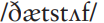 , but there are several phonetic modifications which can differentiate them in speech. In that stuff the /s/ is strongly ARTICULATED and the /t/ is unaspirated, whereas in that’s tough the /s/ is relatively weak and the /t/ is ASPIRATED. In rapid speech such distinctions may disappear: they are only potentially CONTRASTIVE.
There have been several attempts to establish a typology of junctures. A commonly used distinction is between open or plus juncture (the features used at a word boundary, before silence), as illustrated in the above example (usually transcribed with a plus sign <+>), and close juncture (referring to the normal transitions between sounds within a word). To handle the special cases of an open transition within a word, as in co-opt, the notion of internal open juncture may be used. A more general distinction sometimes used to handle these possibilities is that between ‘open’ and ‘close’ transition.
In some American analyses of the INTONATION patterns of larger grammatical units than the word, several types of juncture are distinguished: single-bar or sustained juncture is recognized when the pitch pattern stays level within an UTTERANCE (transcribed with a single forward slash </> or a level arrow <→> ); double-bar or rising juncture is recognized when the pitch pattern rises before a silence (transcribed with a double slash <//> or a rising arrow <↗>); a terminal, double-cross, falling or fading juncture is recognized when the pitch pattern falls before a silence (transcribed with a double cross <#> or a falling arrow <↘>).
Juncture is used in ROLE AND REFERENCE GRAMMAR to describe that part of the grammar which deals with how sub-CLAUSAL units combine. It is seen in association with a theory of NEXUS – the type of SYNTACTIC relationship which obtains between the units in the juncture.
 0
0
 0
0
لا توجد تعليقات بعد
ما رأيك بالمقال : كن أول من يعلق على هذا المحتوى
 الاكثر قراءة في Phonology
 اخر الاخبار
اخبار العتبة العباسية المقدسة

الآخبار الصحية


مواضيع ذات صلة
 قسم الشؤون الفكرية يصدر كتاباً يوثق تاريخ السدانة في العتبة العباسية المقدسة
 "المهمة".. إصدار قصصي يوثّق القصص الفائزة في مسابقة فتوى الدفاع المقدسة للقصة القصيرة
 (نوافذ).. إصدار أدبي يوثق القصص الفائزة في مسابقة الإمام العسكري (عليه السلام)