Phonology and morphology
The archiphoneme is useful in signaling cases where oppositions are suspended, but has two problems. First, a representation like /mEri/ is three ways ambiguous for a General American speaker, since it could be Mary, merry or marry: this might in fact be quite appropriate, because the three sound the same at the phonetic level, but it would be helpful to have a way of identifying, somewhere in the phonology, just which is which. Secondly, in some cases that look rather like neutralization, the archiphoneme cannot really be invoked. For instance, the English regular plural ending on nouns is marked by an spelling, which means more than one thing phonologically: in cats, caps, chiefs, where the final sound of the stem is voiceless, the plural suffix is realized as voiceless [s]; in dogs, heads, pans, hooves, dolls, eyes, where the final sound of the stem is voiced, the plural suffix is also voiced [z]; and finally, in cases where the stem ends in a sibilant, namely
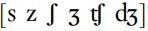 a vowel is inserted for reasons of ease of articulation, since sequences of two sibilants are not allowed in English, giving horses, bushes, churches with [əz] (or [Iz]). This might, on the face of it, seem to be a purely phonetic matter, involving assimilation of the plural ending to the last segment of the stem; but there is more to it than that.
If voicing assimilation were necessary in final clusters, forms like hence, face, loss would not be possible words of English, since they involve final sequences of a voiced consonant or vowel, followed by voiceless [s]. What matters, in the plural cases, is what that final sound is doing: the cases where it is a suffix indicating plural behave differently from those in which it is part of the stem.
Similarly, singular and plural noun forms like leaf – leaves, hoof – hooves, knife – knives might initially appear to represent a case of neutralization, where the usual contrast between /f/ and /v/ is suspended before /z/ (recall that this is pronounced voiced). However, whatever is going on here cannot be ascribed straightforwardly to the phonetic context, since there are also cases, as in (4), where either the singular and plural both have voiceless fricatives, or both have voiced ones.

Neutralization always involves a regular suspension of contrast in a particular phonetic context. Here, we are dealing with an alternation between two phonemes, /f/ and /v/, in a particular grammatical context. Leaf has a final /f/, and leaves a medial /v/ – there is no intermediate, archiphonemic form here. The determining factor is neither phonetic nor phonological: it is simply a fact about certain English nouns (including leaf, hoof, knife, life, wife, but excluding chief, roof, hive, stove) that they have /f/ in some forms, notably the singular, and /v/ in others, notably the plural
Such alternation between phonemes, depending on grammatical facts, is very common. For instance, before certain suffixes, the shape of the final consonant of a stem may change: hence /k/, /s/ and /ʃ/, otherwise three distinct phonemes as in kin, sin and shin, occur predictably depending whether the stem electric stands alone, or has a following suffix. Similar alternations involve president and other words derived from that, as shown in (5). English speakers can perfectly well pronounce [k] before the sound sequence [Iti], as in kitty, or [t] before [i], as in pretty or Betty: the fact that these sounds do not appear in electricity or presidency, where we find [s] instead, reflects the function of -ity and -y as suffixes in those cases.









