Grammar
Tenses
Present

Present Simple
Present Continuous
Present Perfect
Present Perfect Continuous
Past
Past Simple
Past Continuous
Past Perfect
Past Perfect Continuous
Future
Future Simple
Future Continuous
Future Perfect
Future Perfect Continuous
Parts Of Speech
Nouns
Countable and uncountable nouns
Verbal nouns
Singular and Plural nouns
Proper nouns
Nouns gender
Nouns definition
Concrete nouns
Abstract nouns
Common nouns
Collective nouns
Definition Of Nouns
Animate and Inanimate nouns
Nouns
Verbs
Stative and dynamic verbs
Finite and nonfinite verbs
To be verbs
Transitive and intransitive verbs
Auxiliary verbs
Modal verbs
Regular and irregular verbs
Action verbs
Verbs
Adverbs
Relative adverbs
Interrogative adverbs
Adverbs of time
Adverbs of place
Adverbs of reason
Adverbs of quantity
Adverbs of manner
Adverbs of frequency
Adverbs of affirmation
Adverbs
Adjectives
Quantitative adjective
Proper adjective
Possessive adjective
Numeral adjective
Interrogative adjective
Distributive adjective
Descriptive adjective
Demonstrative adjective
Pronouns
Subject pronoun
Relative pronoun
Reflexive pronoun
Reciprocal pronoun
Possessive pronoun
Personal pronoun
Interrogative pronoun
Indefinite pronoun
Emphatic pronoun
Distributive pronoun
Demonstrative pronoun
Pronouns
Pre Position
Preposition by function
Time preposition
Reason preposition
Possession preposition
Place preposition
Phrases preposition
Origin preposition
Measure preposition
Direction preposition
Contrast preposition
Agent preposition
Preposition by construction
Simple preposition
Phrase preposition
Double preposition
Compound preposition
prepositions
Conjunctions
Subordinating conjunction
Correlative conjunction
Coordinating conjunction
Conjunctive adverbs
conjunctions
Interjections
Express calling interjection
Phrases
Sentences
Clauses
Part of Speech
Grammar Rules
Passive and Active
Preference
Requests and offers
wishes
Be used to
Some and any
Could have done
Describing people
Giving advices
Possession
Comparative and superlative
Giving Reason
Making Suggestions
Apologizing
Forming questions
Since and for
Directions
Obligation
Adverbials
invitation
Articles
Imaginary condition
Zero conditional
First conditional
Second conditional
Third conditional
Reported speech
Demonstratives
Determiners
Direct and Indirect speech
Linguistics
Phonetics
Phonology
Linguistics fields
Syntax
Morphology
Semantics
pragmatics
History
Writing
Grammar
Phonetics and Phonology
Semiotics
Reading Comprehension
Elementary
Intermediate
Advanced
Teaching Methods
Teaching Strategies
Assessment


Proper Adjective
 المؤلف:
ENGLISHCLUB.COM
المؤلف:
ENGLISHCLUB.COM
 المصدر:
...
المصدر:
...
 الجزء والصفحة:
...
الجزء والصفحة:
...
 17-5-2021
 2186
2186




+
-
20
What are Proper Adjectives?
Most adjectives are "common adjectives". They describe people, places and things, for example:
tall man, big dog, noisy baby,large garden, empty room, beautiful city, red car, hot weather, expensive watch
"Proper adjectives" also describe people, places and things, but they are based on names and therefore need to be capitalized, like the names. For example, Spain is the name of a country and starts with a capital letter. The adjective based on Spain (Spanish) must also start with a capital letter. Mars is the name of a planet and starts with a capital letter. The adjective based on Mars (Martian) must also start with a capital letter. Shakespeare was the name of a famous writer and starts with a capital letter. The adjective based on Shakespeare (Shakespearean) must also start with a capital letter.
Since you live in Spain, do you enjoy Spanish food?
If people ever live on the planet Mars, they will have to endure the extremes of the Martian climate.
Although William Shakespeare is best known for his plays, many exams also cover Shakespearean poetry.
Proper adjectives are mostly of two types:
those that come from names of places—countries, continents, regions, cities
those that come from names of people—usually famous people, mostly historical, some modern
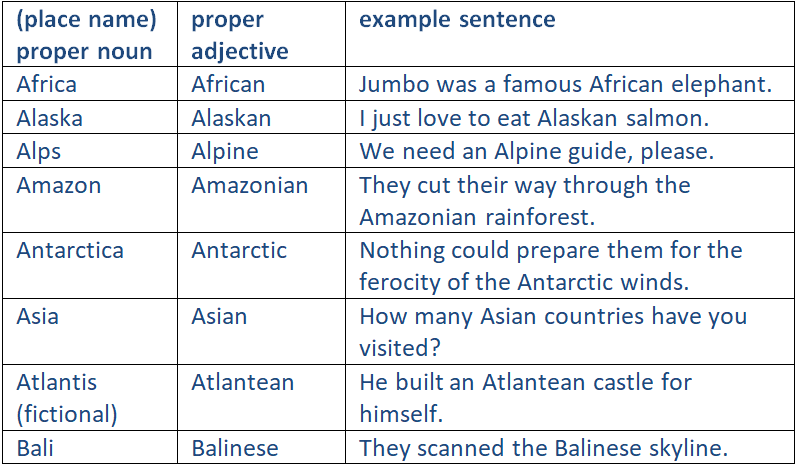
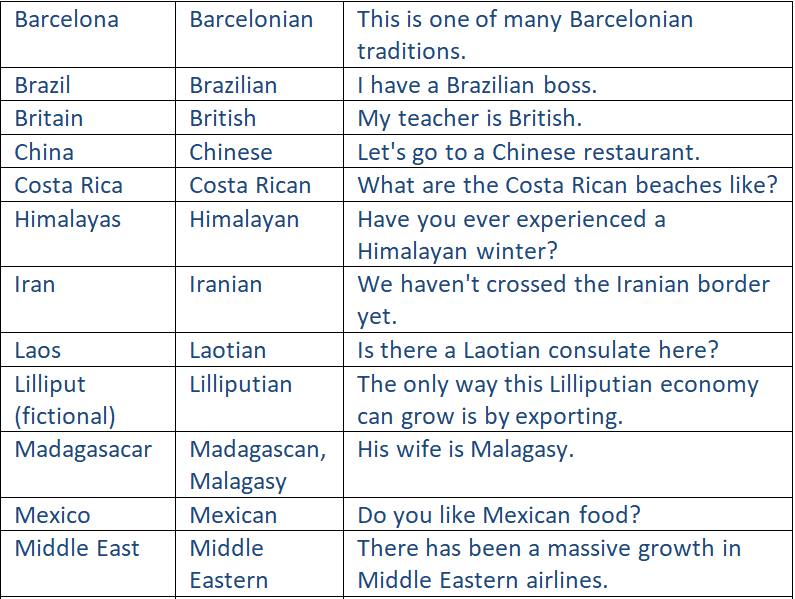
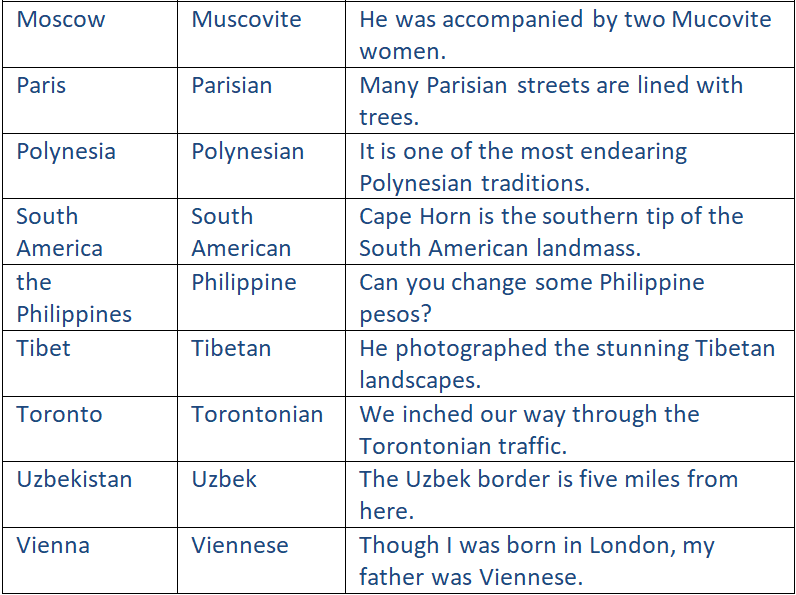
Proper Adjectives from Place Names (countries, continents, regions, cities)
Your country is a proper noun and it has a capitalized proper adjective. Here are a few examples of proper adjectives based on place names, and you can find a much longer list of proper adjectives based on place names here:
Proper Adjectives from People's Names (eponymous )
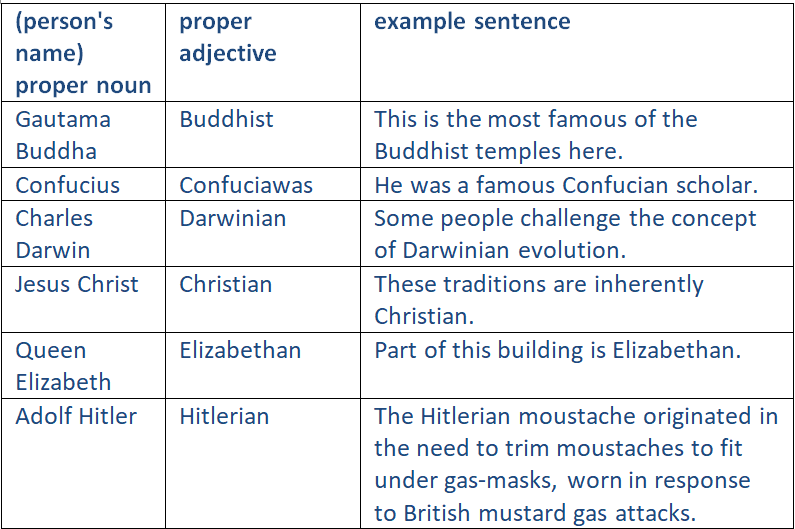
Your name is a proper noun and if you were super-famous it might have a capitalized proper adjective. Nouns and adjectives derived from people's names—both real and fictional—are called "eponymous". Eponymous adjectives are by definition proper adjectives. Here are a few examples, and you can find a much longer list of eponymous adjectives here:
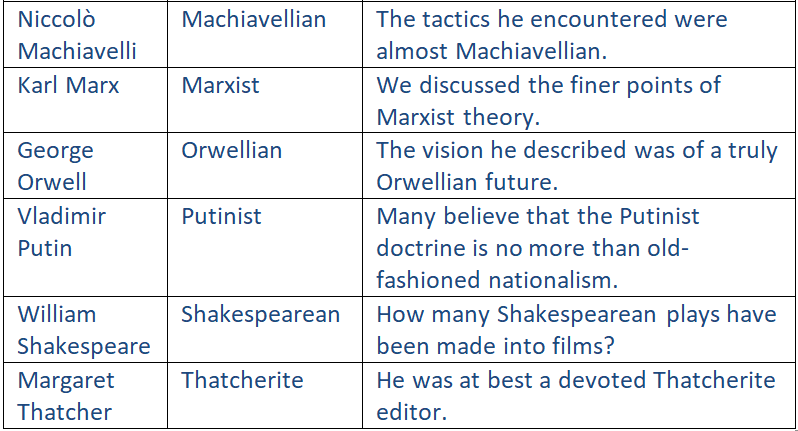
Prefixes with Proper Adjectives
Normally, a prefix attached to a proper adjective should not be capitalized. Look at these examples:
pre-Christian
Paganism was one of many pre-Christian religions.
pan-European
The search for a pan-European identity started well before 1900.
post-Thatcherite
Did wages go up in post-Thatcherite Britain?
Note that the prefix should not be capitalized, unless it starts the sentence:
anti-Western
Anti-Western sentiment was an inevitable consequence.
If the prefix itself is formed from a proper noun, then the prefix should of course by capitalized. In the following example, Austro- comes from the proper noun Austria and Hungarian comes from the proper noun Hungary.
Austro-Hungarian
The assassination of the heir to the Austro-Hungarian throne led directly to the First World War.
In the next example, the prefix Afro- comes from the proper noun Africa, and Caribbean is the proper adjective from the proper noun Caribbean:
Afro-Caribbean
He loves Afro-Caribbean music.
Hyphenation with Proper Adjectives
The same logic applies with suffixes and other hyphenated forms—capitalize only the word or words derived from a proper noun:
English-speaking
She asked for an English-speaking guide to show her around.
When Proper Adjectives Lose their Connection
Sometimes proper adjectives lose their connection with the proper noun that gave them the right to be capitalized, for example:
gargantuan, titanic, caesarian, draconian, herculean, spartan
 0
0
 0
0
لا توجد تعليقات بعد
ما رأيك بالمقال : كن أول من يعلق على هذا المحتوى
 الاكثر قراءة في Proper adjective
 اخر الاخبار
اخبار العتبة العباسية المقدسة

الآخبار الصحية


 قسم الشؤون الفكرية يصدر كتاباً يوثق تاريخ السدانة في العتبة العباسية المقدسة
 "المهمة".. إصدار قصصي يوثّق القصص الفائزة في مسابقة فتوى الدفاع المقدسة للقصة القصيرة
 (نوافذ).. إصدار أدبي يوثق القصص الفائزة في مسابقة الإمام العسكري (عليه السلام)