Grammar
Tenses
Present

Present Simple
Present Continuous
Present Perfect
Present Perfect Continuous
Past
Past Simple
Past Continuous
Past Perfect
Past Perfect Continuous
Future
Future Simple
Future Continuous
Future Perfect
Future Perfect Continuous
Parts Of Speech
Nouns
Countable and uncountable nouns
Verbal nouns
Singular and Plural nouns
Proper nouns
Nouns gender
Nouns definition
Concrete nouns
Abstract nouns
Common nouns
Collective nouns
Definition Of Nouns
Animate and Inanimate nouns
Nouns
Verbs
Stative and dynamic verbs
Finite and nonfinite verbs
To be verbs
Transitive and intransitive verbs
Auxiliary verbs
Modal verbs
Regular and irregular verbs
Action verbs
Verbs
Adverbs
Relative adverbs
Interrogative adverbs
Adverbs of time
Adverbs of place
Adverbs of reason
Adverbs of quantity
Adverbs of manner
Adverbs of frequency
Adverbs of affirmation
Adverbs
Adjectives
Quantitative adjective
Proper adjective
Possessive adjective
Numeral adjective
Interrogative adjective
Distributive adjective
Descriptive adjective
Demonstrative adjective
Pronouns
Subject pronoun
Relative pronoun
Reflexive pronoun
Reciprocal pronoun
Possessive pronoun
Personal pronoun
Interrogative pronoun
Indefinite pronoun
Emphatic pronoun
Distributive pronoun
Demonstrative pronoun
Pronouns
Pre Position
Preposition by function
Time preposition
Reason preposition
Possession preposition
Place preposition
Phrases preposition
Origin preposition
Measure preposition
Direction preposition
Contrast preposition
Agent preposition
Preposition by construction
Simple preposition
Phrase preposition
Double preposition
Compound preposition
prepositions
Conjunctions
Subordinating conjunction
Correlative conjunction
Coordinating conjunction
Conjunctive adverbs
conjunctions
Interjections
Express calling interjection
Phrases
Sentences
Clauses
Part of Speech
Grammar Rules
Passive and Active
Preference
Requests and offers
wishes
Be used to
Some and any
Could have done
Describing people
Giving advices
Possession
Comparative and superlative
Giving Reason
Making Suggestions
Apologizing
Forming questions
Since and for
Directions
Obligation
Adverbials
invitation
Articles
Imaginary condition
Zero conditional
First conditional
Second conditional
Third conditional
Reported speech
Demonstratives
Determiners
Direct and Indirect speech
Linguistics
Phonetics
Phonology
Linguistics fields
Syntax
Morphology
Semantics
pragmatics
History
Writing
Grammar
Phonetics and Phonology
Semiotics
Reading Comprehension
Elementary
Intermediate
Advanced
Teaching Methods
Teaching Strategies
Assessment


Future Perfect
 المؤلف:
GRAMMARLY.COM
المؤلف:
GRAMMARLY.COM
 المصدر:
...
المصدر:
...
 الجزء والصفحة:
...
الجزء والصفحة:
...
 31-3-2021
 1446
1446




+
-
20
Future Perfect
The future perfect is a verb tense used for actions that will be completed before some other point in the future.
Example :
The parade will have ended by the time Chester gets out of bed. At eight o’clock I will have left.
Key words: Verb, past participle, tense, preposition
The future perfect tense is for talking about an action that will be completed between now and some point in the future. Imagine that your friend Linda asks you to take care of her cat for a few days while she goes on a trip. She wants you to come over today at noon so she can show you where to find the cat food and how to mash it up in the bowl just right so that Fluffy will deign to eat it. But you’re busy this afternoon, so you ask Linda if you can come at eight o’clock tonight instead.
“No, that won’t work! At eight o’clock I will have left already,” she says.
What does the future perfect tell us here? It tells us that Linda is going to leave for her trip some time after right now, but before a certain point in the future (eight o’clock tonight). She probably shouldn’t have waited until the last minute to find a cat sitter.
The Future Perfect Formula
The formula for the future perfect tense is pretty simple: will have + [past participle]. It doesn’t matter if the subject of your sentence is singular or plural. The formula doesn’t change.
When to Use the Future Perfect Tense
Sometimes, you can use the future perfect tense and the simple future tense interchangeably. In these two sentences, there is no real difference in meaning because the word before makes the sequence of events clear:
Example :
Linda will leave before you get there. Linda will have left before you get there.
But without prepositions such as before or by the time that make the sequence of events clear, you need to use the future perfect to show what happened first.
Example :
At eight o’clock Linda will leave. (This means that Linda will wait until 8 o’clock to leave.) At eight o’clock Linda will have left. (This means Linda will leave before 8 o’clock.)
When Not to Use the Future Perfect Tense
The future perfect tense is only for actions that will be complete before a specified point in the future. In other words, the action you’re talking about must have a deadline. If you don’t mention a deadline, use the simple future tense instead of the future perfect tense.
Correct Linda will leave.
Incorrect Linda will have left.
The deadline can be very specific (eight o’clock) or it can be vague (next week). It can even depend on when something else happens (after the parade ends). It just has to be some time in the future.
How to make the Future Perfect Negative
Making a negative future perfect construction is easy! Just insert not between will and have.
Example :
We will not have eaten breakfast before we get to the airport tomorrow morning. They will not have finished decorating the float before the parade.
You can also use the contraction won’t in the place of will not. They won’t have finished decorating the float before the parade.
How to Ask a Question
The formula for asking a question in the future perfect tense is will + [subject] + have + [past participle]:
Example
Will you have eaten lunch already when we arrive? Will they have finished decorating the float before the parade?
Prepositional Phrases that Often Go With the Future Perfect
By this time next week, Linda will have left for her trip. Three days from now, we will have finished our project. At midnight, the party will have ended. Will you have eaten already? Chester will not have arrived by the time the parade is over. When I travel to France, I will have been to ten countries. My sister will have cleaned the bathroom before the party. As soon as someone buys this chair, I will have sold all the furniture I wanted to get rid of.
Common Regular Verbs in the Future Perfect Tense

Common Irregular Verbs in the Future Perfect Tense
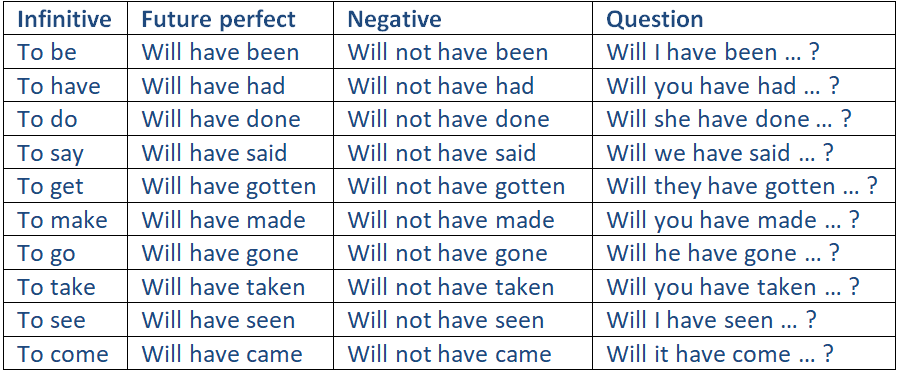
Be careful when using the verb “to be” in the future perfect tense. The construction is easy to confuse with the future perfect continuous tense.
The past participle of “to get” is gotten in American English. In British English, the past participle is got.
 0
0
 0
0
لا توجد تعليقات بعد
ما رأيك بالمقال : كن أول من يعلق على هذا المحتوى
 الاكثر قراءة في Future Perfect
 اخر الاخبار
اخبار العتبة العباسية المقدسة

الآخبار الصحية


 قسم الشؤون الفكرية يصدر كتاباً يوثق تاريخ السدانة في العتبة العباسية المقدسة
 "المهمة".. إصدار قصصي يوثّق القصص الفائزة في مسابقة فتوى الدفاع المقدسة للقصة القصيرة
 (نوافذ).. إصدار أدبي يوثق القصص الفائزة في مسابقة الإمام العسكري (عليه السلام)