

Grammar


Tenses


Present

Present Simple

Present Continuous

Present Perfect

Present Perfect Continuous


Past

Past Simple

Past Continuous

Past Perfect

Past Perfect Continuous


Future

Future Simple

Future Continuous

Future Perfect

Future Perfect Continuous


Parts Of Speech


Nouns

Countable and uncountable nouns

Verbal nouns

Singular and Plural nouns

Proper nouns

Nouns gender

Nouns definition

Concrete nouns

Abstract nouns

Common nouns

Collective nouns

Definition Of Nouns

Animate and Inanimate nouns

Nouns


Verbs

Stative and dynamic verbs

Finite and nonfinite verbs

To be verbs

Transitive and intransitive verbs

Auxiliary verbs

Modal verbs

Regular and irregular verbs

Action verbs

Verbs


Adverbs

Relative adverbs

Interrogative adverbs

Adverbs of time

Adverbs of place

Adverbs of reason

Adverbs of quantity

Adverbs of manner

Adverbs of frequency

Adverbs of affirmation

Adverbs


Adjectives

Quantitative adjective

Proper adjective

Possessive adjective

Numeral adjective

Interrogative adjective

Distributive adjective

Descriptive adjective

Demonstrative adjective


Pronouns

Subject pronoun

Relative pronoun

Reflexive pronoun

Reciprocal pronoun

Possessive pronoun

Personal pronoun

Interrogative pronoun

Indefinite pronoun

Emphatic pronoun

Distributive pronoun

Demonstrative pronoun

Pronouns


Pre Position


Preposition by function

Time preposition

Reason preposition

Possession preposition

Place preposition

Phrases preposition

Origin preposition

Measure preposition

Direction preposition

Contrast preposition

Agent preposition


Preposition by construction

Simple preposition

Phrase preposition

Double preposition

Compound preposition

prepositions


Conjunctions

Subordinating conjunction

Correlative conjunction

Coordinating conjunction

Conjunctive adverbs

conjunctions


Interjections

Express calling interjection

Phrases

Sentences


Grammar Rules

Passive and Active

Preference

Requests and offers

wishes

Be used to

Some and any

Could have done

Describing people

Giving advices

Possession

Comparative and superlative

Giving Reason

Making Suggestions

Apologizing

Forming questions

Since and for

Directions

Obligation

Adverbials

invitation

Articles

Imaginary condition

Zero conditional

First conditional

Second conditional

Third conditional

Reported speech

Demonstratives

Determiners


Linguistics

Phonetics

Phonology

Linguistics fields

Syntax

Morphology

Semantics

pragmatics

History

Writing

Grammar

Phonetics and Phonology

Semiotics


Reading Comprehension

Elementary

Intermediate

Advanced


Teaching Methods

Teaching Strategies

Assessment
French–English
المؤلف:
Mehmet Yavas̡
المصدر:
Applied English Phonology
الجزء والصفحة:
P193-C8
2025-03-18
577
French–English
The overlay of the native phonemes onto the target English inventory gives us the following picture:
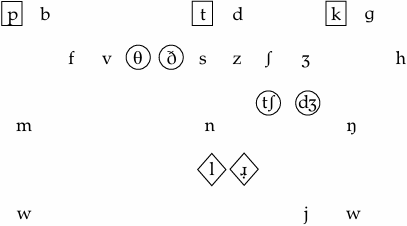
French consonants that are not relevant for the discussion are /ɲ, ɥ/.
Missing target phonemes include the interdentals /θ/ and /ð/ (which are rendered as [s] and [z] respectively, giving rise to mispronunciations such as think [sɪŋk], that [zæt]) and affricates /tʃ/ and /dʒ/ (which are rendered as [ʃ] and [ʒ] respectively). The status of /ŋ/ is different in that while it does not occur in native French words, one does find it in final position in borrowed words.
Allophonic differences may be observed in /p, t, k/ regarding aspiration. As in other Romance languages, voiceless stops are unaspirated in French, leading to mispronunciations of English targets.
Salient phonetic differences belong, once again, to the realm of liquids. The lateral in French is always ‘clear’, and the non-lateral is either an alveolar trill, /r/, or the uvular fricative/approximant, /ʁ/, and these are consistently used to substitute for the English liquid targets. The sounds /t, d/ present minor phonetic differences, as these are dental in French.
The mismatches and the under-differentiations regarding the target vowel contrasts are highlighted in the following diagram:
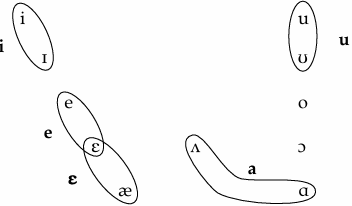
French vowels that are not relevant are /y, ø, œ/ and the nasal vowels / ε͂, ɑ͂, ɔ͂, œ͂/.
The syllable structure of French, which can be described as (C) (C) V (C) (C), allows a maximum of double onsets and codas. In addition, the combinations allowed by these double onsets (basically, C1 = /f, v/ or stop, C2 = liquid), and codas (basically C1 = liquid, C2 = stop) are more limited than those of English. Thus, some problems are expected in these mismatches.
Although French is classified as a syllable-timed language, it does not have the typical ‘staccato’ (or ‘machine-gun’) rhythm, and has reduced vowels.
Despite this, the rhythm is quite different than that of English. In an English rhythm group, the first syllable is stressed and its pitch is higher than the other unstressed syllables. In French, on the other hand, the final syllable of each rhythmic group is lengthened and its pitch is leveled to half way before it is lowered. Thus, learners have considerable problems with English stress and rhythm.
The following summarizes the major trouble spots:
• missing target phonemes: / θ, ð, ʧ, ʤ, (ŋ)/;
• aspiration;
• salient phonetic differences: liquids;
• certain onset and coda clusters;
• insufficient separation of several target vowel contrasts;
• stress;
• rhythm.
الاكثر قراءة في Phonology
اخر الاخبار
اخبار العتبة العباسية المقدسة
الآخبار الصحية

قسم الشؤون الفكرية يصدر كتاباً يوثق تاريخ السدانة في العتبة العباسية المقدسة
"المهمة".. إصدار قصصي يوثّق القصص الفائزة في مسابقة فتوى الدفاع المقدسة للقصة القصيرة
(نوافذ).. إصدار أدبي يوثق القصص الفائزة في مسابقة الإمام العسكري (عليه السلام)


