0
settings
الوضع الليلي
moon
انماط الصفحة الرئيسية arrow
EN
1
المرجع الالكتروني للمعلوماتية

Grammar

Tenses

Present

Present Simple

Present Continuous

Present Perfect

Present Perfect Continuous

Past

Past Simple

Past Continuous

Past Perfect

Past Perfect Continuous

Future

Future Simple

Future Continuous

Future Perfect

Future Perfect Continuous

Parts Of Speech

Nouns

Countable and uncountable nouns

Verbal nouns

Singular and Plural nouns

Proper nouns

Nouns gender

Nouns definition

Concrete nouns

Abstract nouns

Common nouns

Collective nouns

Definition Of Nouns

Animate and Inanimate nouns

Nouns

Verbs

Stative and dynamic verbs

Finite and nonfinite verbs

To be verbs

Transitive and intransitive verbs

Auxiliary verbs

Modal verbs

Regular and irregular verbs

Action verbs

Verbs

Adverbs

Relative adverbs

Interrogative adverbs

Adverbs of time

Adverbs of place

Adverbs of reason

Adverbs of quantity

Adverbs of manner

Adverbs of frequency

Adverbs of affirmation

Adverbs

Adjectives

Quantitative adjective

Proper adjective

Possessive adjective

Numeral adjective

Interrogative adjective

Distributive adjective

Descriptive adjective

Demonstrative adjective

Pronouns

Subject pronoun

Relative pronoun

Reflexive pronoun

Reciprocal pronoun

Possessive pronoun

Personal pronoun

Interrogative pronoun

Indefinite pronoun

Emphatic pronoun

Distributive pronoun

Demonstrative pronoun

Pronouns

Pre Position

Preposition by function

Time preposition

Reason preposition

Possession preposition

Place preposition

Phrases preposition

Origin preposition

Measure preposition

Direction preposition

Contrast preposition

Agent preposition

Preposition by construction

Simple preposition

Phrase preposition

Double preposition

Compound preposition

prepositions

Conjunctions

Subordinating conjunction

Correlative conjunction

Coordinating conjunction

Conjunctive adverbs

conjunctions

Interjections

Express calling interjection

Phrases

Sentences

Clauses

Part of Speech

Grammar Rules

Passive and Active

Preference

Requests and offers

wishes

Be used to

Some and any

Could have done

Describing people

Giving advices

Possession

Comparative and superlative

Giving Reason

Making Suggestions

Apologizing

Forming questions

Since and for

Directions

Obligation

Adverbials

invitation

Articles

Imaginary condition

Zero conditional

First conditional

Second conditional

Third conditional

Reported speech

Demonstratives

Determiners

Direct and Indirect speech

Linguistics

Phonetics

Phonology

Linguistics fields

Syntax

Morphology

Semantics

pragmatics

History

Writing

Grammar

Phonetics and Phonology

Semiotics

Applied Linguistics

Reading Comprehension

Elementary

Intermediate

Advanced

Teaching Methods

Teaching Strategies

Assessment

قم بتسجيل الدخول اولاً لكي يتسنى لك الاعجاب والتعليق.

Movement, Wh-Agreement, and Apparent Wh-in-Situ

المؤلف:  Lisa Lai-Shen Cheng and Norbert Corver

المصدر:  Wh-Movement Moving on

الجزء والصفحة:  C7-P165

2026-11-09

25

+

-

20

Movement, Wh-Agreement, and Apparent Wh-in-Situ


In current minimalist syntax (Chomsky 2000, 2001, 2004), movement is an operation that does not introduce a trace; rather, it leaves behind a complete copy of the moved element, with the result that structures formed by movement exhibit multiple copies of the moved element. In the phonology, it is determined which of these copies is phonetically realized, the typical case being that only the highest copy is pronounced (see Nissenbaum 2000).
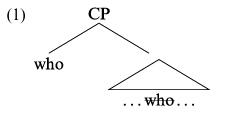
This copy theory of movement allows for an option not available in trace theory, namely, that language-specific phonological constraints might dictate that the copy privileged for pronunciation is the lowest, as opposed to the highest. This possibility has been productively explored by Brody (1995), Groat and O’Neil (1996), Pesetsky (1997, 1998, 2000), Bosˇkovic´ (2001), Bobaljik (2002), and others (but see Nunes 2004 for a different view). Following this line of thought, we argue here that certain types of wh-in-situ instantiate ‘‘hidden’’ movement configurations that are created by wh-movement in overt syntax, followed by pronunciation of only the lowest copy.
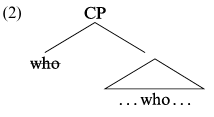
Our evidence for these hidden movement configurations is supplied by the phenomenon of wh-agreement, which is widely believed to track wh movement in overt syntax, before Spell-Out. In brief, we show that there are languages in which the morphological patterns of wh-agreement occur in certain wh-in-situ contexts. Continuing to assume that this special morphology provides a record of the history of wh-movement before the derivation is shipped to PF, its occurrence in certain wh-in-situ constructions reveals that here too, movement has occurred in overt syntax. The only difference from overt wh-movement is that the lower rather than the higher copy is pronounced. Our proposal thus invokes the copy-plus delete theory of movement to integrate one strand of research on wh-in situ with research on the morphology of extraction.


لا توجد تعليقات بعد

ما رأيك بالمقال : كن أول من يعلق على هذا المحتوى

اشترك بقناتنا على التلجرام ليصلك كل ما هو جديد

