Cognitive approaches to grammar
Construction Grammar
Predictability and polysemy
The reference work for the framework labelled Construction Grammar is usually taken to be Goldberg (1995). In what follows the label “Construction Grammar” is taken to refer to Goldberg’s version. Originally (i.e. in Goldberg 1995 as well as in Fillmore’s work, from which Goldberg’s model derives, see e.g. Fillmore 1988 and Fillmore and Kay 1996), constructions were posited in grammar if and only if some aspect of their meaning was regarded as “not strictly predictable from [the construction’s] component parts or from other previously established constructions” (Goldberg 1995: 4). For example, a sentence like Sam slept the whole trip away is said to be unaccounted for by the syntactic rules of English (e.g. sleep a trip is not a possible string in English) and, hence, a construction with the syntax “Subject Verb Object (referring to time) away” and the meaning (roughly) “to spend the specified amount of time by being constantly engaged in the activity denoted by the verb” should be recognized as a unit in the grammar of English. Further, the term construction was usually taken to exclude combinations of two or more morphemes, that is, it covered only combinations of syntactic phrases (cf. syntax and idioms in Table 1 in The symbolic alternative to traditional concepts of grammar). More recently, however, Goldberg (e.g. Goldberg and Casenhiser 2006) seems to have opted for (or at least to have taken an agnostic stance on) a more comprehensive definition of construction, i.e. one along the lines of both Cognitive Grammar and Radical Construction Grammar. Constructions should be posited in grammar even if they are fully predictable (e.g. I love you vs. kick the bucket) and all the types listed in Table 1 in The symbolic alternative to traditional concepts of grammar, should be categorized as constructions. This in turn implies that, as in Cognitive Grammar and Radical Construction Grammar, no strict separation is postulated between what are traditionally called the lexicon and syntax. Rather, they are taken to form a continuum.
Despite the use of a more inclusive notion of construction in recent work, Construction Grammar still draws a sharp distinction between constructional meaning and word meaning. As is pointed out by Langacker (2005a), Construction Grammar aims at minimizing lexical polysemy in favor of constructional polysemy. Consider the verb slice, which can be used in a variety of constructions, as shown in (1) (from Goldberg and Casenhiser 2006):
(1) a. He sliced the bread. (transitive)
b. Pat sliced the carrots into the salad. (caused motion)
c. Pat sliced Chris a piece of pie. (ditransitive)
d. Emeril sliced and diced his way to stardom. (way-construction)
e. Pat sliced the box open. (resultative)
Construction Grammar argues against postulating five different senses for slice (as would be done in traditional generative approaches, where constructions are projected from a verb’s argument structure). Rather, slice, meaning simply “cut with a sharp instrument”, is claimed to combine with five different constructions (or argument structures), all of which are independently stored in the grammar of English. The interaction between constructional meaning and verbal meaning in the case of (1b) is illustrated in a Construction Grammar format in Figure 3.
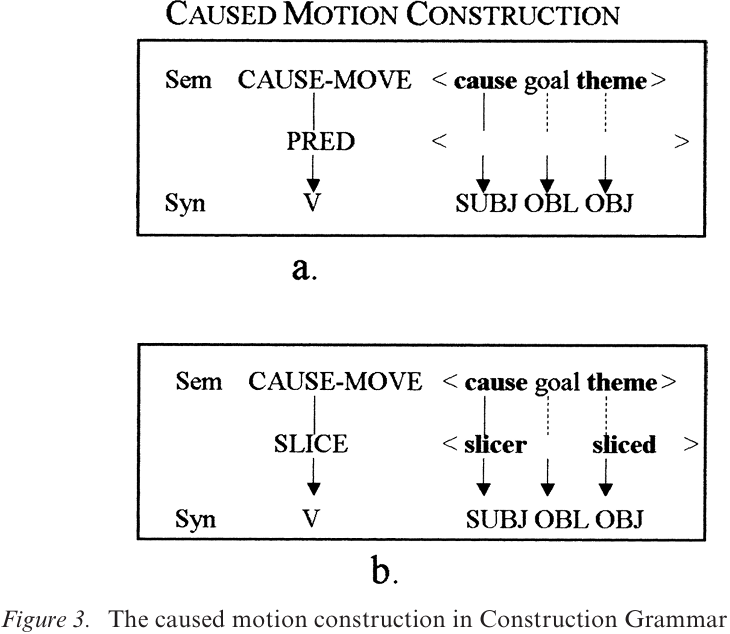
Figure 3a depicts the schema for the caused motion construction. Construction Grammar distinguishes between the semantics (Sem) and the syntax (Syn) of a given construction. The exact details of the representational conventions used in Construction Grammar are not our concern here. It will suffice to point out that the semantics of the caused motion construction indicates that an argument (cause) causes another entity (theme) to move towards a certain position (i.e. goal). The causal relation and the ensuing movement, i.e. the overall caused motion predicate, are abbreviated as CAUSE-MOVE. Cause is realized syntactically as a subject (SUBJ), goal as an oblique (OBL, that is, an adjective phrase or a prepositional phrase), and theme as a direct object (OBJ). The construction also specifies (by way of the middle tier) that specific instantiations of the construction are obtained by merging the schematic caused motion predicate (CAUSE-MOVE) with a specific predicate (PRED), which corresponds syntactically to a verb (V), e.g. slice in our example. This is shown in Figure 3b. Slice (as well as making reference to a sharp instrument as part of its semantic base) takes two arguments, a “slicer” argument (i.e. the cause argument), Pat, and a “sliced” argument (the theme argument), the carrots. The merger between the caused motion construction and slice results in the specific construction Pat sliced the carrots into the salad.








