Methodology in Cognitive Linguistics
What Cognitive Linguistics actually does
Growing interest in an empirical methodology
Now, this initial overview only establishes that the relevant empirical methods do indeed appear in the context of Cognitive Linguistics, and that most of them have in fact been around for quite a while. However, the overview does not say much about the impact they have: what is the position of these forms of research within Cognitive Linguistics as a whole? If one compares the impact of data-oriented studies in the total field of Cognitive Linguistics over a number years, a steady increase in the importance of empirical research may be noticed. In Table 1, the presence of a number of relevant keywords in the Cognitive Linguistics Bibliography is broken down over four periods in time. The terms (whose presence in any field in the bibliographical entries is counted) relate to empirical methods of research: the general terms data and empirical on the one hand, and the methodologically more specific terms corpus and experiment(al) on the other. The Cognitive Linguistics Bibliography is a magnificent research instrument compiled predominantly by René Dirven; it is included in the subscription to the journal Cognitive Linguistics. The version of the bibliography used for Table 1 is the version of September 2005, which includes a total of 7000 entries.
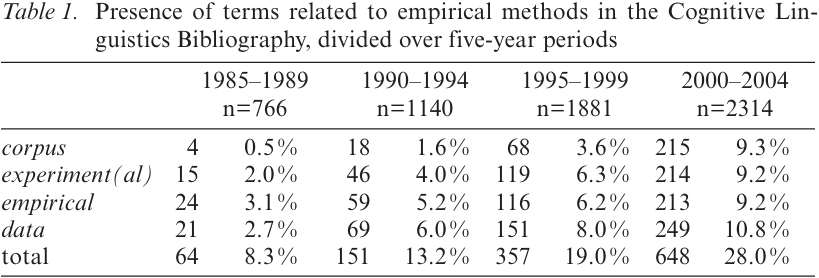
Coarse though the calculation may be, the table does show that there is a continuous increase in the number of books and articles that refer to empirical approaches: the number of bibliographical entries that cites either of the four terms (the row labeled total) rises steadily to 28% in the final period, and the growth occurs with each of the four terms separately. The separate growth curves for the individual terms are fairly even, except in the case of corpus, where the line shows a marked increase from the penultimate to the last period. This is not altogether surprising: the massive availability of corpus materials is a relatively recent phenomenon, specifically if we take into account the use of the internet as a corpus.
The impression we get from Table 1 in Growing interest in an empirical methodology is strengthened by further indications of an intensification of the appeal of empirical methods within Cognitive Linguistics. It suffices to have a look at some of the thematic symposia organized over the last few years: the Empirical Methods in Cognitive Linguistics workshop held at Cornell University in May 2003, the theme session on the use of corpora in Cognitive Linguistics organized during the ICLC8 in Logrono, July 2003, the workshop on the necessity of experimental methods in semantics organized during the 20th Scandinavian Conference in Linguistics at the University of Helsinki in January 2004, the choice of experimental and empirical methods as the focus theme of the 7th Conference on Conceptual Structure, Discourse, and Language at the University of Alberta in October 2004, and the corpus based theme session Language System and Language Use at the ICLC9 in Seoul, July 2005– all of these testify to the growing importance that the Cognitive Linguistics community attaches to an empirical methodology.








