Relevance of Knowledge of Second Language Acquisition:
FINDINGS
Disintegration of Past, Present, and Future
Prior experiences and personal beliefs and expectations were a powerful source for learning-to-teach (Kagan, 1993) that helped Peiling create ways of thinking about understanding and interpreting SLA. There were also sites/sources for ambiguity, inconsistency, and messiness, which often brought contradictory viewpoints and put her in an ambivalent position, as shown in this study.
Peiling’s comment that “there is no connection [in class] to me as a former [EFL] student and teacher” (Interview, 03-23-02) crystallized her sense of alienation due to the disintegration of her previous learning and teaching experiences as they came into contact with the current knowledge in SLA. The in-depth classroom observation seemed to suggest that the format (lecture-based) and the focus (research and theory-based) of the course did not allow her voices, struggles, issues, and problems derived from the contradictory viewpoints and the ambivalent positions to be heard, discussed, validated, or resolved in the SLA course.
For example, the instructor devoted most of the class time to demonstrating how certain linguistic features (e.g., yes/no question formation, negation, relative clauses etc.) were acquired by different groups of L2 learners (classroom observations, from 08-30-01 to 12-11-01). Peiling questioned the validity of L2 acquisition based on her EFL background and said,
[I didn’t go through the sequence] because I learned the rules first and most of the time I didn’t make such mistakes [in] those examples. I don’t know. It seems not so bad to learn such rules first. (Interview, 09-20-02)
However, she never thought that her questioning was valid and was worth bringing up for further discussion in class with her peers (the majority of whom were EFL learners) in the lecture-oriented class.
Should Peiling believe in the “internal order” suggested by the theory and supported by the instructor, or should she follow her “personal practical knowledge” (Golombek, 1998, p. 447) gained through years of experience as an EFL learner [and teacher?]? In the SLA class, unfortunately, Peiling was not encouraged, asked or given any time or opportunity to talk about what acquisition order meant to her as an experienced L2 learner and teacher (Classroom observation, 08-29-02 to 12-11-01).
Peiling’s instructor believed that SLA knowledge can “help each teacher to decide how to solve certain problems and how to anticipate certain problems” because knowledge of SLA is “another tool for helping [teacher-learners when] making decisions.” As for exactly what to do with the knowledge, the instructor assumed that “it’s up to individual teachers” whose “years of practical experience” would give teacher-learners “pretty good ideas what to do in class” (Interview with the instructor, 11-13-01).
Prior to taking the course, Peiling had 13 years of practical experience as an EFL learner and 3 years of practical experience as an EFL teacher. However, 16 years of “practical experience” did not give Peiling “pretty good ideas what to do in class” (Interview with the instructor, 11-13-01) as assumed by the instructor. Peiling commented,
I just don’t know how to relate the readings or the theories to the experience I have. I don’t know. (Interview, 01-09-02)
Peiling had difficulty relating her current understanding of SLA to her previous experience to aid in her future teaching. Her problem, she felt, was that she was never required or guided to make this connection through the design of the SLA course. The instructor perceived that application was not the major focus for the course: little time was used for addressing application in class and rarely was Peiling asked to address application in her assignments. The design of the course, therefore, was consistent with the theoretical orientation of the instructor, who did not perceive a necessary link between theories of SLA and their classroom application.
In contrast, a series of questions raised by Peiling revealed her own concerns about the practical implications of SLA theories (e.g., developmental patterns). She asked,
Does it mean that we (L2 teachers] need to follow those orders to teach our students? Do I need to start from the easiest part? What if I teach the more difficult first? What will be the result? (Interview, 09-14-01)
Acquisitional order or developmental patterns were not merely theoretical but implied an extremely messy notion for her future teaching. On the one hand, she thought knowing orders of morphemic acquisition gave her a different perspective on looking at her students’ development. She said,
Well, I think the impact of knowing acquisition order is that it lets me know that it’s ok. Kids have their development of language even though they are still making some mistakes (Interview, 09-14-01)
On the other hand, however, she did not know how to resolve the tension between theory and practice. Below are two examples.
Actually I think the main reason is that there isn’t much time. Of course I hope them to be target-like as soon as possible...I wonder how long it would take for students to construct their own knowledge of language…(Interview, 09-20-01)
...I don’t know if I will feel OK even though I know such [an idea] theoretically when I teach. When I teach something several times, students still have such mistakes. I will still feel very angry (laughing). Yeah! So I mean I think theoretically knowing something does not mean you can feel it’s OK. (Interview, 10-07-02)
Peiling commented on her SLA class, saying, “In SLA, I could not see the instructor trying to invite us to use those theories to apply to teaching.” Hence, Peiling had a deep sense of alienation coming from the separation of SLA knowledge and future teaching. She stated,
Knowing more about language [development] does not mean that it helps me know more about teaching. I don’t think it influences me on teaching. The knowledge is for me, not for students, or how I am gonna teach. (Interview, 11-20-01)
All the while Peiling was pondering many issues that were not addressed in class. To her surprise, therefore, in her final exam she was given the essay question below:
Given the findings in SLA regarding the rule of an LAD [Language Acquisition Device] and natural acquisition orders, what claims have been made regarding pedagogical applications? Do you agree with such claims? Should, for example, a syllabus reflect the natural orders discovered, but ordering the introduction of structures in the order of natural acquisition? Why or why not? Give an example. What advantages and disadvantages do instructed (classroom) learners have in comparison to those in ‘natural’ contexts? Can we change the order of acquisition with teaching? What effect can teaching have for the SLA learner? In your answer, be sure to distinguish those who are learning the language as a second language (in the community where he target language is used) and those who are learning it as a foreign language (no TL in the surrounding community). (Question on Final Exam Sheet, 12-10-01)
Although Peiling thought the exam was very practical, she wondered why such practical issues were not addressed in class and were, rather, held back until the final exam.
While the course instructor expected that the design of the course (lecture-oriented, research-oriented term papers and readings) and “years of practical experience” of teacher-learners might enable them to address the question, Peiling’s response to the final exam also provided evidence counter to the instructor’s assumption:
I should say that [the exam question is] related to our daily life but actually 1 don’t know why because she seldom mentioned [such practical issues in class). Actually, I don’t think she made such connections in her class most of the times. (Interview, 01-09-02)
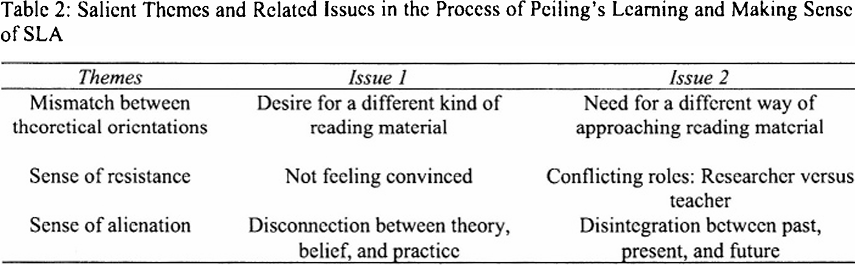
Table 2 summarizes the salient themes and related issues in the process of Peiling’s learning and making sense of SLA.
Question 2: What was the impact of taking the SLA course on her subsequent EFL teaching practices in Taiwan?
Peiling took the SLA course in the last semester of her Master’s program. She returned to teach EFL in an elementary school in Taiwan the following semester after one and a half years of study in the United States. Data collection in Peiling’s EFL classroom lasted about four months. The major data collection devices were weekly interviews and daily classroom observations (7 AM to 5 PM, five days a week).
What did SLA knowledge mean in Peiling’s EFL setting? What impact did it have on Peiling’s subsequent EFL practices? To answer this research question, I examined Peiling’s EFL classroom from two perspectives. First, how did Peiling perceive the relevancy of her knowledge of SLA in relation to her EFL practices? Second, what change was made in Peiling’s EFL class in relation to the salient messages supported by the course? Prior to addressing the questions, it is important to understand the situation in which Peiling was teaching EFL.








