ANALYSIS OF SKELETAL MATERIALS
The first question the anthropologist must ask is, “Is the submitted material really bone?” With whole bones, the answer is obvious. A surprising number of materials can superficially resemble a bone fragment, so even professionals need to be careful, especially with very small fragments. It may be necessary to take a thin section of the material and examine it microscopically for cell morphology. Elemental analysis is also very useful for small fragments because few materials have the same elemental ratios as bone. Once the material is determined to be bone, the second question is whether the bone is animal or human. This can present a greater challenge than it may appear at first. Pig bones, bear paws, and some sheep bones can, at first, appear similar to human bones, as illustrated in Figure 1. A comprehensive knowledge of human anatomy and a solid grounding in animal osteology will answer most of these ques tions. A comparative collection of catalogued skeletal remains is crucial to an accurate taxonomical assessment: It can be as useful to know what something is, not just what it is not (see “In More Detail: When Is a Doctor Not a Doctor?”).
IN MORE DETAIL: WHEN IS A DOCTOR NOT A DOCTOR? Dr Douglas Ubelaker writes of the following example in his book, Human Skeletal Remains (1999). A bone fragment had been found in a remote part of Alaska. The bone displayed a fracture that had been repaired surgically with a metal plate . The extensive bone growth over the surgical plate indicated the patient had received the surgery long before death. Given the nature of the surgery and the surgical efforts, the authorities began to search for the surgeon who had performed the operation. After these efforts failed, the bone was sent to Dr Ubelaker at the Smithsonian Institution, where a microscopic section revealed the bone to have a nonhuman bone cell morphology, one that closely matched that of a large dog. This explains why the surgeon couldn’t be found—because the doctor was a veterinarian! This is an excellent example of why assumptions are dangerous and one should not come to a conclusion until all the facts are in.
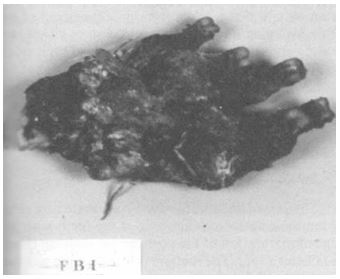
FIGURE 1 If a questioned material is bone, it still may not be human; some animal bones look very much like human bones at first glance (like this bear paw). A professional trained in non human skeletal anatomy may need to be consulted.









