0
EN
1
المرجع الالكتروني للمعلوماتية

Grammar

Tenses

Present

Present Simple

Present Continuous

Present Perfect

Present Perfect Continuous

Past

Past Simple

Past Continuous

Past Perfect

Past Perfect Continuous

Future

Future Simple

Future Continuous

Future Perfect

Future Perfect Continuous

Parts Of Speech

Nouns

Countable and uncountable nouns

Verbal nouns

Singular and Plural nouns

Proper nouns

Nouns gender

Nouns definition

Concrete nouns

Abstract nouns

Common nouns

Collective nouns

Definition Of Nouns

Animate and Inanimate nouns

Nouns

Verbs

Stative and dynamic verbs

Finite and nonfinite verbs

To be verbs

Transitive and intransitive verbs

Auxiliary verbs

Modal verbs

Regular and irregular verbs

Action verbs

Verbs

Adverbs

Relative adverbs

Interrogative adverbs

Adverbs of time

Adverbs of place

Adverbs of reason

Adverbs of quantity

Adverbs of manner

Adverbs of frequency

Adverbs of affirmation

Adverbs

Adjectives

Quantitative adjective

Proper adjective

Possessive adjective

Numeral adjective

Interrogative adjective

Distributive adjective

Descriptive adjective

Demonstrative adjective

Pronouns

Subject pronoun

Relative pronoun

Reflexive pronoun

Reciprocal pronoun

Possessive pronoun

Personal pronoun

Interrogative pronoun

Indefinite pronoun

Emphatic pronoun

Distributive pronoun

Demonstrative pronoun

Pronouns

Pre Position

Preposition by function

Time preposition

Reason preposition

Possession preposition

Place preposition

Phrases preposition

Origin preposition

Measure preposition

Direction preposition

Contrast preposition

Agent preposition

Preposition by construction

Simple preposition

Phrase preposition

Double preposition

Compound preposition

prepositions

Conjunctions

Subordinating conjunction

Correlative conjunction

Coordinating conjunction

Conjunctive adverbs

conjunctions

Interjections

Express calling interjection

Phrases

Sentences

Clauses

Part of Speech

Grammar Rules

Passive and Active

Preference

Requests and offers

wishes

Be used to

Some and any

Could have done

Describing people

Giving advices

Possession

Comparative and superlative

Giving Reason

Making Suggestions

Apologizing

Forming questions

Since and for

Directions

Obligation

Adverbials

invitation

Articles

Imaginary condition

Zero conditional

First conditional

Second conditional

Third conditional

Reported speech

Demonstratives

Determiners

Direct and Indirect speech

Linguistics

Phonetics

Phonology

Linguistics fields

Syntax

Morphology

Semantics

pragmatics

History

Writing

Grammar

Phonetics and Phonology

Semiotics

Reading Comprehension

Elementary

Intermediate

Advanced

Teaching Methods

Teaching Strategies

Assessment

قم بتسجيل الدخول اولاً لكي يتسنى لك الاعجاب والتعليق.

MIXED PRE-MODIFIERS AND THEIR ORDERING

المؤلف:  Angela Downing

المصدر:  ENGLISH GRAMMAR A UNIVERSITY COURSE

الجزء والصفحة:  P399-C10

2026-07-02

41

+

-

20

MIXED PRE-MODIFIERS AND THEIR ORDERING

Between the head of a NG and the other elements, there is one basic logical relationship, that of successive dependency: leftwards from the head to the pre-head elements and rightwards in the case of the post-head elements, as indicated by the arrows in the following example:
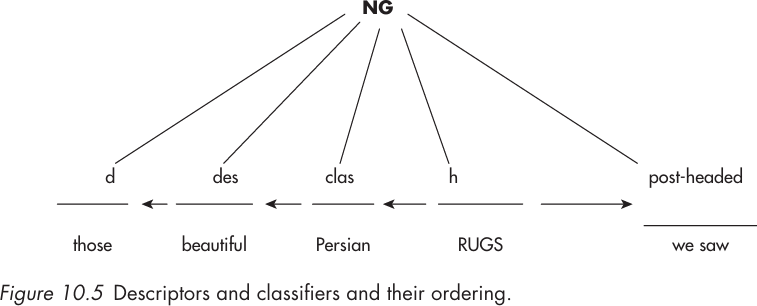
 

Within this logical framework, speakers seem to use semantic criteria, based on degrees of permanence and objectivity, to decide the order of pre-modifiers. Those properties perceived as permanent, intrinsic and undisputed are placed nearest the head of the nominal group. Those that are more variable, subjective or attitudinal are placed further from the head.


Immediately to the left of the head is the classifier, since this is the closest relationship, as in Persian rugs, radio program, park entrance, leather suitcases.


Where there is more than one classifier, affiliation precedes substance as in German leather suitcases, Indian lamb curry. If there is no affiliation, substance precedes other classifiers (steel medical instrument, cotton gardening gloves).


The next place, moving to the left, is occupied by color adjectives, and before them come any participial modifiers (battered brown German leather suitcases, stained blue plumbers’ overalls). Preceding these are the most central adjectives, such as tall, young, long, hot. At the start of the list are the attitudinal adjectives – such as beautiful, ugly, marvelous, horrible, nice, nasty – after any determinatives. This is the unmarked order, which causes us to say:

a large oil tanker                                          and not *an oil large tanker

increased income tax rebates                      and not *income tax increased rebates

a beautiful blue silk scarf                             and not *a silk beautiful blue scarf

a nice hot Indian curry                                 and not *a hot Indian nice curry


Participial modifiers can occupy various positions. Those that are verbal nouns, such as gardening in gardening gloves, always stay close to the head noun, whereas those that have become gradable adjectives, such as interested, bored, exciting, may occur nearer the determinative, if there is one. If the participial seems to have an evaluative tinge, it is even more likely to precede other adjectives:

interested foreign spectators

an exciting new adventure story

a battered old leather suitcase


The following extract from All American Girl shows how a teenager sees herself at a particular moment:

I stood on the kerb across from the Founding Church of Scientology, squinting into the light drizzle and headlights in the direction Theresa was supposed to come. As I stood there, I couldn’t help feeling kind of sorry for myself. I mean, there I was, a fifteen-year-old, left-handed, red-headed, misunderstood middle-child reject, broke, standing in the rain after skipping her drawing-class because she couldn’t take criticism.


اخر الاخبار

اشترك بقناتنا على التلجرام ليصلك كل ما هو جديد

