0
EN
1
المرجع الالكتروني للمعلوماتية

Grammar

Tenses

Present

Present Simple

Present Continuous

Present Perfect

Present Perfect Continuous

Past

Past Simple

Past Continuous

Past Perfect

Past Perfect Continuous

Future

Future Simple

Future Continuous

Future Perfect

Future Perfect Continuous

Parts Of Speech

Nouns

Countable and uncountable nouns

Verbal nouns

Singular and Plural nouns

Proper nouns

Nouns gender

Nouns definition

Concrete nouns

Abstract nouns

Common nouns

Collective nouns

Definition Of Nouns

Animate and Inanimate nouns

Nouns

Verbs

Stative and dynamic verbs

Finite and nonfinite verbs

To be verbs

Transitive and intransitive verbs

Auxiliary verbs

Modal verbs

Regular and irregular verbs

Action verbs

Verbs

Adverbs

Relative adverbs

Interrogative adverbs

Adverbs of time

Adverbs of place

Adverbs of reason

Adverbs of quantity

Adverbs of manner

Adverbs of frequency

Adverbs of affirmation

Adverbs

Adjectives

Quantitative adjective

Proper adjective

Possessive adjective

Numeral adjective

Interrogative adjective

Distributive adjective

Descriptive adjective

Demonstrative adjective

Pronouns

Subject pronoun

Relative pronoun

Reflexive pronoun

Reciprocal pronoun

Possessive pronoun

Personal pronoun

Interrogative pronoun

Indefinite pronoun

Emphatic pronoun

Distributive pronoun

Demonstrative pronoun

Pronouns

Pre Position

Preposition by function

Time preposition

Reason preposition

Possession preposition

Place preposition

Phrases preposition

Origin preposition

Measure preposition

Direction preposition

Contrast preposition

Agent preposition

Preposition by construction

Simple preposition

Phrase preposition

Double preposition

Compound preposition

prepositions

Conjunctions

Subordinating conjunction

Correlative conjunction

Coordinating conjunction

Conjunctive adverbs

conjunctions

Interjections

Express calling interjection

Phrases

Sentences

Clauses

Part of Speech

Grammar Rules

Passive and Active

Preference

Requests and offers

wishes

Be used to

Some and any

Could have done

Describing people

Giving advices

Possession

Comparative and superlative

Giving Reason

Making Suggestions

Apologizing

Forming questions

Since and for

Directions

Obligation

Adverbials

invitation

Articles

Imaginary condition

Zero conditional

First conditional

Second conditional

Third conditional

Reported speech

Demonstratives

Determiners

Direct and Indirect speech

Linguistics

Phonetics

Phonology

Linguistics fields

Syntax

Morphology

Semantics

pragmatics

History

Writing

Grammar

Phonetics and Phonology

Semiotics

Reading Comprehension

Elementary

Intermediate

Advanced

Teaching Methods

Teaching Strategies

Assessment

قم بتسجيل الدخول اولاً لكي يتسنى لك الاعجاب والتعليق.

REFERRING TO PEOPLE AND THINGS AS DEFINITE, INDEFINITE, GENERIC DEFINITE AND INDEFINITE REFERENCE

المؤلف:  Angela Downing

المصدر:  ENGLISH GRAMMAR A UNIVERSITY COURSE

الجزء والصفحة:  P375-C10

2026-06-30

22

+

-

20

REFERRING TO PEOPLE AND THINGS AS DEFINITE, INDEFINITE, GENERIC

DEFINITE AND INDEFINITE REFERENCE

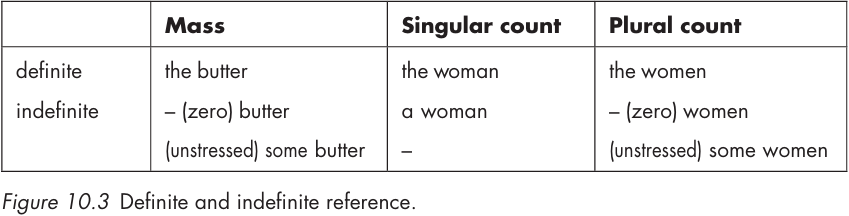
In English, the grammar obliges us to refer to people and things as definite, indefinite, or generic. This is done syntactically by the use of determinatives, and among these, in particular, by the definite, indefinite and zero articles. Definite reference is made by the or a deictic determinative (this, that, these, those) or a possessive (my, your, etc.). Indefinite reference is made by a(n), unstressed some, any or the absence of a marker, which, since its absence is grammatically significant, is called the ‘zero article’. ‘Zero’ doesn’t mean that an article has been omitted, as may occur in a newspaper headline, such as Plane crashes on village, but is a category in its own right.


The three articles are distributed as follows with mass and count nouns:
 

An entity is considered as ‘indefinite’ if there is nothing in the discourse or the situation or our general knowledge of the world that identifies it for us. This is the case with an amateur musician, a 70-strong orchestra, a violinist, all introduced for the first time by the indefinite article a(n) in the news item from The Week below:

An amateur musician has formed a 70-strong orchestra by approaching strangers on the London Underground. Shaun Buswell, 36, came up with the idea after meeting a violinist on the Tube in 2011. Having drawn up rules – musicians had to be carrying their instruments when he met them – he approached more than 300 people in 12 months. His orchestra, which includes students from the Royal Academy of Music, played their first gig at the Shepherd’s Bush Empire on Saturday, raising money for a children’s charity.


Once the entity has already been mentioned it can be considered as ‘definite’: Shaun Buswell, his orchestra. Definiteness is inferred if there is sufficient information to identify it, either in the text (the idea) or in the non-linguistic situation (the London Underground, their first gig) or in general knowledge (the Tube). Note that the gig had not been previously mentioned. We identify it in relation to orchestra and musician through general knowledge and inference: gigs are performances, especially by pop musicians. This is known as indirect anaphoric reference.


اخر الاخبار

اشترك بقناتنا على التلجرام ليصلك كل ما هو جديد

