CAUSATIVE PROCESSES
CAUSATIVE MATERIAL PROCESSES AND ERGATIVE PAIRS
The prototypical pattern of direct causation is quite complex. A controlling, purposeful, responsible Agent directs its energy towards something or someone (the Affected), so that this undergoes the action named by the verb, with a consequent change of state. The following example illustrate this transitive-causative structure.
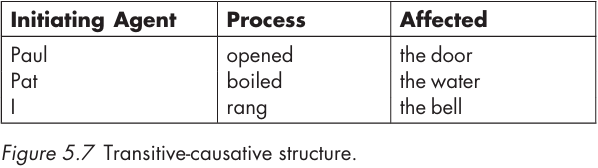
From this perspective, the action of boiling, ringing, etc. is initiated by a controlling Agent or a Force participant: The sun melted the ice.
The Affected is, however, the essential participant, the one primarily involved in the action. It is the door that opens, the water that boils and the bell that rings.
If we conceptualize the situation from a different angle, in which no Agent initiator is present, we encode the process as ‘happening’ of its own accord. An Agent can’t be added. This is the anti-causative structure.
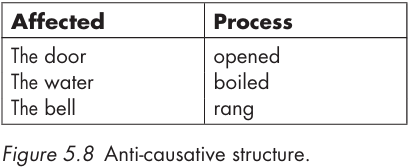
When the Affected object of a transitive clause (e.g. the bell) is the same as the Affected subject of an intransitive clause, we have an ergative alternation or ergative pair, as in I rang the bell (transitive) and the bell rang (intransitive). This key participant in both cases is sometimes called the Medium. Ergative systems in many languages are ordinarily characterized by morphological case marking, the subject of the intransitive clause and the object of the transitive clause being marked in the same way, while the Agentive subject is marked differently. This is not the case with English which instead marks both the subject of an intransitive clause and that of a transitive clause as nominative, and the object of the transitive as accusative. We can see this in the two meanings of leave: he left (went away, intrans.), he left them (abandon, trans.).
Nevertheless, the term ‘ergative’ has been extended to English on the basis of the semantic association between S (intrans.) and O (trans.) in alternations illustrated by boil, ring, etc. The semantic similarity between these two is one of change of state.
The test for recognizing an ergative pair is that the transitive-causative, two- participant structure must always allow for the corresponding one-participant, anti- causative structure. Compare the previous examples (e.g. he opened the door/the door opened) with the following, in which the first, although transitive, is not causative. There is no intransitive counterpart, and consequently, no ergative pair:
Pelé kicked the ball. *The ball kicked
The ergative alternation allows us to express a situation from both perspectives, 1 the transitive-causative and 2 the intransitive:
1 A gust of wind fluttered the papers on the desk and whirled them in a spiral on to the floor.
2 The papers fluttered in the gust of wind and whirled in a spiral to the floor.
Ergative pairs account for many of the most commonly used verbs in English, some of which are listed below, with examples:
burn I’ve burnt the toast. The toast has burnt.
break The wind broke the branches. The branches broke.
burst She burst the balloon. The balloon burst.
close He closed his eyes. His eyes closed.
cook I’m cooking the rice. The rice is cooking.
fade The sun has faded the carpet. The carpet has faded.
freeze The low temperature has frozen the milk. The milk has frozen.
melt The heat has melted the ice. The ice has melted.
run Tim is running the bathwater. The bathwater is running.
stretch I stretched the elastic. The elastic stretched.
tighten He tightened the rope. The rope tightened.
Wave Someone waved a flag. A flag waved.
Within this alternation – described here as an ‘ergative pair’ – there is a set of basically intransitive volitional activities (walk, jump, march) in which the second participant is involved either willingly or unwillingly. The control exerted by the Agent predominates in the transitive-causative:
He walked the dogs in the park. The dogs walked.
He jumped the horse over the fence The horse jumped over the fence.
The sergeant marched the soldiers. The soldiers marched.
It is also possible to have an additional agent and an additional causative verb in the transitive clauses of ergative pairs; for example, The child got his sister to ring the bell, Mary made Peter boil the water.








