Motivation and Compositionality
We can relate motivation to the logical notion of composition or compositionality. We say that something is logically compositional if it is defined entirely in terms of its parts. For example, the word doghouse is compositional, at least in its original sense, because its meaning is derivable from its two components, dog and house. Because it is purely compositional, we could also call doghouse a motivated sign (although if we break it down, the sound shapes of dog and house are purely arbitrary and unmotivated). But in the expression in the doghouse ‘in a state of disfavor or repudiation’, the word is not compositional, since there is nothing in particular about doghouses that suggests that an occupant of one should be in disfavor.
Another example of a compositional form is the Kujamaat Jóola dubitive-incompletive, which expresses an action that was never completed or whose existence is in doubt. For emphasis, the dubitive-incompletive suffix (INC) is doubled (1b). It can even be repeated several times (Thomas and Sapir 1967: 350, note 2):
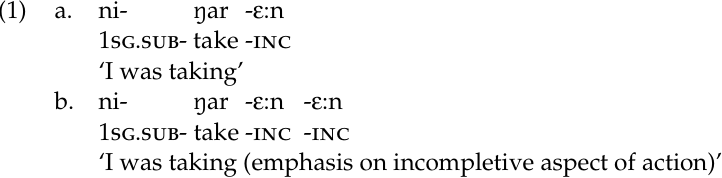
Expressing emphasis through doubling should be considered compositional.
The following set of English words is particularly significant in light of partial motivation and compositionality:

Our first response to this list is to say that these are all morphologically complex words formed with the prefix be-. But are they motivated signs? In each case, the prefix be- has a different effect on the meaning of the stem (head, friend, siege, witch). In the word behead, it indicates ‘deprive of’ (as in the obsolete verbs beland and belimb), but it means nothing of the sort in the other forms. This suggests that these forms are not completely motivated. The meanings of the stems in (2) are never lost, simply transformed. The forms are therefore partially motivated.
The question of whether or not the forms in (2) are compositional is more difficult and depends in large part on our approach to linguistic analysis. It is undoubtedly the case that formation of words with the prefix be- is no longer productive in English. Some linguists will nevertheless want to analyze forms like behead and bewitch as having two parts. Our approach, however, will be to say that these forms are stored whole in the lexicon – they are memorized. We would say the same for forms like crayfish, raspberry, boysenberry, and cranberry.1 While the isolatability of the stems fish and berry make it possible to isolate cray-, rasp-, boysen-, and cran- as affixes, doing so is largely an academic exercise; we will assume so, at least, until the opposite can be shown by experimental means.
The preceding data lead into a major issue: the relationship between derivation and the lexicon. Recall that although some linguists consider the lexicon to be equivalent to the morphology, our definition of lexicon is a list of forms that speakers of a language know or memorize. One question we need to ask is whether lexemes formed by productive derivational processes are ever stored in the lexicon. We address this explicitly in Compounding and Zero-derivation. We present various types of derivational processes, so that students can become familiar with them.
1 Cran- occurs in the names of some juice products, such as cranapple juice, but this form is best seen as a blend. Cran-, rasp-, and to a lesser extent boysen- and cray- are often brought up as examples by linguists, but where do they come from? Cranberry comes from German kranbeere, etymologically ‘crane berry’. Rasp- in raspberry is of unknown origin, but it has an archaic cognate raspis. Boysenberry (a hybrid of the loganberry and various blackberries) is named for the man who developed it, Rudolf Boysen. Finally, crayfish arose through a folk etymology: the original form was crevice ‘crab’, borrowed from Old French. (Etymologies courtesy of the American Heritage Dictionary and the Oxford Dictionary of English Etymology.)








