A secondary affix
In Primary and Secondary Affixes, we explored the distinction between primary and secondary affixes in detail. In Kujamaat Jóola, most derivational affixes are primary. However, one is not: -ulɔ, -ul; -u. This affix, which is secondary, implies that an action begins away from the speaker. It can sometimes be translated ‘from’ or ‘over’. Note that it has a tense vowel in two of its variants.
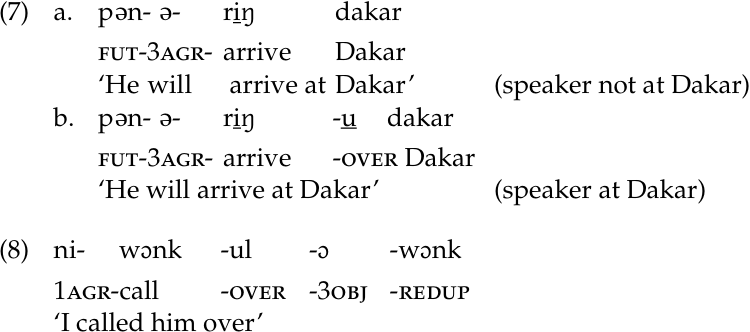
We will introduce other verbal derivational affixes in Derivation and Semantics. We treat -u ‘from’ separately from them because, as discussed by Sapir, its morphophonology sets it apart.
First, -u ‘from’ can follow inflectional markers. This makes it exceptional not only among Kujamaat Jóola derivational affixes, but among derivational affixes cross-linguistically.
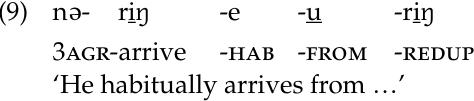
-u is also exceptional in not acting as an added syllable on the verb stem for purposes of calculating the allomorphs of the infinitive. Recall from Words and Lexemes that infinitives, like nouns, are assigned to noun classes, and that monosyllabic stems take the class 3 prefix ε-, while stems of more than one syllable take the class 7 prefix ka-. As seen in (10), other derivational suffixes, represented here by the causative -εn, result in the infinitive being assigned to class 7, while -u ‘from’ does not.

Finally, the derivational suffix -u ‘from’ differs from other derivational affixes in not reduplicating when the verb stem is reduplicated for verb emphasis (11b). Other derivational suffixes, again represented by the causative, do participate in reduplication:
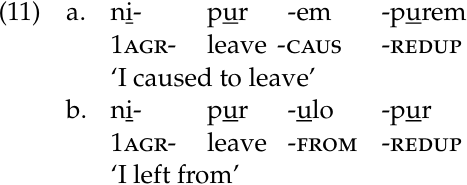
All of these properties suggest that -u ‘from’ in Kujamaat Jóola is a secondary affix. In short:
● It can follow inflectional markers.
● It does not count as an extra syllable of the verb stem when determining which noun class the infinitive should be assigned to.
● It does not reduplicate along with the verb stem for verb emphasis.
These properties suggest that -u has a more distant relation to the stem than other Kujamaat Jóola derivational affixes, which was also true of secondary affixes, when compared to primary affixes, in English. Nonetheless, this list barely resembles the one we prepared for English in Primary and Secondary Affixes. There, secondary affixes differed from primary affixes in the following ways:
● Secondary affixes occur farther from the stem than primary affixes.
● Secondary affixes do not cause a stress shift, while primary affixes do.
● Secondary affixes are more likely than primary affixes to require their stem to be the citation form of the lexeme.
● Secondary affixes are likely to be more productive than primary affixes.
The only parallel between the two bulleted lists is between their first members. In both English and Kujamaat Jóola, secondary affixes appear farther from the stem than primary affixes.
This topic has made two main points. The first is that the primary-secondary affix distinction is just as valid in Kujamaat Jóola as in English. More broadly, while we focus on English morphology, the facts you learn are readily transferable to the study of the morphology of other languages. The second major point is that the properties of the secondary affix -u ‘from’ in Kujamaat Jóola are different from those of secondary affixes in English. While the same phenomena appear in the morphology of language after language, the way we come to understand or describe those phenomena must often be different.








