Kujamaat Jóola Morphophonology
Vowel harmony
The most salient feature of Kujamaat Jóola’s phonology happens to be something that is profoundly related to its morphology – vowel harmony. Vowel harmony is the agreement among some or all of the vowels in a word with respect to a given feature, such as height, rounding, or backness. In Finnish, for example, vowels harmonize for frontness. If all the vowels in a root are front, then vowels in any suffix must also be front, as seen by the partial declension paradigm of ‘forest’ in the last column of (1) below. If any of the vowels in the root are not front, as seen in the partial declension paradigms of words meaning ‘house’, ‘cat’, and ‘log’ in the first three columns of (1), the suffix vowel does not change. Two of the roots below, kissa ‘cat’ and tukki ‘log’, undergo degemination in the ablative, inessive, and elative (degemination is shortening of a long consonant, as in tukki → tuki):
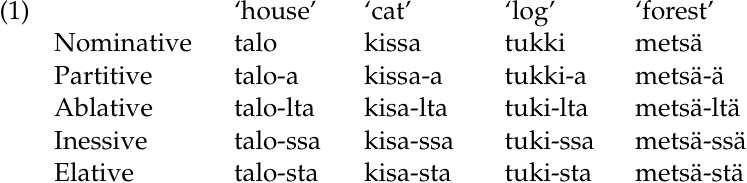
The /a/ vowel of the case-endings may be realized as back [ɑ] or front [æ] (orthographic <ä>) depending on the backness of the preceding vowel.
In Kujamaat Jóola, there are two sets of vowels, tense and lax:
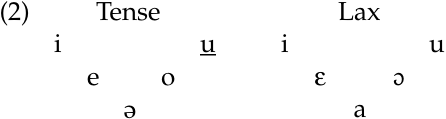
It may seem strange that schwa is classified as a tense vowel, but as explained by Sapir (1975: 3), the tense–lax distinction in West African languages is typically different from that of European languages. In West African languages, like Kujamaat Jóola, tense vowels are relatively higher and closer to center than lax vowels. This explains why schwa, which is higher and more central than /a/, is considered its tense counterpart. The difference between high tense and lax vowels is hard to perceive for foreigners, but the same is not true for the lower vowels, where distinctions are readily apparent.
All vowels in a word must be either tense or lax. Since tense vowels are dominant, whenever any tense vowel is found in a morphologically complex word, vowels that are otherwise lax become tense.1 Harmony spreads out both ways from a tense vowel:
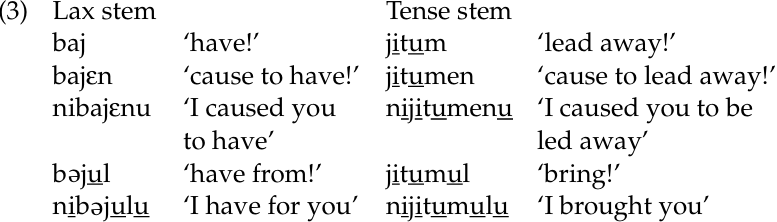
As we see in (3), the process of vowel harmony leads to the existence of two allomorphs, or variants, for all morphemes with lax vowels that can occur together in a word with morphemes containing tense vowels. The stem /baj-/ ‘have’, for instance, may be realized as [baj-] or [bəj-]. The causative marker /-εn/ also occurs as [-en], and the sub ject prefixes /ni-/ ‘I’ and /u-/ ‘you (sg)’ as [ni-] and [u-]. Morphemes containing tense vowels, by contrast, never alternate, because tense always dominates over lax. The stem /jitum/ ‘bring’ always appears with the same shape, because its vowels are underlyingly tense. Likewise, the directional marker /-ul/ has an underlyingly tense vowel. Both /jitum/ and /-ul/ trigger vowel harmony but are never affected by it. We can tell whether a morpheme’s vowels are basically tense or lax by whether it alternates; alternating morphemes whose vowels are sometimes lax and sometimes tense are underlyingly lax, while non-alternating morphemes whose vowels are always tense are underlyingly tense.
The importance of the tense–lax distinction in Kujamaat Jóola goes well beyond phonology and morphology. In a 1975 article, Sapir explores the social role played by tense and lax vowel harmony. It turns out that vowel harmony is not absolute. Some speakers make relatively more use of it, and their speech is considered to be kələ ‘big’ by other Kujamaat Jóola speakers. Those who make relatively less use of it have speech that is called mis ‘thin’. Big and thin are always relative terms. There are no speakers who have only tense vowels or only lax vowels. It is a “quantitative tendency … to favor lax or tense pronunciation” (Sapir 1975: 5; emphasis his) that determines whether someone’s speech is ‘big’ or ‘thin’.
As Sapir relates, he first became aware of the big–thin distinction while working with three Kujamaat Jóola speakers, AB (thin), KB (intermediate), and AK (big), on a dictionary project. The big–thin distinction came across in three general areas. Of highest importance was variation in the application of vowel harmony. While vowel harmony is obligatory in the language, the extent and degree of vowel harmony are not fixed. A tense morpheme might affect all of the vowels of a base, or only an adjacent vowel (Sapir 1975: 6):

Likewise, vowels affected by vowel harmony “may only partially tense, that is, they may become tainted with tenseness, not completely tense.” This observation is especially intriguing, because it suggests that the phonological feature [tense] is not an all-or-nothing matter.
A second area in which the big–thin distinction is apparent is suffixes. Three Kujamaat Jóola suffixes have regional variants that differ in part in containing tense versus lax vowels. AB, Sapir’s ‘thin’ consultant, used the lax variants of the three suffixes. KB, the intermediate consultant, used the lax variants of two, but the tense variant of the third. AK, Sapir’s ‘big’ consultant, used the tense variants of two suffixes. The tense and lax variants of the third suffix were in free variation (Sapir 1975: 5):

The big–thin distinction also asserted itself in vocabulary. There is quite a bit of lexical variation between the Kujamaat Jóola speakers of different villages. Sometimes lexical items are completely distinct. Sometimes dialectal forms are only slightly different and are due in part or in full to the tense–lax distinction. Here are a few examples (Sapir 1975: 5):

As seen in (6), the intermediate speaker shares the lax variant of ‘shinny up a tree’ with the thin speaker, but shares the tense variants of the other three forms with the ‘big’ speaker. For more detail on this and the other two areas that contribute to the big–thin distinction (harmony, variation in the form of suffixes), we refer the reader to Sapir (1975).
The big–thin distinction, as mentioned above, is not absolute, but instead must be seen as falling out along a continuum. A Kujamaat Jóola speaker will be able to place another’s speech as being bigger or thinner than his or her own. Regional dialects differ in terms of their relative bigness or thinness, and Kujamaat Jóola speakers even refer to other languages as being various degrees of big. The fundamental role of the big–thin distinction in Kujamaat Jóola society is identification of someone else as being similar or different. The closer in speech a person is to another, the more likely it is that that person is “reliable and trust-worthy, or at least predictable” (Sapir 1975: 10).
Below is part of Sapir’s description of a conversation that he had with a Kujamaat Jóola woman, who characterized the speech of Sindian, the village of KB, Sapir’s intermediate consultant, as being “heavy” and “hard to understand” (1975: 10). Sapir explains that, to his knowledge, speakers of the woman’s dialect didn’t have difficulty understanding Sindian speech. Sindian speech was simply different:
Although Sindian speech was heavy it was not nearly so heavy as Kasa, a different dialect where there are some real difficulties. In turn Kasa was not as heavy as Wolof, the dominant language of Sénégal, nor was Wolof as heavy as French. English, my speech and the official language of the neighboring ex-colony of Gambia, was to this woman unquestionably the heaviest speech imaginable, just kəkəkəkəkə like so many pied crows.
One of the most interesting aspects of the big–thin distinction is how speakers are placed in one category or another. Recall that Sapir had three consultants. One talked ‘big’ (AK) and one ‘thin’ (AB), and the third fell between them. As Sapir notes, nothing in the speech of the third individual placed it closer to that of the ‘thin’ or the ‘big’ speaker.
But this individual, KB, called his speech ‘big’, and the other two agreed. The reason for this had nothing to do with the tense–lax distinction. It was social. KB and AK, the ‘big’ speaker, were both Muslims, younger, and from outlying villages. Furthermore, they had worked with Sapir previously. AB, the ‘thin’ speaker, was Catholic, older, and from the administrative center. He was also fairly new to the project. KB’s decision to call himself ‘big’ had more to do with his perceived similarities to AK than with the tenseness of his speech.
Because the decision to classify someone as ‘big’ or ‘thin’ is based in part on social factors, Kujamaat Jóola people can disagree about whether someone talks ‘big’ or ‘thin’. Sapir gives another example, where two of his consultants disagreed over whether the speech of Kagnaru, a village, was ‘big’ or ‘thin’. KB, who considered his speech ‘big’, classified Kagnaru’s dialect as ‘thin’. It was true that the people of Kagnaru spoke ‘thinner’ than KB. But they did not speak as ‘thin’ as AB. KB’s labeling of their speech as ‘thin’ came more from the difficult relationship between his village and theirs. AB disagreed with KB. For him, the speech of Kagnaru was ‘big’:
Although he admitted that Kagnaru might speak ‘thinner’ than [KB’s village] they were both ‘bigger’ speakers than himself and he saw no reason why he should be grouped with them. And socially, didn’t the Kagnaru people intermarry with [KB’s village] and quarrel with villages connected to his own family? And weren’t they for the most part Muslims? (Sapir 1975: 13)
This passage illustrates the way in which the big–thin distinction, though it is related to both phonology and morphology, also reflects social factors such as intermarriage and religion.
This short excursion into vowel harmony and the metalinguistic role of the tense–lax distinction should convince the reader that a morphologist must also be a bit of a phonologist. An understanding of Kujamaat Jóola vowel harmony is essential if we are to identify the morphological building blocks of the language – the smallest grammatically significant pieces. We need to recognize, for example, that although the first singular subject prefix may be realized as [ni-] or [ni-], in both cases we are dealing with the same underlying form, /ni-/. What’s more, if we were out in the field working with Kujamaat Jóola consultants, it would be essential to realize that variation in vowel harmony plays a social role. What we started off considering as a phenomenon at the intersection of Kujamaat Jóola phonology and morphology turned out to be a tripartite issue that brings together phonology, morphology, and sociolinguistics.
1 The picture is complicated by sociolinguistic factors.








