0
EN
1
المرجع الالكتروني للمعلوماتية

Grammar

Tenses

Present

Present Simple

Present Continuous

Present Perfect

Present Perfect Continuous

Past

Past Simple

Past Continuous

Past Perfect

Past Perfect Continuous

Future

Future Simple

Future Continuous

Future Perfect

Future Perfect Continuous

Parts Of Speech

Nouns

Countable and uncountable nouns

Verbal nouns

Singular and Plural nouns

Proper nouns

Nouns gender

Nouns definition

Concrete nouns

Abstract nouns

Common nouns

Collective nouns

Definition Of Nouns

Animate and Inanimate nouns

Nouns

Verbs

Stative and dynamic verbs

Finite and nonfinite verbs

To be verbs

Transitive and intransitive verbs

Auxiliary verbs

Modal verbs

Regular and irregular verbs

Action verbs

Verbs

Adverbs

Relative adverbs

Interrogative adverbs

Adverbs of time

Adverbs of place

Adverbs of reason

Adverbs of quantity

Adverbs of manner

Adverbs of frequency

Adverbs of affirmation

Adverbs

Adjectives

Quantitative adjective

Proper adjective

Possessive adjective

Numeral adjective

Interrogative adjective

Distributive adjective

Descriptive adjective

Demonstrative adjective

Pronouns

Subject pronoun

Relative pronoun

Reflexive pronoun

Reciprocal pronoun

Possessive pronoun

Personal pronoun

Interrogative pronoun

Indefinite pronoun

Emphatic pronoun

Distributive pronoun

Demonstrative pronoun

Pronouns

Pre Position

Preposition by function

Time preposition

Reason preposition

Possession preposition

Place preposition

Phrases preposition

Origin preposition

Measure preposition

Direction preposition

Contrast preposition

Agent preposition

Preposition by construction

Simple preposition

Phrase preposition

Double preposition

Compound preposition

prepositions

Conjunctions

Subordinating conjunction

Correlative conjunction

Coordinating conjunction

Conjunctive adverbs

conjunctions

Interjections

Express calling interjection

Phrases

Sentences

Clauses

Part of Speech

Grammar Rules

Passive and Active

Preference

Requests and offers

wishes

Be used to

Some and any

Could have done

Describing people

Giving advices

Possession

Comparative and superlative

Giving Reason

Making Suggestions

Apologizing

Forming questions

Since and for

Directions

Obligation

Adverbials

invitation

Articles

Imaginary condition

Zero conditional

First conditional

Second conditional

Third conditional

Reported speech

Demonstratives

Determiners

Direct and Indirect speech

Linguistics

Phonetics

Phonology

Linguistics fields

Syntax

Morphology

Semantics

pragmatics

History

Writing

Grammar

Phonetics and Phonology

Semiotics

Reading Comprehension

Elementary

Intermediate

Advanced

Teaching Methods

Teaching Strategies

Assessment

قم بتسجيل الدخول اولاً لكي يتسنى لك الاعجاب والتعليق.

Describing vowels

المؤلف:  David Hornsby

المصدر:  Linguistics A complete introduction

الجزء والصفحة:  71-4

2023-12-13

1420

+

-

20

Describing vowels

Whereas consonants can generally be described in terms of the nature of the closure in the vocal tract, vowels present a challenge in that there is no full contact between articulators, so we are left with the task of describing tongue position in vocal space. To address this problem, phoneticians have identified a number of anchor points in relation to which vowels may be located in phonetic space: these are known as cardinal vowels, and they correspond, as we will see, fairly well to the main vowels of standard French.


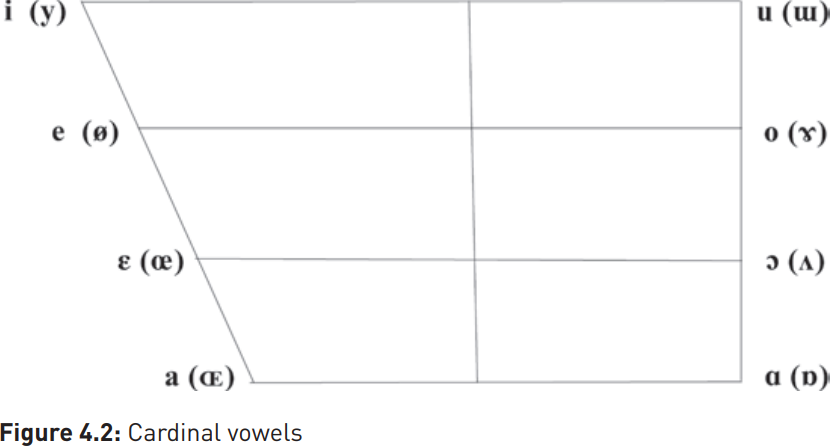
These cardinal vowels are located within an idealized version of the vocal tract known as the vowel quadrilateral (shown in the diagram on the next page). These vowels are numbered for ease of reference: phoneticians refer to the primary cardinal vowels 18, shown in bold, and the secondary cardinal vowels 916, shown in brackets.


Cardinals 1–4 are all pronounced with the tongue raised at the front of the mouth, and for this reason are called front vowels. Try producing the vowel in ski, keeping your tongue perfectly still (imagine the French or Scottish pronunciation): you’ll notice that your tongue is raised almost as far forward and as close to the roof of your mouth as it can go without actually making contact. The vowel you’re producing, [i] (Cardinal 1), is therefore a close (or high) front vowel. By contrast, the vowel [a] in RP cat for which the mouth is generally wide open and the tongue raised at the bottom of the vocal tract, is an open (or low) front vowel. The two intermediate vowels, [e] and [ ε ], those of French thé and belle respectively (and similar to the vowels in Scots English cake and English English head), are known as half-close (or high-mid) and half-open (or low-mid).


اخر الاخبار

اشترك بقناتنا على التلجرام ليصلك كل ما هو جديد