0
EN
1
المرجع الالكتروني للمعلوماتية

Grammar

Tenses

Present

Present Simple

Present Continuous

Present Perfect

Present Perfect Continuous

Past

Past Simple

Past Continuous

Past Perfect

Past Perfect Continuous

Future

Future Simple

Future Continuous

Future Perfect

Future Perfect Continuous

Parts Of Speech

Nouns

Countable and uncountable nouns

Verbal nouns

Singular and Plural nouns

Proper nouns

Nouns gender

Nouns definition

Concrete nouns

Abstract nouns

Common nouns

Collective nouns

Definition Of Nouns

Animate and Inanimate nouns

Nouns

Verbs

Stative and dynamic verbs

Finite and nonfinite verbs

To be verbs

Transitive and intransitive verbs

Auxiliary verbs

Modal verbs

Regular and irregular verbs

Action verbs

Verbs

Adverbs

Relative adverbs

Interrogative adverbs

Adverbs of time

Adverbs of place

Adverbs of reason

Adverbs of quantity

Adverbs of manner

Adverbs of frequency

Adverbs of affirmation

Adverbs

Adjectives

Quantitative adjective

Proper adjective

Possessive adjective

Numeral adjective

Interrogative adjective

Distributive adjective

Descriptive adjective

Demonstrative adjective

Pronouns

Subject pronoun

Relative pronoun

Reflexive pronoun

Reciprocal pronoun

Possessive pronoun

Personal pronoun

Interrogative pronoun

Indefinite pronoun

Emphatic pronoun

Distributive pronoun

Demonstrative pronoun

Pronouns

Pre Position

Preposition by function

Time preposition

Reason preposition

Possession preposition

Place preposition

Phrases preposition

Origin preposition

Measure preposition

Direction preposition

Contrast preposition

Agent preposition

Preposition by construction

Simple preposition

Phrase preposition

Double preposition

Compound preposition

prepositions

Conjunctions

Subordinating conjunction

Correlative conjunction

Coordinating conjunction

Conjunctive adverbs

conjunctions

Interjections

Express calling interjection

Phrases

Sentences

Clauses

Part of Speech

Grammar Rules

Passive and Active

Preference

Requests and offers

wishes

Be used to

Some and any

Could have done

Describing people

Giving advices

Possession

Comparative and superlative

Giving Reason

Making Suggestions

Apologizing

Forming questions

Since and for

Directions

Obligation

Adverbials

invitation

Articles

Imaginary condition

Zero conditional

First conditional

Second conditional

Third conditional

Reported speech

Demonstratives

Determiners

Direct and Indirect speech

Linguistics

Phonetics

Phonology

Linguistics fields

Syntax

Morphology

Semantics

pragmatics

History

Writing

Grammar

Phonetics and Phonology

Semiotics

Reading Comprehension

Elementary

Intermediate

Advanced

Teaching Methods

Teaching Strategies

Assessment

قم بتسجيل الدخول اولاً لكي يتسنى لك الاعجاب والتعليق.

govern (v.)

المؤلف:  David Crystal

المصدر:  A dictionary of linguistics and phonetics

الجزء والصفحة:  214-7

2023-09-14

1619

+

-

20

govern (v.)

A term used in GRAMMATICAL analysis to refer to a process of SYNTACTIC linkage whereby one WORD (or word-CLASS) requires a specific MORPHOLOGICAL FORM of another word (or class). For example, PREPOSITIONS in Latin are said to ‘govern’ NOUNS, making a certain case form obligatory (e.g. ad plus ACCUSATIVE). The notion is, accordingly, not readily applicable to a language like English, where case endings are few – to say that, in the man kicked the ball, kicked ‘governs’ the ball is true only in a loose SEMANTIC sense (and, even then, it is debatable whether this is a valid notion of government, when the relationship between other ELEMENTS is considered: almost any pairs of elements, e.g. the man and kicked, might be said to be displaying government, in this sense). The term is usually contrasted with AGREEMENT, where the form taken by one word requires a corresponding form in another.


In GENERATIVE grammar, a RULE is said to be governed or ungoverned depending on whether it does or does not have LEXICAL exceptions. For example, because not all ACTIVE TRANSITIVE SENTENCES take the PASSIVE (e.g. They have a car, The hat suits you), the passivization rule would be said to be ‘governed’. An example of an ungoverned rule is REFLEXIVIZATION
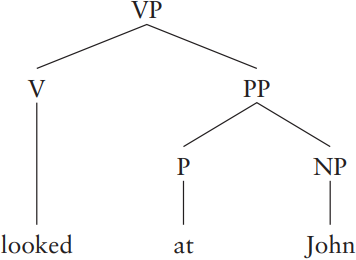
(e.g. I shaved myself, etc.). In later generative grammar, the conditions which determine whether one CONSTITUENT governs another were made more EXPLICIT. When several possible NODES C-COMMAND a constituent, the governor is the lowest of these nodes in the TREE (i.e. the ‘minimal’ node), as long as there is no intervening NOUN PHRASE or S-bar (cf. the conventions of X-BAR syntax). For example, in the tree representing looked at John, both looked and at c-command John; but only at is said to ‘govern’ John (looked John not being possible), i.e. to be the governing node. Governing nodes are noun, VERB, ADJECTIVE, preposition, TENSE and POSSESSIVE.


In relation to GOVERNMENT-BINDING THEORY, a governing category is the minimal structure (noun phrase or sentence) within which the relationships of binding obtain. X is the governing category for Y, where X is N, V, A, P, or AGR, if and only if X and Y are DOMINATED by exactly the same maximal PROJECTIONS (full phrasal categories). When an empty category is governed by a CO-INDEXED category, it is said to be ‘antecedent-governed’ (important for the EMPTY CATEGORY PRINCIPLE).


In DEPENDENCY grammar, the governor refers to the superordinate NODE in a dependency tree, which ‘governs’ or ‘controls’ a set of ‘dependent’ nodes. Each combination of governor and dependent defines a specific structural relationship. For example, the verb is seen as the governor of the noun phrases occurring in CLAUSE STRUCTURE, and each verb/noun-phrase combination specifies a syntactic RELATION, e.g. SUBJECT, INDIRECT OBJECT. In the phrase up the tree, up governs tree, and tree governs the. Because of the possibility of ambiguity with sense above, some linguists use the term ‘controller’ instead of ‘governor’.

لا توجد تعليقات بعد

ما رأيك بالمقال : كن أول من يعلق على هذا المحتوى

اخر الاخبار

اشترك بقناتنا على التلجرام ليصلك كل ما هو جديد


