Vowels in English ‘keywords’
Vowels are perhaps the most important variable between varieties of English. If you think of a word in your own variety, and compare it with the pronunciation of that word in some other variety, you will easily be able to appreciate this.
First, there are systemic differences: i.e. differences in the structure of the vowel system. For example, most northern varieties of Anglo-English, and southern Irish, have five short vowels, [i ε a ɒ υ], which in stressed syllables must be followed by a consonant (in words like ‘hid’, ‘head’, ‘had’), but most other varieties have six: the five ‘northern’ ones plus  . So in words like ‘love’, ‘run’, ‘up’, some varieties have [υ], while most have
  .
.
Vowel length can be a systemic difference. In Anglo-English (and many other) varieties, there is a contrast between ‘long’ and ‘short’ vowels, in pairs like ‘bit’ – ‘beat’, ‘bud’ – ‘bird’, ‘cot’ – ‘caught’. Speakers have to learn which words have long vowels, and which have short; it is a lexical property. In Scottish and northern Irish varieties, vowels are long or short depending on where they are in a word, the consonant that comes after them, and even the morphological shape of the word: in these varieties, ‘brood’,  , is a morphologically simple word with a short vowel, but ‘brewed’ is ‘brew’+‘ed’,
  , which conditions a long vowel.
Vowel duration also depends on a following syllable-final consonant. Before voiced consonants, vowels are regularly longer; before voiceless consonants, they are regularly shorter: in the words ‘heed, heat, hid, hit’, the vowels are progressively shorter in duration.
Another systemic variable is rhotics (r-sounds). Some varieties (such as most of Anglo-English, Australia, New Zealand, South Africa and parts of the USA) only permit [r] sounds before vowels – they are non-rhotic – while others (such as most of north America, parts of England, Ireland and Scotland) permit [r] after vowels and before consonants and are called rhotic.
Non-rhotic varieties typically have a larger number of diphthongs (vowel + vowel combinations) than do rhotic varieties. For example, in RP, the word ‘care’ in isolation is pronounced [kεə]. When a consonant comes after it, as in ‘I don’t care for that’, the word is also pronounced [kεə]. But if a vowel follows, then [r] is inserted, as in ‘care [kεər] in the community’. In rhotic varieties, the word ‘care’ is always pronounced with [r], e.g.  .
.
Distinctions made in one variety are not always made elsewhere: for instance, for many Anglo-English speakers, ‘paw’, ‘poor’, ‘pore’ have identical vowels (such as [ɔ:]), while other English speakers do distinguish these (e.g. as [ɑ, ur, ɔr]) (Table 5.1); some American speakers do not distinguish ‘merry’, ‘Mary’ and ‘marry’, [meri], which are all distinct in e.g. RP, [mεri, mεəri, mæri]. While northern and southern varieties of Anglo-English both have a short [a] vowel and a long [ɑ:] or [a:] vowel, there are distributional differences, so that words like ‘grass’, ‘bath’, ‘after’ have the short vowel [a] in the north, but the long one, [ɑ:] or [a:], in the south.
Finally, varieties vary in realization; that is, in the way phonologically equivalent vowels are produced. Australian English has virtually the same vowel system as southern Anglo-English; but as we will see in, their realizations in these varieties are different.
So we cannot state what ‘the vowels of English’ are, because they vary so much, and along many dimensions.
We will adopt the system of so-called ‘keywords’. The concept comes from John Wells’s work (1982), and it makes use of English spelling, which is independent of dialect.
Keywords exploit the fact that the spelling often captures potential (or English-wide) differences which are not exploited in all varieties of English. Referring to vowels by keyword makes it easier to compare across dialects. If we referred to ‘the phonemes of American English’ and ‘the phonemes of RP’, there would be different sets, and the phonemes would not be distributed in the same way through the lexicon. Keywords make it easier to see what the distribution is and provide a way to refer to classes of vowels without using phonemes.
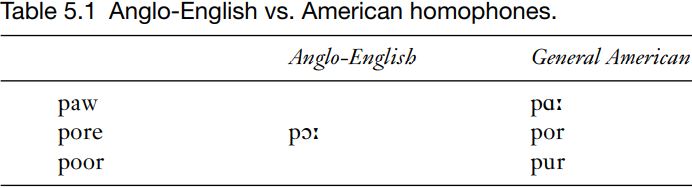
Table 5.2 shows keywords in English orthography, and then gives phonetic values for the vowels of those words, as can be found in ‘Illustrations of the IPA’ (see Further Reading, p. 76). The transcriptions reflect roughly where the vowels lie in the cardinal vowel system. The qualities of vowels are more precisely specified for some of these varieties by plotting them on the vowel quadrilateral.








