0
EN
1
المرجع الالكتروني للمعلوماتية

Grammar

Tenses

Present

Present Simple

Present Continuous

Present Perfect

Present Perfect Continuous

Past

Past Simple

Past Continuous

Past Perfect

Past Perfect Continuous

Future

Future Simple

Future Continuous

Future Perfect

Future Perfect Continuous

Parts Of Speech

Nouns

Countable and uncountable nouns

Verbal nouns

Singular and Plural nouns

Proper nouns

Nouns gender

Nouns definition

Concrete nouns

Abstract nouns

Common nouns

Collective nouns

Definition Of Nouns

Animate and Inanimate nouns

Nouns

Verbs

Stative and dynamic verbs

Finite and nonfinite verbs

To be verbs

Transitive and intransitive verbs

Auxiliary verbs

Modal verbs

Regular and irregular verbs

Action verbs

Verbs

Adverbs

Relative adverbs

Interrogative adverbs

Adverbs of time

Adverbs of place

Adverbs of reason

Adverbs of quantity

Adverbs of manner

Adverbs of frequency

Adverbs of affirmation

Adverbs

Adjectives

Quantitative adjective

Proper adjective

Possessive adjective

Numeral adjective

Interrogative adjective

Distributive adjective

Descriptive adjective

Demonstrative adjective

Pronouns

Subject pronoun

Relative pronoun

Reflexive pronoun

Reciprocal pronoun

Possessive pronoun

Personal pronoun

Interrogative pronoun

Indefinite pronoun

Emphatic pronoun

Distributive pronoun

Demonstrative pronoun

Pronouns

Pre Position

Preposition by function

Time preposition

Reason preposition

Possession preposition

Place preposition

Phrases preposition

Origin preposition

Measure preposition

Direction preposition

Contrast preposition

Agent preposition

Preposition by construction

Simple preposition

Phrase preposition

Double preposition

Compound preposition

prepositions

Conjunctions

Subordinating conjunction

Correlative conjunction

Coordinating conjunction

Conjunctive adverbs

conjunctions

Interjections

Express calling interjection

Phrases

Sentences

Clauses

Part of Speech

Grammar Rules

Passive and Active

Preference

Requests and offers

wishes

Be used to

Some and any

Could have done

Describing people

Giving advices

Possession

Comparative and superlative

Giving Reason

Making Suggestions

Apologizing

Forming questions

Since and for

Directions

Obligation

Adverbials

invitation

Articles

Imaginary condition

Zero conditional

First conditional

Second conditional

Third conditional

Reported speech

Demonstratives

Determiners

Direct and Indirect speech

Linguistics

Phonetics

Phonology

Linguistics fields

Syntax

Morphology

Semantics

pragmatics

History

Writing

Grammar

Phonetics and Phonology

Semiotics

Reading Comprehension

Elementary

Intermediate

Advanced

Teaching Methods

Teaching Strategies

Assessment

قم بتسجيل الدخول اولاً لكي يتسنى لك الاعجاب والتعليق.

Falsetto

المؤلف:  Richard Ogden

المصدر:  An Introduction to English Phonetics

الجزء والصفحة:  52-4

16-6-2022

1130

+

-

20

Falsetto

Falsetto involves the raising of a speaker’s average f0 to way beyond their normal range. To produce falsetto, the vocal folds are stretched and lengthened and the glottis is not completely closed. Falsetto can be used in singing, but also occurs in conversational speech. The IPA has no symbol for marking falsetto.

Here are two cases of falsetto from everyday talk. The first one is part of a complaint from Lesley to her friend Joyce about an acquaintance of theirs, who has offended Lesley. At line 8, she goes into falsetto, probably marking some kind of stance such as ‘outrage’ at the way she has been treated.
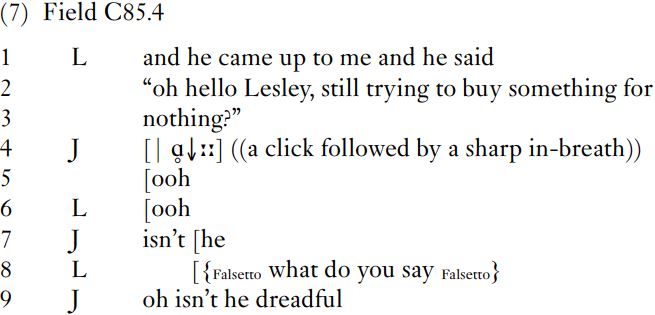
The second example is a woman describing to a friend her feelings towards a man. She compares her earlier stance towards him with her current view of him: she is now much more favorably disposed towards him than she was. She uses the same words to express her stance towards him, but the second time round, she speaks in falsetto, as well as speaking much more slowly and loudly.
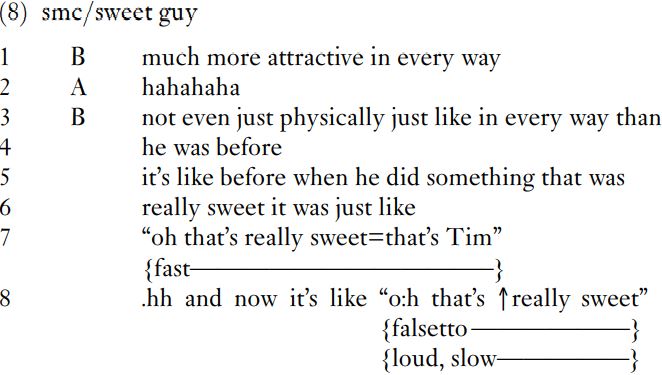
In both of these examples, by moving into falsetto, the speaker is able to use a higher pitch range than her normal one, which means that the difference between the highest and lowest values of the f0 range is expanded. The high pitches the speakers can reach (as high as 673 Hz in the first example and 572 Hz in the second one) may be used to mark out their current talk as conveying something ‘noteworthy’, or something that the other person is expected to comment on. In both these cases, the speakers are involved in presenting a strong stance towards the person they are talking about: in the first case as part of a complaint, and in the second case as part of a positive, upgraded stance as compared to an earlier one. Perhaps falsetto is used to mark an attitude towards the subject matter which is at one extreme or the other – but not neutral.


لا توجد تعليقات بعد

ما رأيك بالمقال : كن أول من يعلق على هذا المحتوى

اخر الاخبار

اشترك بقناتنا على التلجرام ليصلك كل ما هو جديد

