0
EN
1
المرجع الالكتروني للمعلوماتية

Grammar

Tenses

Present

Present Simple

Present Continuous

Present Perfect

Present Perfect Continuous

Past

Past Simple

Past Continuous

Past Perfect

Past Perfect Continuous

Future

Future Simple

Future Continuous

Future Perfect

Future Perfect Continuous

Parts Of Speech

Nouns

Countable and uncountable nouns

Verbal nouns

Singular and Plural nouns

Proper nouns

Nouns gender

Nouns definition

Concrete nouns

Abstract nouns

Common nouns

Collective nouns

Definition Of Nouns

Animate and Inanimate nouns

Nouns

Verbs

Stative and dynamic verbs

Finite and nonfinite verbs

To be verbs

Transitive and intransitive verbs

Auxiliary verbs

Modal verbs

Regular and irregular verbs

Action verbs

Verbs

Adverbs

Relative adverbs

Interrogative adverbs

Adverbs of time

Adverbs of place

Adverbs of reason

Adverbs of quantity

Adverbs of manner

Adverbs of frequency

Adverbs of affirmation

Adverbs

Adjectives

Quantitative adjective

Proper adjective

Possessive adjective

Numeral adjective

Interrogative adjective

Distributive adjective

Descriptive adjective

Demonstrative adjective

Pronouns

Subject pronoun

Relative pronoun

Reflexive pronoun

Reciprocal pronoun

Possessive pronoun

Personal pronoun

Interrogative pronoun

Indefinite pronoun

Emphatic pronoun

Distributive pronoun

Demonstrative pronoun

Pronouns

Pre Position

Preposition by function

Time preposition

Reason preposition

Possession preposition

Place preposition

Phrases preposition

Origin preposition

Measure preposition

Direction preposition

Contrast preposition

Agent preposition

Preposition by construction

Simple preposition

Phrase preposition

Double preposition

Compound preposition

prepositions

Conjunctions

Subordinating conjunction

Correlative conjunction

Coordinating conjunction

Conjunctive adverbs

conjunctions

Interjections

Express calling interjection

Phrases

Sentences

Clauses

Part of Speech

Grammar Rules

Passive and Active

Preference

Requests and offers

wishes

Be used to

Some and any

Could have done

Describing people

Giving advices

Possession

Comparative and superlative

Giving Reason

Making Suggestions

Apologizing

Forming questions

Since and for

Directions

Obligation

Adverbials

invitation

Articles

Imaginary condition

Zero conditional

First conditional

Second conditional

Third conditional

Reported speech

Demonstratives

Determiners

Direct and Indirect speech

Linguistics

Phonetics

Phonology

Linguistics fields

Syntax

Morphology

Semantics

pragmatics

History

Writing

Grammar

Phonetics and Phonology

Semiotics

Reading Comprehension

Elementary

Intermediate

Advanced

Teaching Methods

Teaching Strategies

Assessment

قم بتسجيل الدخول اولاً لكي يتسنى لك الاعجاب والتعليق.

Pitch and fundamental frequency

المؤلف:  Richard Ogden

المصدر:  An Introduction to English Phonetics

الجزء والصفحة:  44-4

15-6-2022

1665

+

-

20

Pitch and fundamental frequency

The pitch of speech is related to the rate of vibration of the vocal folds: grossly speaking, the higher the rate of vocal fold vibration, the higher the pitch. This is not a straightforward relationship because of the way our hearing mechanism works, and as we have seen, the relationship between air pressure, airflow and vocal fold vibration is not quite simple. We use the term ‘pitch’ to refer to a percept rather than a physical event. The rate of vibration of the vocal folds is often called the fundamental frequency, because it is the lowest component frequency of speech. Fundamental frequency is often abbreviated as f0.

The relation between pitch and fundamental frequency is not a linear one, but is more logarithmic in nature. Linear relationships are where an absolute difference of a certain number of units always has the same effect: for example, if the f0 : pitch relation were linear, then the difference between 100 Hz and 200 Hz would sound like the same difference as that between 200 Hz and 300 Hz: a difference of +100 Hz in each case.

For logarithmic relations, the important factor is the proportionality. For example, the difference between 100 Hz and 200 Hz sounds the same as the difference between 200 Hz and 400 Hz, because in each case the second figure is twice the first one: a proportion of 1 : 2. The difference between 200 Hz and 300 Hz is not in the proportion 1 : 2, but 1 : 1.5.

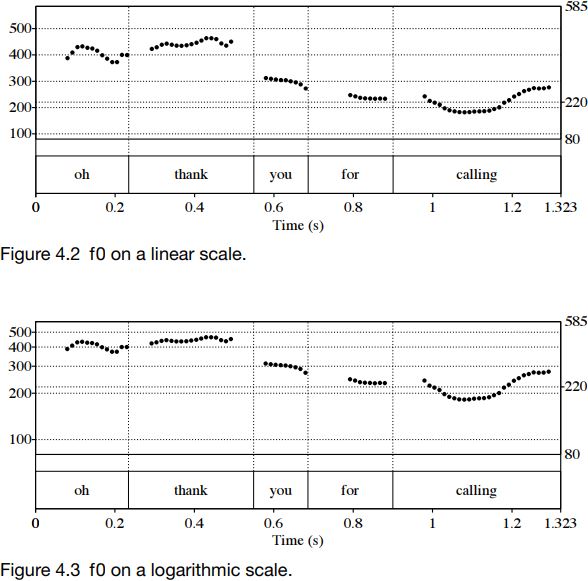
Figures 4.2 and 4.3 show a pitch trace for a production of ‘oh thank you for calling’ by a female speaker. The figures are scaled according to this speaker’s range: her lowest pitch is 80 Hz, and her highest pitch is 585 Hz. Her average pitch is 220, marked on the right. Figure 4.2 shows a linear pitch trace: the steps 200–300–400–500 Hz are equal on the y-axis. The speaker’s average pitch seems rather low in her range on this graph, and certainly lower than half way through her range.

Figure 4.3 shows the same thing on a logarithmic scale. Here, the distance between 100 Hz and 200 Hz is the same as that between 200 Hz and 400 Hz, because the proportion 100 : 200 is the same as 200 : 400, that is 1 : 2 – the second number is twice the value of the first. On this representation, the higher frequencies appear squashed together; and the speaker’s average pitch is more in the centre of the graph. This is closer to what we perceive.
لا توجد تعليقات بعد

ما رأيك بالمقال : كن أول من يعلق على هذا المحتوى

اخر الاخبار

اشترك بقناتنا على التلجرام ليصلك كل ما هو جديد


