0
EN
1
المرجع الالكتروني للمعلوماتية

Grammar

Tenses

Present

Present Simple

Present Continuous

Present Perfect

Present Perfect Continuous

Past

Past Simple

Past Continuous

Past Perfect

Past Perfect Continuous

Future

Future Simple

Future Continuous

Future Perfect

Future Perfect Continuous

Parts Of Speech

Nouns

Countable and uncountable nouns

Verbal nouns

Singular and Plural nouns

Proper nouns

Nouns gender

Nouns definition

Concrete nouns

Abstract nouns

Common nouns

Collective nouns

Definition Of Nouns

Animate and Inanimate nouns

Nouns

Verbs

Stative and dynamic verbs

Finite and nonfinite verbs

To be verbs

Transitive and intransitive verbs

Auxiliary verbs

Modal verbs

Regular and irregular verbs

Action verbs

Verbs

Adverbs

Relative adverbs

Interrogative adverbs

Adverbs of time

Adverbs of place

Adverbs of reason

Adverbs of quantity

Adverbs of manner

Adverbs of frequency

Adverbs of affirmation

Adverbs

Adjectives

Quantitative adjective

Proper adjective

Possessive adjective

Numeral adjective

Interrogative adjective

Distributive adjective

Descriptive adjective

Demonstrative adjective

Pronouns

Subject pronoun

Relative pronoun

Reflexive pronoun

Reciprocal pronoun

Possessive pronoun

Personal pronoun

Interrogative pronoun

Indefinite pronoun

Emphatic pronoun

Distributive pronoun

Demonstrative pronoun

Pronouns

Pre Position

Preposition by function

Time preposition

Reason preposition

Possession preposition

Place preposition

Phrases preposition

Origin preposition

Measure preposition

Direction preposition

Contrast preposition

Agent preposition

Preposition by construction

Simple preposition

Phrase preposition

Double preposition

Compound preposition

prepositions

Conjunctions

Subordinating conjunction

Correlative conjunction

Coordinating conjunction

Conjunctive adverbs

conjunctions

Interjections

Express calling interjection

Phrases

Sentences

Clauses

Part of Speech

Grammar Rules

Passive and Active

Preference

Requests and offers

wishes

Be used to

Some and any

Could have done

Describing people

Giving advices

Possession

Comparative and superlative

Giving Reason

Making Suggestions

Apologizing

Forming questions

Since and for

Directions

Obligation

Adverbials

invitation

Articles

Imaginary condition

Zero conditional

First conditional

Second conditional

Third conditional

Reported speech

Demonstratives

Determiners

Direct and Indirect speech

Linguistics

Phonetics

Phonology

Linguistics fields

Syntax

Morphology

Semantics

pragmatics

History

Writing

Grammar

Phonetics and Phonology

Semiotics

Reading Comprehension

Elementary

Intermediate

Advanced

Teaching Methods

Teaching Strategies

Assessment

قم بتسجيل الدخول اولاً لكي يتسنى لك الاعجاب والتعليق.

The larynx, voicing and voice quality

المؤلف:  Richard Ogden

المصدر:  An Introduction to English Phonetics

الجزء والصفحة:  40-4

14-6-2022

1481

+

-

20

The larynx, voicing and voice quality

Introduction: the production of voicing

We will look at the production of voicing, the construction of the larynx, and the mechanism which gets the vocal folds vibrating. We will then move on to look at ways this vibration can be controlled to produce different pitches and voice qualities.

Good examples of pairs of sounds distinguished by voicing in English are [s f] (voiceless) and [z v] (voiced). Produce a [s] or [f] sound; close your eyes and concentrate on how it feels to produce this sound; and then make a [z] or [v] sound instead. Now produce chains of sounds like [s z s z s …] or [f v f v …] without inserting a pause between them. If you put your fingers in your ears, you will notice a humming or buzzing for [z v] which is not there for [s f]. With the fingers resting very lightly on your larynx, you will notice that [z v] involve a vibration that you do not feel for [s f].

Voicing is produced when the vocal folds vibrate. The vocal folds are located in the larynx (Figure 4.1), which sits just below where your jaw meets your neck. For males, there is a rather prominent notch at the front of the larynx, and it is a couple of centimeters below the jawbone; for females, the larynx is less prominent and may be a bit higher up the neck. If you watch yourself in a mirror, you will probably be able to see your larynx bob down and then up again as you swallow.

The larynx is constructed from three main cartilages: the thyroid, cricoid and arytenoid cartilages. Of these three, the thyroid is the most obvious. It is the largest and is at the front of the larynx, and forms the ‘box’ of the larynx. It consists of two plates which are joined at an angle at the front. Female thyroids are at a wider angle than male thyroids, so the notch where the plates meet is more obvious in males than in females. The thyroid cartilage is attached by muscles to the hyoid bone higher up in the neck.
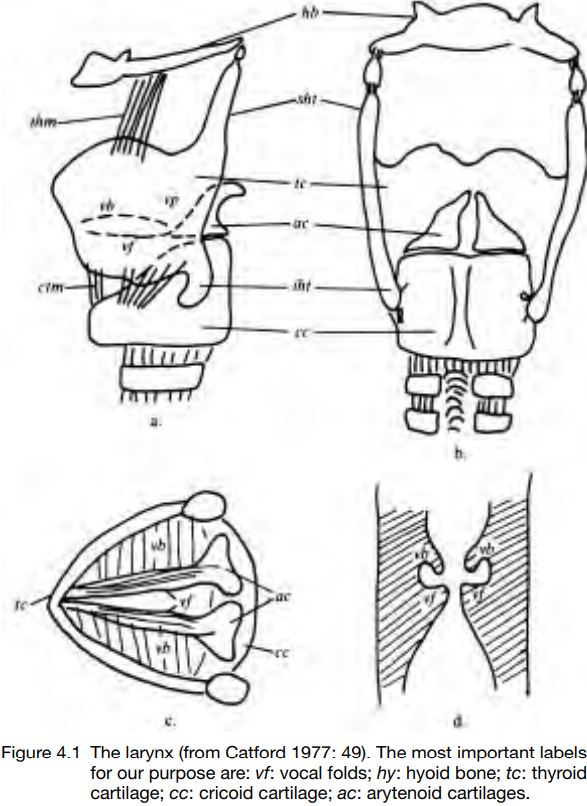
The cricoid cartilage is a sort of ring shape underneath the thyroid. It forms the bottom part of the ‘box’. It has two spurs at the back, one on each side, which reach up to behind the bottom part of the thyroid. The two artytenoid cartilages sit on top of the back of the cricoid cartilage. They can move together and apart, rock backwards and forwards as well as rotate.

The vocal folds are two ligaments (fibrous tissues) which are covered in mucous membrane. They are attached to the arytenoids at the back and the thyroid at the front. At the side, they are attached to muscle in the larynx. In the middle they are free, so that there is a gap or a space between them, known as the glottis. The arytenoids can move, but the thyroid is static; by manipulating the arytenoids, the tension across the vocal folds can be changed, as can their thickness and the way they vibrate.


لا توجد تعليقات بعد

ما رأيك بالمقال : كن أول من يعلق على هذا المحتوى

اخر الاخبار

اشترك بقناتنا على التلجرام ليصلك كل ما هو جديد

