Tonal morphemes
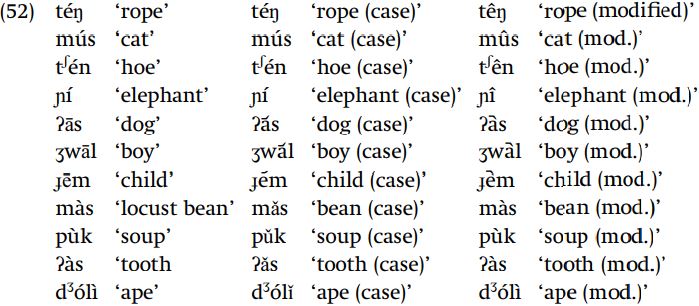
Another example of the kind of dissynchrony between tones and vowels which is explained by the autosegmental model is the tonal morpheme, where a particular morpheme is expressed solely as a tone – this is a variant of the problem of floating tones. One such example is the expression of case marking and the marking of modified nouns in Angas. When a noun is case marked in Angas (when it is at the end of the subject or object NP, for example), case marking is indicated with a suffixed floating H which links to the final vowel, forming a rising tone if the final tone of the noun is M or L. When a noun is followed by an adjective in its phrase, that fact is marked by the suffixation of a floating L tone, which forms a falling contour tone when the last tone is M or H.
Tiv is another language with morphemes being marked by tone, in this case verbal tense-aspect. Verb roots in Tiv lexically have either an H tone or an L tone on the first syllable of the root. The general past tense is marked with a floating L tone; the past habitual with an H; the recent past with the tone sequence HL.
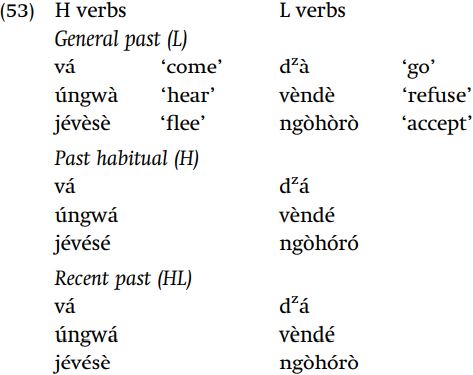
In addition to showing the effects of various floating tone morphemes which mark tense-aspect, these data illustrate the application of a contour-simplification rule. We now consider how representative forms are derived. The concatenation of the L root ngohoro and the recent past morpheme gives the following underlying form:
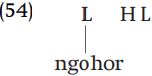
These tones must be assigned to the vowels of the stem: we can see that the first tone links to the first free vowel and the second tone links to the second free vowel. This is an instance of one-to-one left-to-right mapping.

This process is so common that it had been thought that it is actually a universal convention on free tones – we now know, since languages have been discovered which do not obey this condition – that it is a language-specific rule, though a very common one. Application of this rule to (54) gives the surface form.
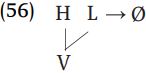
Now consider the disyllabic L root vèndé. This root has two vowels but three tones. If all of the tones were to be associated with the vowels of the root, this would force the final syllable to bear the tone sequence HL, i.e. it would have a falling tone. We can see that there are no contour tones in the data. This leaves us with two possibilities in accounting for vèndé: either the rule associating floating tones with vowels simply does not link a floating tone with a vowel that already has a tone, or floating tones do associate with vowels that already bear an H and then some later rule eliminates tonal contour tones. If we assume that floating tones are all initially associated with a vowel and contours are later eliminated, we will require the following rule, which deletes the L-tone component of a falling tone.
Finally, we come to /dzà/, which has H if one of the floating tone patterns H or HL is added to the root. This can be explained if floating tones are associated with root vowels even when this would result in a contour tone. Linking the melodic tones to this root would result in the following representation:
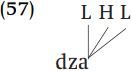
Rule (56) applies in a mirror-image fashion: it deletes L in combination with an H on one vowel, standing before or after the H. This explains why the lexical L is replaced with an H. Under the alternative account, that floating tones only link to vowels which do not have any other tone, we
would be unable to explain why the lexical L is replaced by H when a melodic pattern with an H tone is added.








