Regular language phonology
We begin by motivating aspects of the phonology of the language, especially underlying representations, using regular language data. Verb stems may have different underlying vowels, but the passive is formed by systematically replacing all underlying vowels with /i/. Underlying /i/ deletes in an open syllable, as shown by the following data:
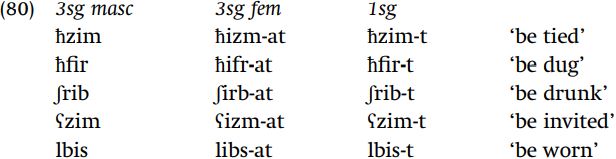
Taking underlying /ħizim/ and /ħizim-t/ as examples, the vowel /i/ in the first syllable is in an open syllable, so the rule of high-vowel deletion applies, giving [ħzim] and [ħzimt]. In the case of /ħizim-at/, both vowels i are in an open syllable: the second i deletes, which makes the first syllable closed, so the first vowel does not delete, resulting in [ħizmat]. The following rule is motivated by (80).

Now we consider another class of nonpassive verbs, where the underlying stem shape is CaCiC. In these stems, the second vowel shows up as i when there is no vowel after the stem. The first vowel of the stem alternates between [i] and [a], surfacing as [i] when the second vowel appears as [i], otherwise surfacing as [a]. Examples of verbs with this vocalic pattern are seen in (82):
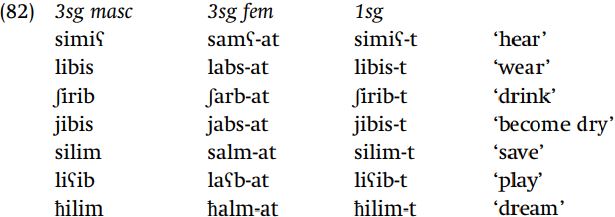
In underlying /samiʕ-at/, the vowel /i/ is in an open syllable so it deletes, giving [samʕat]. In /samiʕ/ and /samiʕ-t/, final /i/ does not delete since it is not in an open syllable, and /a/ assimilates to [i] before [i], by the following harmony rule:

This creates a surface [i] in an open syllable which does not undergo deletion.
Now we turn to stems with the underlying shape /CaCaC/. In a number of such verbs this representation is uncontroversial since that is how it surfaces.
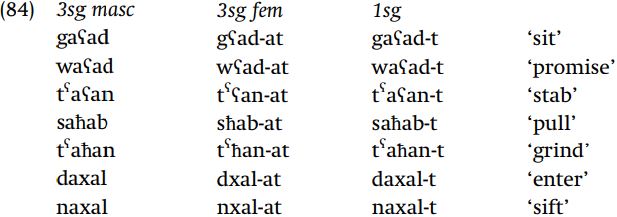
Examples such as [gʕadat] from /gaʕad-at/ illustrate the application of another rule, one deleting /a/ when followed by CVCV.

An important fact about the stems in (84) is that the second consonant is a guttural (x, γ, ħ, h, ʕ or ʔ). There is a dissimilative process in the language turning /a/ into [i] in an open syllable if the next vowel is /a/, providing that the vowel is neither preceded nor followed by a guttural consonant. In the above examples, the consonant in the middle of the stem is a guttural, so neither the first nor the second vowel can undergo the dissimilative raising rule. Now consider the data in (86), where the first consonant is a guttural but the second is not.

This verbal restriction on the consonant next to the target vowel goes beyond what is allowed in the version of the formal theory presented here. How such conditions are to be incorporated into an analysis has been the subject of debate.
Here the first vowel of the stem cannot become [i] because of the preceding consonant, but the second vowel does dissimilate to [i] when followed by /a/, and thus /ʕazam-at/ becomes [ʕzimat] (with deletion of the first vowel by (85)). This rule is separate from the harmony rule that turns /a/ into [i] before [i], because harmony applies irrespective of the flanking consonants, cf. [ħilim] ‘he dreamt.’

In [ʕazam] and [ʕazamt], there is no dissimilation because the first consonant is guttural, which prevents the following /a/ from undergoing dissimilation.
Examples in (88) show the same restriction on dissimilation of the second vowel /a/, which does not become [i] when the last consonant is a guttural.

Another consonantal property inhibiting dissimilation is a coronal sonorant. In this case, if the two vowels are separated by any of /n, r, l/, there is no dissimilation. In the examples of (89), the first vowel is prevented from dissimilating because it is preceded by a guttural. In addition, the second stem vowel is prevented from dissimilating because it is separated from suffixal /a/ by a coronal sonorant. Therefore, both underlying stem vowels remain unchanged.

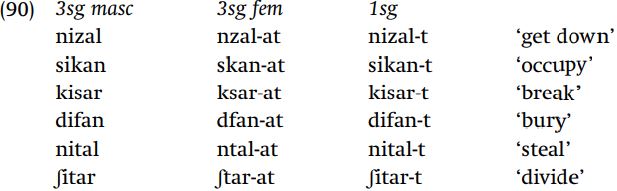
In the examples of (90), the first vowel is followed by a consonant other than a coronal sonorant, and is neither preceded nor followed by a guttural, so it dissimilates to [i]. The second vowel is followed by a coronal sonorant, so there is no dissimilation in the second syllable.
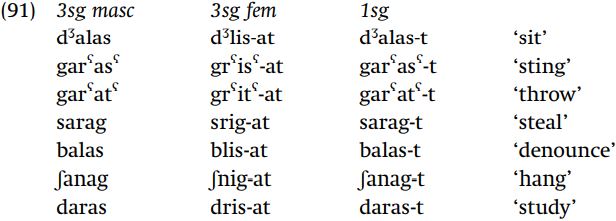
In (91) we find verbs with a coronal sonorant as the second consonant. The second vowel /a/ dissimilates before a, since the intervening consonant is neither guttural nor a coronal sonorant. The preceding coronal sonorant has no effect on dissimilation, since unlike the effect of gutturals, coronal sonorants only have an effect if they stand after the target vowel.
Finally, verbs with no gutturals or coronal sonorants are given in (92).
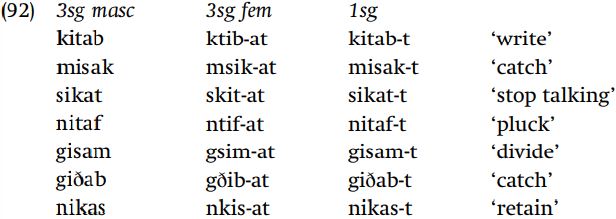
By the deletion rule (85), underlying /katabat/ becomes ktabat, which becomes [ktibat] by dissimilation. In /katab-t/, since the first vowel is not followed by CVCV it cannot elide, and it dissimilates to [i] before [a] in the second syllable.
The vowel /a/ in the second syllable of verbs like [kitab] is only mildly abstract, since it does surface as [a] as long as the syllable is not open. The initial /a/, the syllable on the other hand, is fully abstract since there is no context in this verb where the underlying /a/ appears as such in these verbs, and instead the vowel only appears as [i]. However, we know that the initial vowel cannot be /i/, since if it were, that vowel would delete in an open syllable – contrast active [kitab] and [kitabt] from /katab/ and /katab-t/, with the passives [ktib] and [ktibt] from /kitib/ and /kitib-t/.
The occurrence of initial nondeleting [i] in an open syllable is entirely predictable. It appears when neither the first nor second stem consonant is a guttural, and when the second stem consonant is not a coronal sonorant. This nondeleting [a] is thus in complementary distribution with surface [a] (which nonabstractly derives from underlying /a/), which only appears when one of the first two consonants is a guttural or the second consonant is a coronal sonorant.
Hence there is strong language-internal motivation for claiming that the initial vowel of stems such as [kitab] is underlyingly /a/, and is subject to dissimilation to [i] or deletion.








