0
EN
1
المرجع الالكتروني للمعلوماتية

Grammar

Tenses

Present

Present Simple

Present Continuous

Present Perfect

Present Perfect Continuous

Past

Past Simple

Past Continuous

Past Perfect

Past Perfect Continuous

Future

Future Simple

Future Continuous

Future Perfect

Future Perfect Continuous

Parts Of Speech

Nouns

Countable and uncountable nouns

Verbal nouns

Singular and Plural nouns

Proper nouns

Nouns gender

Nouns definition

Concrete nouns

Abstract nouns

Common nouns

Collective nouns

Definition Of Nouns

Animate and Inanimate nouns

Nouns

Verbs

Stative and dynamic verbs

Finite and nonfinite verbs

To be verbs

Transitive and intransitive verbs

Auxiliary verbs

Modal verbs

Regular and irregular verbs

Action verbs

Verbs

Adverbs

Relative adverbs

Interrogative adverbs

Adverbs of time

Adverbs of place

Adverbs of reason

Adverbs of quantity

Adverbs of manner

Adverbs of frequency

Adverbs of affirmation

Adverbs

Adjectives

Quantitative adjective

Proper adjective

Possessive adjective

Numeral adjective

Interrogative adjective

Distributive adjective

Descriptive adjective

Demonstrative adjective

Pronouns

Subject pronoun

Relative pronoun

Reflexive pronoun

Reciprocal pronoun

Possessive pronoun

Personal pronoun

Interrogative pronoun

Indefinite pronoun

Emphatic pronoun

Distributive pronoun

Demonstrative pronoun

Pronouns

Pre Position

Preposition by function

Time preposition

Reason preposition

Possession preposition

Place preposition

Phrases preposition

Origin preposition

Measure preposition

Direction preposition

Contrast preposition

Agent preposition

Preposition by construction

Simple preposition

Phrase preposition

Double preposition

Compound preposition

prepositions

Conjunctions

Subordinating conjunction

Correlative conjunction

Coordinating conjunction

Conjunctive adverbs

conjunctions

Interjections

Express calling interjection

Phrases

Sentences

Clauses

Part of Speech

Grammar Rules

Passive and Active

Preference

Requests and offers

wishes

Be used to

Some and any

Could have done

Describing people

Giving advices

Possession

Comparative and superlative

Giving Reason

Making Suggestions

Apologizing

Forming questions

Since and for

Directions

Obligation

Adverbials

invitation

Articles

Imaginary condition

Zero conditional

First conditional

Second conditional

Third conditional

Reported speech

Demonstratives

Determiners

Direct and Indirect speech

Linguistics

Phonetics

Phonology

Linguistics fields

Syntax

Morphology

Semantics

pragmatics

History

Writing

Grammar

Phonetics and Phonology

Semiotics

Reading Comprehension

Elementary

Intermediate

Advanced

Teaching Methods

Teaching Strategies

Assessment

قم بتسجيل الدخول اولاً لكي يتسنى لك الاعجاب والتعليق.

Examples for discussion

المؤلف:  David Odden

المصدر:  Introducing Phonology

الجزء والصفحة:  135-5

31-3-2022

1816

+

-

20

Examples for discussion

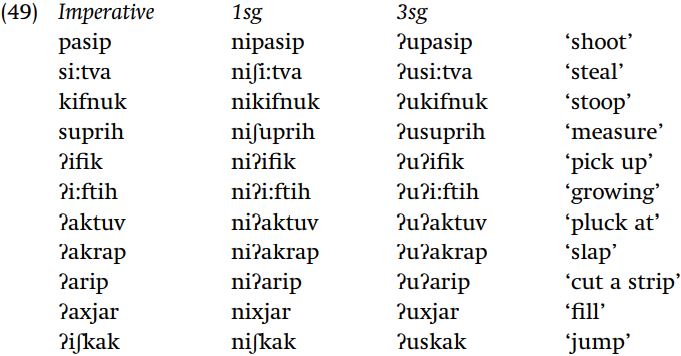
Karok. These data from Karok (California) illustrate three interacting phonological processes. Comment on the underlying forms of the following words, state what phonological rules are motivated, and discuss the order in which these processes apply.

Shona. Often, a seemingly complex problem can be significantly simplified by breaking the problem up into a few interacting processes. If you look at the phonetic realizations of the passive suffix in Shona (Zimbabwe), you see that there are seven different manifestations of this suffix. However, this considerable range of variation can be explained in terms of a much smaller set of very general phonological rules, whose interaction results in many surface realizations of the suffix.
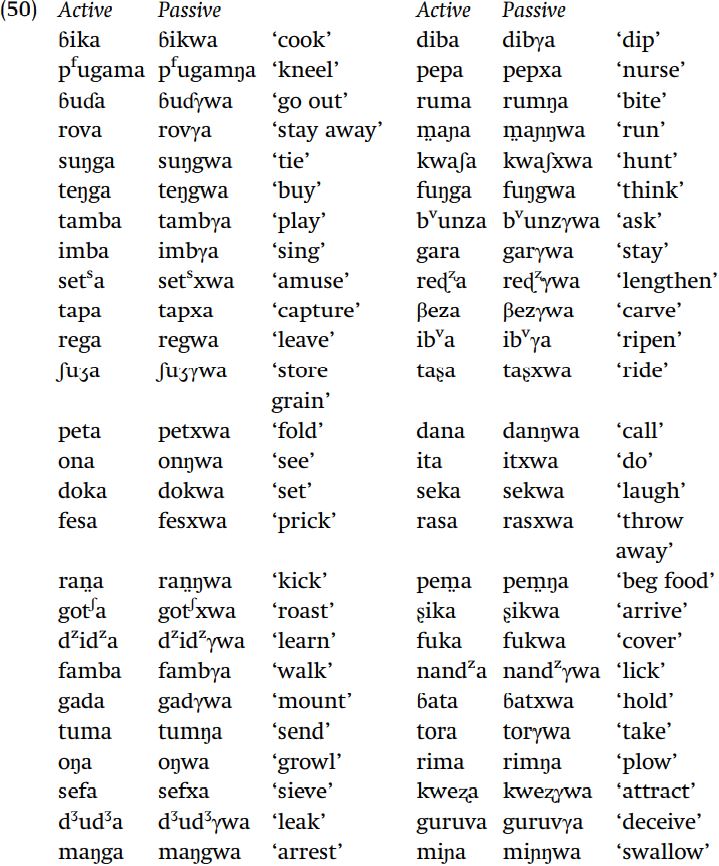
The precise rules which you postulate will depend on what you assume to be the underlying form of the passive suffix, since there are two plausible underlying forms for the suffix, based on the data above. The phonological alternations seen in the following examples are relevant to deciding what the underlying form of the passive suffix is (and therefore exactly how these phonological alternations are to be analyzed). These inflected forms involve a prefix marking the subject, followed by one of various tense markers such as -t ʃ a-, -no-, and -a-, or no marker, finally followed by the verb stem.
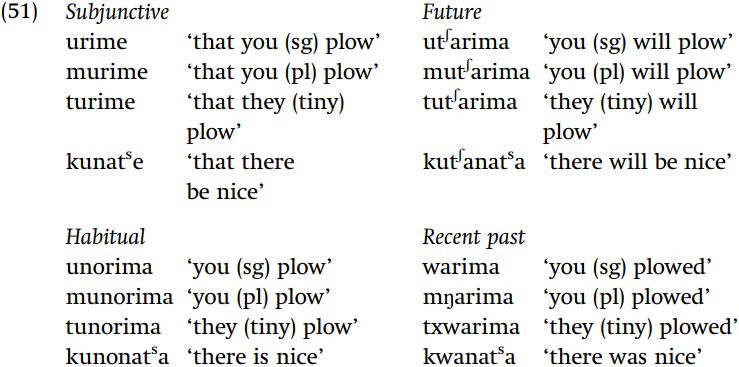
A further fact which is relevant to deciding on the correct analysis is that [γ], [x] do not appear after vowels or at the beginning of a word.

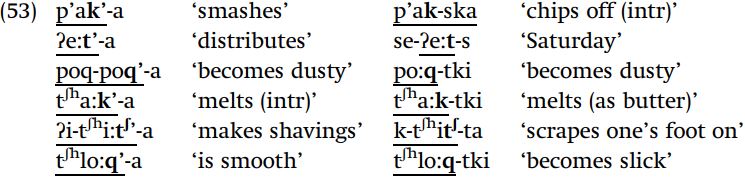
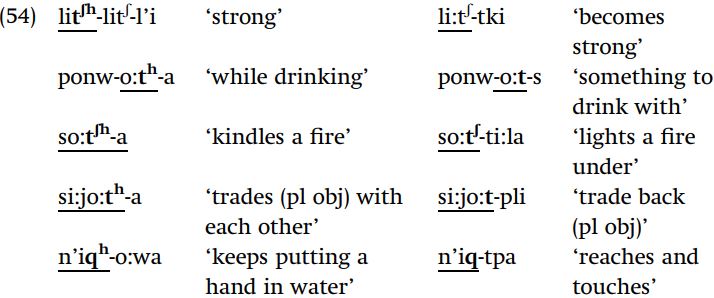
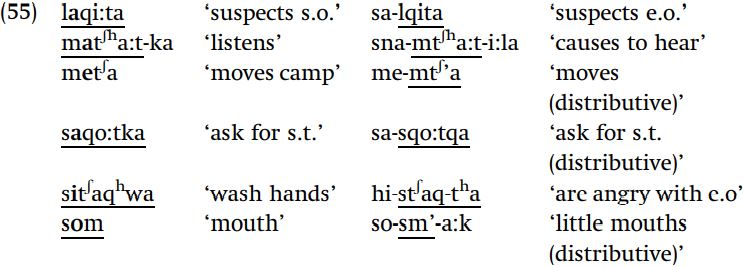
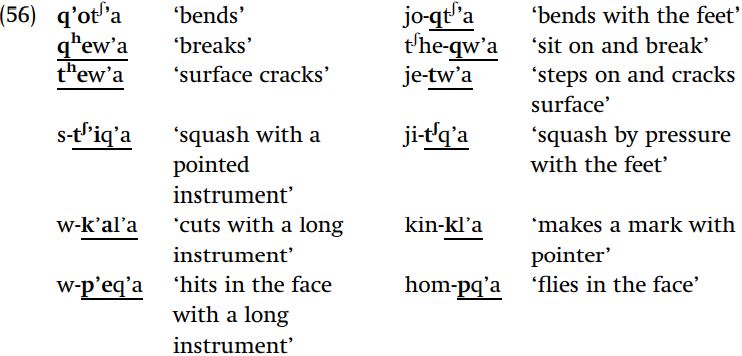
Klamath. The data in (52)–(56) from Klamath (Oregon) illustrate two processes. The first deaspirates and deglottalizes consonants before obstruents, before glottalized and voiceless resonants, as well as in word-final positions. The examples in (52) illustrate plain voiceless obstruents, which do not undergo any phonetic alternations. The data below involve a range of inflectionally and derivationally related word forms: the common root is underlined (the last form in this set also illustrates an alternation between i and j’, which is not crucial).
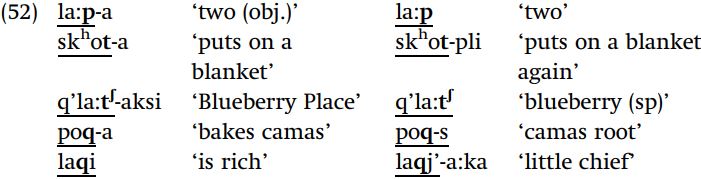
The data in (53) provide examples of underlyingly glottalized obstruents, which become plain voiceless consonants unless they are followed by a vowel or plain sonorant.

Data in (53) show that aspirated consonants deaspirate in this same context.
The second process, syncope, deletes a short vowel from the first syllable of a stem when preceded by a CV prefix and followed by CV.
What do these examples show about the interaction of these two processes?
لا توجد تعليقات بعد

ما رأيك بالمقال : كن أول من يعلق على هذا المحتوى

اخر الاخبار

اشترك بقناتنا على التلجرام ليصلك كل ما هو جديد


