0
EN
1
المرجع الالكتروني للمعلوماتية

Grammar

Tenses

Present

Present Simple

Present Continuous

Present Perfect

Present Perfect Continuous

Past

Past Simple

Past Continuous

Past Perfect

Past Perfect Continuous

Future

Future Simple

Future Continuous

Future Perfect

Future Perfect Continuous

Parts Of Speech

Nouns

Countable and uncountable nouns

Verbal nouns

Singular and Plural nouns

Proper nouns

Nouns gender

Nouns definition

Concrete nouns

Abstract nouns

Common nouns

Collective nouns

Definition Of Nouns

Animate and Inanimate nouns

Nouns

Verbs

Stative and dynamic verbs

Finite and nonfinite verbs

To be verbs

Transitive and intransitive verbs

Auxiliary verbs

Modal verbs

Regular and irregular verbs

Action verbs

Verbs

Adverbs

Relative adverbs

Interrogative adverbs

Adverbs of time

Adverbs of place

Adverbs of reason

Adverbs of quantity

Adverbs of manner

Adverbs of frequency

Adverbs of affirmation

Adverbs

Adjectives

Quantitative adjective

Proper adjective

Possessive adjective

Numeral adjective

Interrogative adjective

Distributive adjective

Descriptive adjective

Demonstrative adjective

Pronouns

Subject pronoun

Relative pronoun

Reflexive pronoun

Reciprocal pronoun

Possessive pronoun

Personal pronoun

Interrogative pronoun

Indefinite pronoun

Emphatic pronoun

Distributive pronoun

Demonstrative pronoun

Pronouns

Pre Position

Preposition by function

Time preposition

Reason preposition

Possession preposition

Place preposition

Phrases preposition

Origin preposition

Measure preposition

Direction preposition

Contrast preposition

Agent preposition

Preposition by construction

Simple preposition

Phrase preposition

Double preposition

Compound preposition

prepositions

Conjunctions

Subordinating conjunction

Correlative conjunction

Coordinating conjunction

Conjunctive adverbs

conjunctions

Interjections

Express calling interjection

Phrases

Sentences

Clauses

Part of Speech

Grammar Rules

Passive and Active

Preference

Requests and offers

wishes

Be used to

Some and any

Could have done

Describing people

Giving advices

Possession

Comparative and superlative

Giving Reason

Making Suggestions

Apologizing

Forming questions

Since and for

Directions

Obligation

Adverbials

invitation

Articles

Imaginary condition

Zero conditional

First conditional

Second conditional

Third conditional

Reported speech

Demonstratives

Determiners

Direct and Indirect speech

Linguistics

Phonetics

Phonology

Linguistics fields

Syntax

Morphology

Semantics

pragmatics

History

Writing

Grammar

Phonetics and Phonology

Semiotics

Reading Comprehension

Elementary

Intermediate

Advanced

Teaching Methods

Teaching Strategies

Assessment

قم بتسجيل الدخول اولاً لكي يتسنى لك الاعجاب والتعليق.

Manner of articulation

المؤلف:  David Odden

المصدر:  Introducing Phonology

الجزء والصفحة:  55-3

25-3-2022

1465

+

-

20

Manner of articulation

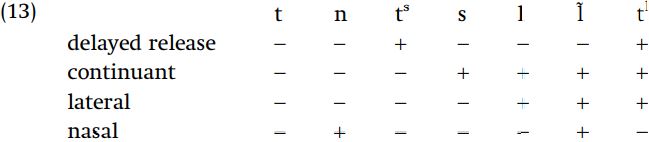
Other features relate to the manner in which a segment is produced, apart from the location of the segment’s constriction. The manner features are:

continuant (cont): the primary constriction is not narrowed so much that airflow through the oral cavity is blocked.

delayed release (del.rel): release of a total constriction is slowed so that a fricative is formed after the stop portion.

nasal (nas): the velum is lowered which allows air to escape through the nose.

lateral (lat): the mid section of the tongue is lowered at the side.

The feature [continuant] groups together vowels, glides, fricatives, and [h] as [+continuant]. Note that [continuant] is a broader group than the traditional notion “fricative” which refers to segments such as [s], [ ʃ], or [θ].

The term “fricative” generally refers to nonsonorant continuants, i.e. the class defined by the conjunction of features [+continuant, -sonorant]. Since continuants are defined as sounds where air can flow continuously through the oral cavity, nasals like [m n ŋ] are [-continuant], even though they allow continuous airflow (through the nose).

Affricates such as [tʃ , pf ] are characterized with the feature [+delayed release]. Necessarily, all affricates are [-continuant], since they involve complete constriction followed by a period of partial fricative-like constriction, and therefore they behave essentially as a kind of stop. This feature is in question, since [pf t ʃ kx ] do not act as a unified phonological class; nevertheless, some feature is needed to characterize stops versus affricates. Various alternatives have been proposed, for example that [kx ] might just be the pronunciation of aspirated [kh ] since velar [kx ] and [kh ] never seem to contrast; perhaps the feature [strident] defines [ts ] vs. [t]. The proper representation of affricates is a currently unresolved issue in phonology.

The feature [+nasal] is assigned to sounds where air flows through the nasal passages, for example [n] as well as nasalized vowels like [ã]. Liquids and fricatives can be nasalized as well, but the latter especially are quite rare. L-like sounds are characterized with the feature [lateral]. Almost all [+lateral] sounds are coronal, though there are a few reports of velar laterals. Detailed information on the phonetics and phonology of these segments is not available.

Examples of the major manners of articulation are illustrated below, for coronal place of articulation.
لا توجد تعليقات بعد

ما رأيك بالمقال : كن أول من يعلق على هذا المحتوى

اخر الاخبار

اشترك بقناتنا على التلجرام ليصلك كل ما هو جديد


