The phonetic characteristics of stress
Native speakers of English are intuitively aware that certain syllables in each word, and one syllable in particular, will be more phonetically prominent than others. In father, the first syllable seems stronger than the second; in about, it is the other way around; and in syllable, the first syllable stands out from the rest. These more prominent syllables are stressed; and stress is a culminative property, signaled by a number of subsidiary phonetic factors, which work together to pick out a stressed syllable from the unstressed ones which surround it. There are three important factors which combine to signal stress. First, the vowels of stressed syllables are produced with higher fundamental frequency; that is, the vocal folds vibrate more quickly, and this is heard as higher pitch. Secondly, the duration of stressed syllables is greater, and they are perceived as longer. Thirdly, stressed syllables are produced with greater intensity, and are thus heard as louder than adjacent unstressed syllables. In addition, stress has effects on vowel quality, in that vowels often reduce to schwa under low stress. To take our earlier examples of father, about, and syllable, the stressed syllables have the full vowels [ɑ:], [aυ] and [I] respectively, but the unstressed ones typically have schwa; we do not say , for instance, but
The interaction of these phonetic factors produces an effect which is clearly audible, but crucially relative: that is, we cannot distinguish a stressed from an unstressed syllable if each is spoken in isolation, but only by comparing the syllables of a word, or a longer string, to see which are picked out as more prominent. Indeed, within the word, there can be more than one level of stress. Some words have only stressed versus unstressed syllables, as in father, about and syllable. However, in entertainment, the first and the third syllables bear some degree of stress. Both have full vowels [ε] and [eI], as opposed to the unstressed second and fourth syllables with schwa; but the third syllable is more stressed than the first. Phonologists distinguish primary stress (the main stress in the word, on the third syllable of entertainment) from secondary stress (a lesser degree of stress elsewhere, here initially). Special IPA diacritic marks are placed at the beginning of the relevant syllable to show primary and secondary stress, as in entertainment  , about
 , and father
 . The difference between secondary stress and no stress is clear in a pair like raider
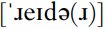 , where the second syllable is unstressed and has schwa, versus radar
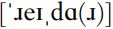 , where both syllables have full vowels and some degree of stress, although in both words the first syllable is more stressed than the second.








