0
EN
1
المرجع الالكتروني للمعلوماتية

Grammar

Tenses

Present

Present Simple

Present Continuous

Present Perfect

Present Perfect Continuous

Past

Past Simple

Past Continuous

Past Perfect

Past Perfect Continuous

Future

Future Simple

Future Continuous

Future Perfect

Future Perfect Continuous

Parts Of Speech

Nouns

Countable and uncountable nouns

Verbal nouns

Singular and Plural nouns

Proper nouns

Nouns gender

Nouns definition

Concrete nouns

Abstract nouns

Common nouns

Collective nouns

Definition Of Nouns

Animate and Inanimate nouns

Nouns

Verbs

Stative and dynamic verbs

Finite and nonfinite verbs

To be verbs

Transitive and intransitive verbs

Auxiliary verbs

Modal verbs

Regular and irregular verbs

Action verbs

Verbs

Adverbs

Relative adverbs

Interrogative adverbs

Adverbs of time

Adverbs of place

Adverbs of reason

Adverbs of quantity

Adverbs of manner

Adverbs of frequency

Adverbs of affirmation

Adverbs

Adjectives

Quantitative adjective

Proper adjective

Possessive adjective

Numeral adjective

Interrogative adjective

Distributive adjective

Descriptive adjective

Demonstrative adjective

Pronouns

Subject pronoun

Relative pronoun

Reflexive pronoun

Reciprocal pronoun

Possessive pronoun

Personal pronoun

Interrogative pronoun

Indefinite pronoun

Emphatic pronoun

Distributive pronoun

Demonstrative pronoun

Pronouns

Pre Position

Preposition by function

Time preposition

Reason preposition

Possession preposition

Place preposition

Phrases preposition

Origin preposition

Measure preposition

Direction preposition

Contrast preposition

Agent preposition

Preposition by construction

Simple preposition

Phrase preposition

Double preposition

Compound preposition

prepositions

Conjunctions

Subordinating conjunction

Correlative conjunction

Coordinating conjunction

Conjunctive adverbs

conjunctions

Interjections

Express calling interjection

Phrases

Sentences

Clauses

Part of Speech

Grammar Rules

Passive and Active

Preference

Requests and offers

wishes

Be used to

Some and any

Could have done

Describing people

Giving advices

Possession

Comparative and superlative

Giving Reason

Making Suggestions

Apologizing

Forming questions

Since and for

Directions

Obligation

Adverbials

invitation

Articles

Imaginary condition

Zero conditional

First conditional

Second conditional

Third conditional

Reported speech

Demonstratives

Determiners

Direct and Indirect speech

Linguistics

Phonetics

Phonology

Linguistics fields

Syntax

Morphology

Semantics

pragmatics

History

Writing

Grammar

Phonetics and Phonology

Semiotics

Reading Comprehension

Elementary

Intermediate

Advanced

Teaching Methods

Teaching Strategies

Assessment

قم بتسجيل الدخول اولاً لكي يتسنى لك الاعجاب والتعليق.

Utterances and sentences

المؤلف:  Patrick Griffiths

المصدر:  An Introduction to English Semantics And Pragmatics

الجزء والصفحة:  4-1

9-2-2022

1696

+

-

20

Pragmatics distinguished from semantics

Utterances and sentences

In our immediate experience as language users, the things that have meaning are utterances, and (1.2) presents three examples.
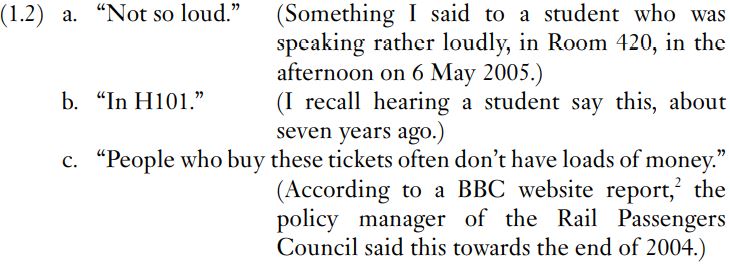
Utterances are the raw data of linguistics. Each utterance is unique, having been produced by a particular sender in a specific situation.

(Though it may seem a bit strange, I will use the term utterance to cover not only spoken utterances but also individual stretches of written language up to sentence-size, done by a particular person at a particular time.) Because they are tied to a sender and a time, utterances can never be repeated. When early in the morning on 6 May 2005 I said, in our apartment, “Not so loud”, because I was worried that the noise of our TV might bother the neighbors, that was a different utterance from (1.2a). Even when someone is held to have said (or written) “the same thing twice”, as in the case of people who “repeat themselves” (or someone who repeats what someone else has uttered), there is going to be more than one utterance constituting the repetition – differing in time, or having been made by a different speaker. No-one keeps a record of every utterance, but in principle they are all distinguishable
The abstract linguistic object on which an utterance is based is a sentence. My recollection is that the utterance “In H101” mentioned in (1.2b) was based on the sentence The class will be in Room H101, because it was said in response to me asking “Where’s the class going to be?” We talk of repetition when two or more utterances are based on the same sentence.

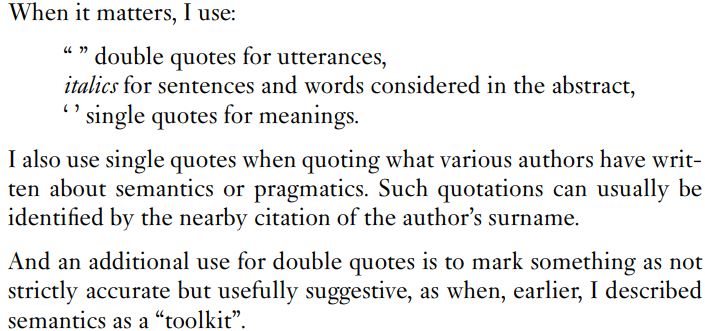
Utterances are interpreted in context. The context of (1.2c) indicated clearly that often was to be understood as modifying what followed it, to mean ‘… are often not rich’, rather being a modifier of what came before: ‘People who buy these tickets often …’. I read about (1.2c) in a report on the internet. If I had heard the utterance, it is likely that the speaker’s delivery would have signaled which of the two meanings was intended. For the ‘frequent purchaser’ meaning, there would probably have been an intonational break straight after often, one that the report writer could have marked with a comma. Without such a break, either interpretation would be possible, but the absence of a break could be taken as a pointer towards the ‘often not well off ’ interpretation. Nonetheless, intonation does not obviate the need to consider context: we tend to use context to check that we have heard the intonation correctly, and to treat intonation as a clue regarding which contextual information to use.


لا توجد تعليقات بعد

ما رأيك بالمقال : كن أول من يعلق على هذا المحتوى

اخر الاخبار

اشترك بقناتنا على التلجرام ليصلك كل ما هو جديد

