Government
Consider now the examples in (5).
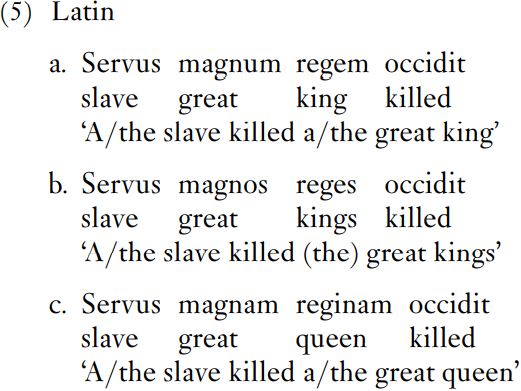
Regem in (5a) is the direct object of occidit and has the suffix -em. The adjective has the suffix -um. In (5b) reges is the direct object of occidit, is plural and has the suffix -es. The adjective has the suffix -os. In (5c), reginam is the direct object of occidit, is singular and has the suffix -am. The adjective has the same suffix. Regem, reginam and reges are said to be in the accusative case. Note that reges, with the same suffix -es, is subject in (2a) and direct object in (5b), but that the adjective has different suffixes.
Occidit is a verb that requires an object in what is called the accusative case. In the examples in (5), occidit, in the traditional formula, governs its object noun in the accusative case; that is, it assigns accusative case to the stems reg- (king) and regin- (queen). Independently of the verb, these nouns are singular in (5a) and (5c) and plural in (5b). The combination of accusative and singular requires the choice of the suffixes -em or -am depending on the stem, and the choice of accusative and plural requires -es for the stem reg-. The properties ‘accusative’ and ‘singular’ or ‘accusative and plural’ are passed on to the adjective in the direct object noun phrase, magn-, and the appropriate suffix is chosen.
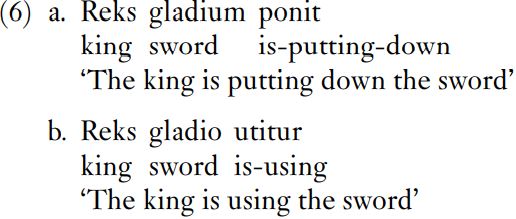
The majority of verbs in Latin assign accusative case to their object noun, but many verbs assign one or other of the remaining three cases. For example, the verb utor (I use) governs its object noun in the ablative case, as shown in (6).
For verb and object noun too, a similar pattern occurs in Old English, as demonstrated in (7).
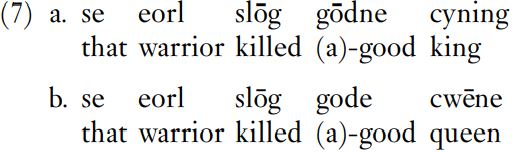
In (7b), the object noun cwe¯ne, with the suffix -e, is modified by the adjective go¯de, with the suffix -e. This contrasts with the subject noun cwe¯n in (3b) with no suffix and modified by the adjective go¯du, with the suffix -u. In (7a), the noun cyning has no suffix but the adjective does have a special suffix, namely -ne as in go¯dne. There is no contrast in the suffixes added to subject and object plural nouns.
The patterns of suffixes are summed up by saying that slo¯g requires its object noun to be in the accusative case. Other verbs require their noun to be in a different case; andwyrdan ‘answer’, for instance, requires its object noun to take dative suffixes, as shown in (8).

Cyninge in (8) has the dative case suffix -e and go¯dum has the dative suffix -um. The verb bı¯dan ‘wait for’ requires its object noun to take a genitive suffix, as in (9).

In (9), cyninges has the genitive suffix -es and the adjective go¯des has the same suffix.
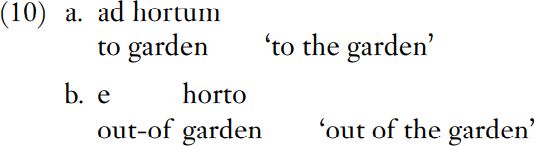
Prepositions in Latin also assign case to their complement nouns. Ad (to) governs nouns in the accusative case, and de (from) governs nouns in the ablative case.
The nominative case was thought of as the case that was used when speakers were using nouns to name entities. The theory was, and indeed still is, that speakers pick out and name an entity and then say something about it. ‘Accusative’ looks as though it should have something to do with accusing; this does not make much sense but results from a mistranslation into Latin of a Greek term meaning ‘what is effected or brought about’. It seems that the central examples of accusative case were taken to be the Classical Greek equivalents of ‘She built a house’.
‘Ablative’ derives from a Latin word meaning ‘taking away’ and occurs with prepositions expressing movement from or off something, as in (10b).
The above Latin examples show that different case-number suffixes are added to nouns and adjectives and that which suffix is chosen in a particular clause depends on the noun. Latin nouns fall into a number of different classes, known as genders.
Prepositions in Old English also require their complement nouns to have particular case suffixes. For example, to¯ ‘to’ governs its complement noun in the dative case (like most prepositions), but †urh ‘by means of ’ governs its complement noun in the accusative case. The distinction is exemplified in (11).
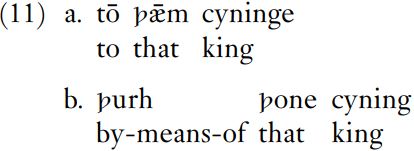
In (11a), †æ¯m is the dative form of se ‘that’ and cyninge has the dative suffix -e. In (11b), †one is the accusative form of se but cyning has no suffix.








