Classes of nouns
Selectional restrictions, as hinted above, lead us to employ large subclasses of nouns that are familiar from traditional grammar. The subclasses are set out in 13.
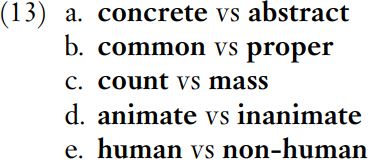
These subclasses were established in traditional grammar not just for the analysis of English but for the analysis of all the languages of Europe. They have been extended to the analysis of languages all over the world – many languages outside Europe have particularly intricate sets of distinctions. We have brought in these subclasses in connection with selectional restrictions, which are closely connected with semantics. A very important point, however, is that the distinctions set out in (13) are relevant to the grammar of many languages. We are not suggesting that all the distinctions are relevant to the grammar of every language, but any sample of languages from different language families and different areas of the world will show that each distinction affects the grammar of some languages. For example, English proper nouns such as Ethel typically exclude the and a, using the examples reproduced below as (14). Common nouns, which are not the names of people, towns and so on, typically allow or require the or a, for example lecturer in (14b), gritter and salt in (15a).
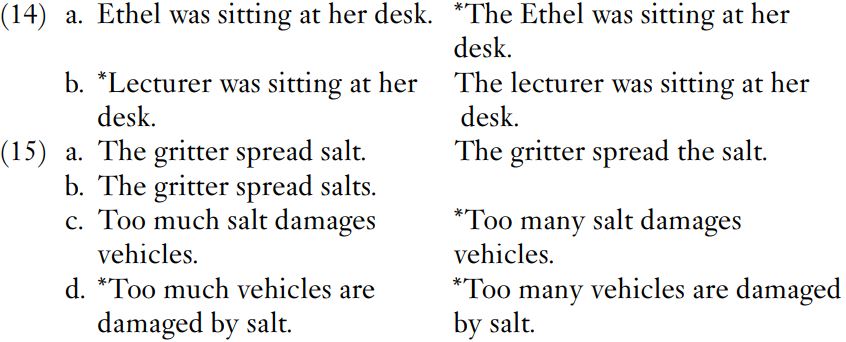 The distinction between common and proper nouns does have a semantic component; proper nouns are the names of people, places, organizations and institutions. The distinction is also very important for the grammar of English noun phrases; proper nouns such as Ethel in (14a) exclude the, and singular common nouns such as lecturer in (14b) require the. (The plural does not – Lecturers all wear food-stained pullovers and sandals is impeccable in its grammar even if not in its content.)
The distinction between count and mass nouns is involved in important grammatical choices but likewise has a meaning component. With respect to grammar, mass nouns require much, as in (15c), and exclude many; count nouns require many and exclude much. With respect to meaning, count nouns refer to entities that are thought of as individuals, that can be counted – boy, plant, idea. Mass nouns denote entities that are conceived of as a mass of stuff that cannot be split into countable individuals – water, flour, wine, salt. Mass nouns typically occur in the singular; when they occur in the plural, they change their meaning. Wines has the interpretation ‘kinds of wine’
In other languages, the distinctions between the subclasses of nouns are relevant for the assignment of case, for example. This is demonstrated by the two Russian examples in (16).
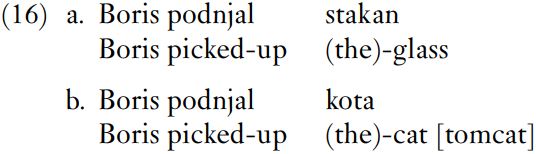
Stakan in (16a) is inanimate and has no case suffix. Kot is animate and takes the case suffix -a. Other patterns in the Russian case system involve the distinction between concrete and abstract and between count and mass, but we omit the details.
We close this section with a comment on the terms ‘concrete’ and ‘abstract’. Lecturer and wine are examples of concrete nouns, while truth and amazement are abstract nouns. We are using the traditional labels, but the key distinction is whether a given noun denotes an entity that is abstract or not abstract. The difficulty is that ‘concrete’ evokes an entity made of the substance called ‘concrete’, or at least an entity that is hard and solid. Lecturers are not made of the substance we call ‘concrete’ and wine is not solid, but neither wine nor lecturers are abstract. They can be physically seen, touched and manipulated, whereas truth and amazement canon.








