Classes of verbs and subcategorization restrictions
Some of these classes of verbs have traditional labels as listed in (6). These labels are convenient for talking about classes of verbs rather than individual verbs.
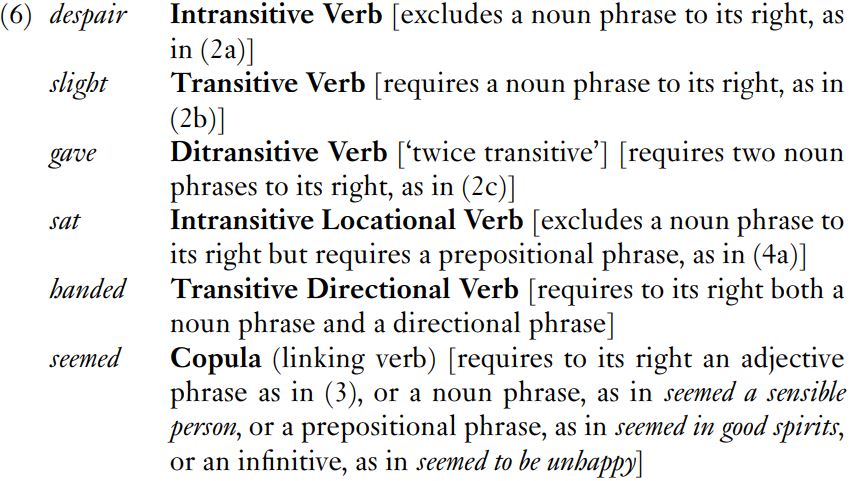 To sum up, a given lexical item controls ‘lexical insertion’, the inserting of lexical items into its complements. Another approach that has been advocated more recently is to have no separate set of rules that specify syntactic structure but to have that work carried out by lexical entries. The entry for seem can be thought of as a set of instructions to build a syntactic structure containing a noun phrase, a verb and, for example, an adjective phrase. The entry for hand can be thought of as a set of instructions to build a syntactic structure containing a noun phrase, a verb, a noun phrase and a directional prepositional phrase, and so on for the other types of verb.
As well as controlling the number and general type of complements, lexical verbs control the choice of preposition. For example, blame occurs in the constructions in (7).

Depending on which way the event is presented, blame requires for or on; no other prepositions are possible. Similarly, accuse requires the preposition of, as in Eleanor accused Willoughby of unprincipled behavior.
The constraints that lexical verbs place on number and type of constituents, choice of preposition and choice of case are known as subcategorization. We are dealing with the class or category of verbs, but the different constructions required by different verbs allow us to set up subclasses or subcategories of verb. Hence the term ‘subcategorization’. This discussion has not exhausted the topic of subcategorization; in particular.








