0
EN
1
المرجع الالكتروني للمعلوماتية

Grammar

Tenses

Present

Present Simple

Present Continuous

Present Perfect

Present Perfect Continuous

Past

Past Simple

Past Continuous

Past Perfect

Past Perfect Continuous

Future

Future Simple

Future Continuous

Future Perfect

Future Perfect Continuous

Parts Of Speech

Nouns

Countable and uncountable nouns

Verbal nouns

Singular and Plural nouns

Proper nouns

Nouns gender

Nouns definition

Concrete nouns

Abstract nouns

Common nouns

Collective nouns

Definition Of Nouns

Animate and Inanimate nouns

Nouns

Verbs

Stative and dynamic verbs

Finite and nonfinite verbs

To be verbs

Transitive and intransitive verbs

Auxiliary verbs

Modal verbs

Regular and irregular verbs

Action verbs

Verbs

Adverbs

Relative adverbs

Interrogative adverbs

Adverbs of time

Adverbs of place

Adverbs of reason

Adverbs of quantity

Adverbs of manner

Adverbs of frequency

Adverbs of affirmation

Adverbs

Adjectives

Quantitative adjective

Proper adjective

Possessive adjective

Numeral adjective

Interrogative adjective

Distributive adjective

Descriptive adjective

Demonstrative adjective

Pronouns

Subject pronoun

Relative pronoun

Reflexive pronoun

Reciprocal pronoun

Possessive pronoun

Personal pronoun

Interrogative pronoun

Indefinite pronoun

Emphatic pronoun

Distributive pronoun

Demonstrative pronoun

Pronouns

Pre Position

Preposition by function

Time preposition

Reason preposition

Possession preposition

Place preposition

Phrases preposition

Origin preposition

Measure preposition

Direction preposition

Contrast preposition

Agent preposition

Preposition by construction

Simple preposition

Phrase preposition

Double preposition

Compound preposition

prepositions

Conjunctions

Subordinating conjunction

Correlative conjunction

Coordinating conjunction

Conjunctive adverbs

conjunctions

Interjections

Express calling interjection

Phrases

Sentences

Clauses

Part of Speech

Grammar Rules

Passive and Active

Preference

Requests and offers

wishes

Be used to

Some and any

Could have done

Describing people

Giving advices

Possession

Comparative and superlative

Giving Reason

Making Suggestions

Apologizing

Forming questions

Since and for

Directions

Obligation

Adverbials

invitation

Articles

Imaginary condition

Zero conditional

First conditional

Second conditional

Third conditional

Reported speech

Demonstratives

Determiners

Direct and Indirect speech

Linguistics

Phonetics

Phonology

Linguistics fields

Syntax

Morphology

Semantics

pragmatics

History

Writing

Grammar

Phonetics and Phonology

Semiotics

Reading Comprehension

Elementary

Intermediate

Advanced

Teaching Methods

Teaching Strategies

Assessment

قم بتسجيل الدخول اولاً لكي يتسنى لك الاعجاب والتعليق.

Latin (Indo-European)

المؤلف:  Rochelle Lieber

المصدر:  Introducing Morphology

الجزء والصفحة:  127-7

24-1-2022

1981

+

-

20

Latin (Indo-European)

Like Turkish, and unlike Mandarin and Samoan, Latin is a heavily inflected language. And like Turkish, its inflections are almost entirely suffixal.4 However, its inflection looks rather different from Turkish inflection in that often several meanings are combined into a single inflectional morpheme in Latin. Its toolbag is somewhat larger for derivation than for inflection, with some prefixation and compounding in addition to suffixation. Indeed, you will probably recognize elements of Latin derivational morphology, as many of them have been borrowed into English. We will look at inflection first, then derivation.

Latin nouns are inflected for case, number, and gender, and adjectives are inflected to agree with them. (27) shows the paradigm for the feminine noun puella ‘girl’, and (28) a noun phrase with an agreeing adjective:
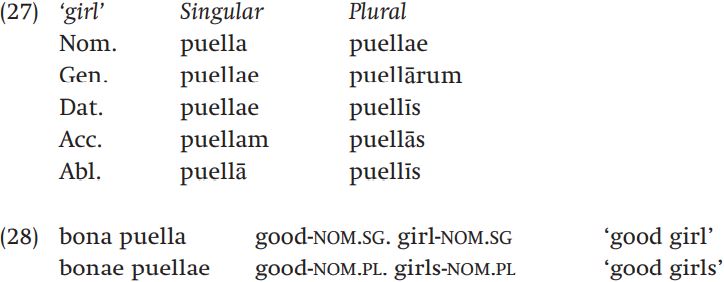
Each inflection carries a combination of meanings that includes case, number, and gender. For example, the morpheme -ārum is used in the genitive plural, and in addition, signals that this noun belongs to the first Latin declension, almost all of whose members are feminine in gender.

Verbs have a number of different stems which form the basis of inflectional paradigms that show aspect (imperfect vs. perfect) and voice (active vs. passive), as well as person and number. A portion of the paradigms for the verbs ‘love’ and ‘warn’ are shown in (29
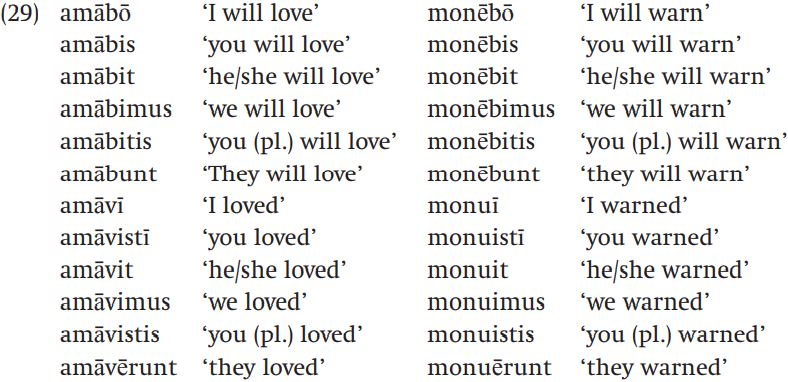
These verb forms are built on one of the stem forms, called the Theme Vowel stem (amā-, monē-) to which a future suffix -bi- or a perfect suffix -v- is attached. Then person and number suffixes are attached. Interestingly, different person and number affixes are used in the past than in other tenses:
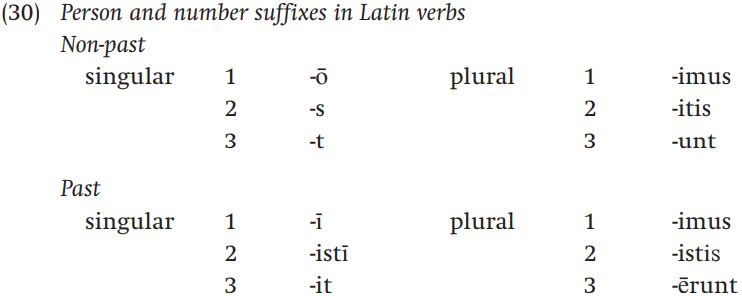
In the non-past, the suffixes combine person and number; in some sense, however, the second set of suffixes also signals past tense in addition to person and number, since they are only used in the past tense.

Latin has both derivational suffixes and prefixes. For example, it forms abstract nouns from verb roots by adding the suffix -or:

The suffix -men attaches to either roots or theme vowel stems to form nouns that denote the result of an action:

The prefix amb- attaches to verbs and means ‘around’ and the prefix inattaches to adjectives to form negative adjectives:

Latin does not use compounding as much as English and Germanic languages do, but it does have some compounds:

When two roots are put together into a compound, the linking vowel -i- is used between them.


لا توجد تعليقات بعد

ما رأيك بالمقال : كن أول من يعلق على هذا المحتوى

اخر الاخبار

اشترك بقناتنا على التلجرام ليصلك كل ما هو جديد

