Least Squares Fitting--Perpendicular Offsets
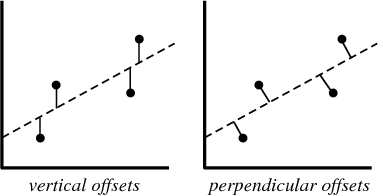
In practice, the vertical offsets from a line (polynomial, surface, hyperplane, etc.) are almost always minimized instead of the perpendicular offsets. This provides a fitting function for the independent variable  that estimates
  for a given
  (most often what an experimenter wants), allows uncertainties of the data points along the
  - and
- and  -axes to be incorporated simply, and also provides a much simpler analytic form for the fitting parameters than would be obtained using a fit based on perpendicular offsets.
The residuals of the best-fit line for a set of  points using unsquared perpendicular distances
  of points
  are given by
 |
(1)
|
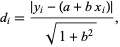
Since the perpendicular distance from a line  to point
  is given by
 |
(2)
|
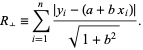
the function to be minimized is
 |
(3)
|
Unfortunately, because the absolute value function does not have continuous derivatives, minimizing  is not amenable to analytic solution. However, if the square of the perpendicular distances
![R__|_^2=sum_(i=1)^n([y_i-(a+bx_i)]^2)/(1+b^2)](https://mathworld.wolfram.com/images/equations/LeastSquaresFittingPerpendicularOffsets/NumberedEquation4.gif) |
(4)
|
is minimized instead, the problem can be solved in closed form.  is a minimum when
=0](https://mathworld.wolfram.com/images/equations/LeastSquaresFittingPerpendicularOffsets/NumberedEquation5.gif) |
(5)
|
and
+sum_(i=1)^n([y_i-(a+bx_i)]^2(-1)(2b))/((1+b^2)^2)=0.](https://mathworld.wolfram.com/images/equations/LeastSquaresFittingPerpendicularOffsets/NumberedEquation6.gif) |
(6)
|
The former gives
and the latter
![(1+b^2)sum_(i=1)^n[y_i-(a+bx_i)]x_i+bsum_(i=1)^n[y_i-(a+bx_i)]^2=0.](https://mathworld.wolfram.com/images/equations/LeastSquaresFittingPerpendicularOffsets/NumberedEquation7.gif) |
(9)
|
But
so (10) becomes
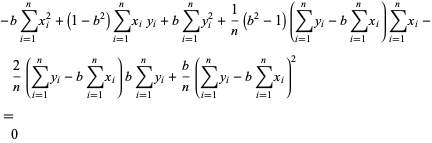
Plugging (◇) into (14) then gives
 |
(15)
|
After a fair bit of algebra, the result is
![b^2+(sum_(i=1)^(n)y_i^2-sum_(i=1)^(n)x_i^2+1/n[(sum_(i=1)^(n)x_i)^2-(sum_(i=1)^(n)y_i)^2])/(1/nsum_(i=1)^(n)x_isum_(i=1)^(n)y_i-sum_(i=1)^(n)x_iy_i)b-1=0.](https://mathworld.wolfram.com/images/equations/LeastSquaresFittingPerpendicularOffsets/NumberedEquation9.gif) |
(16)
|
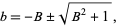
So define
and the quadratic formula gives
 |
(19)
|
with  found using (◇). Note the rather unwieldy form of the best-fit parameters in the formulation. In addition, minimizing
  for a second- or higher-order polynomial leads to polynomial equations having higher order, so this formulation cannot be extended.
REFERENCES:
Sardelis, D. and Valahas, T. "Least Squares Fitting-Perpendicular Offsets." https://library.wolfram.com/infocenter/MathSource/5292/.








