الوضع الليلي


 1:43:33
  2025-10-19
  1863
1863
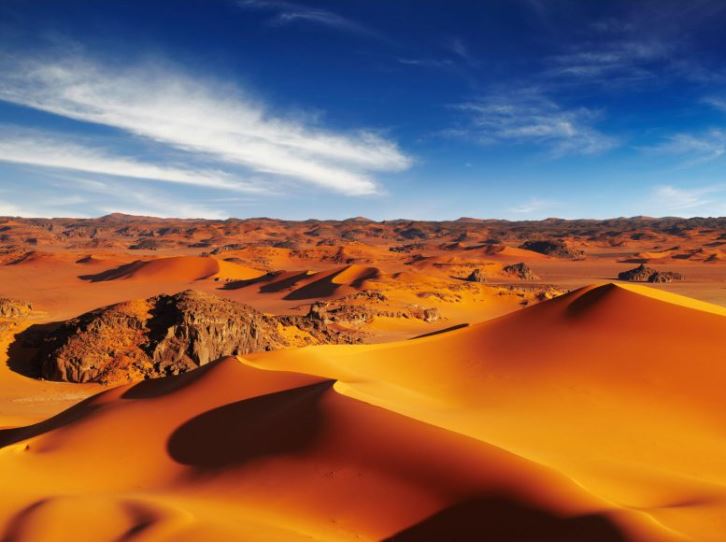
Once one of the planet’s driest landscapes, the Sahara Desert may become far wetter by the end of this century.
The Sahara Desert ranks among the driest places on Earth, receiving only about 3 inches of precipitation each year — roughly one-tenth of what Chicago experiences from rain, sleet, and snow.
However, scientists from the University of Illinois Chicago (UIC) predict that this arid landscape could become significantly wetter in the latter half of the 21st century.
Their findings, published in npj Climate and Atmospheric Science, suggest that the Sahara could receive up to 75% more rainfall compared with its historical average. The researchers also project that under extreme climate scenarios, precipitation will rise across southeastern and south-central Africa.
“Changing rainfall patterns will affect billions of people, both in and outside Africa,” said lead author Thierry Ndetatsin Taguela, a postdoctoral climate researcher in the College of Liberal Arts and Sciences. “We have to start planning to face these changes, from flood management to drought-resistant crops.”
Taguela said understanding how rising temperatures affect rainfall can help in the development of adaptation strategies. In the study, he used an ensemble of 40 climate models to simulate summer precipitation in Africa in the second half of the 21st century (2050-2099) compared with the historical period (1965-2014). Taguela analyzed models’ outputs under two climate scenarios: one that simulated moderate greenhouse gas emissions and one that simulated very high greenhouse gas emissions.
The Scenarios and Results
Both scenarios predicted that precipitation over Africa will generally increase by the end of the 21st century, with some regional variation. Notably, rainfall in the Sahara Desert is expected to increase by 75%, followed by a 25% increase in southeastern Africa and a 17% increase in south-central Africa. In contrast, researchers expect the southwestern region to be drier, with an anticipated 5% decline in precipitation.
“The Sahara is projected to almost double its historical precipitation levels, which is surprising for such a climatologically dry region,” Taguela said. “But while most models agree on the overall trend of wetter conditions, there’s still considerable uncertainty in how much rainfall they project. Improving these models is critical for building confidence in regional projections.”
For the most part, these projected changes are associated with the effects of climate change, as higher temperatures help the atmosphere hold more moisture, which in turn enhances rainfall. Changes in atmospheric circulation also played a part in reducing rainfall.
“Understanding the physical mechanisms driving precipitation is essential for developing adaptation strategies that can withstand both wetter and drier futures,” Taguela said.
Reality Of Islam |
|
For more th
A new polym

A tiny chip

Researchers
 9:3:43
2018-11-05
9:3:43
2018-11-05
10 benefits of Marriage in Islam
7:5:22
2019-04-08
benefits of reciting surat yunus, hud &
9:45:7
2018-12-24
advantages & disadvantages of divorce
11:35:12
2018-06-10
6:0:51
2018-10-16
2:42:26
2023-02-02
7:34:7
2023-02-28
3:18:29
2022-12-24
8:4:21
2022-01-08
10:55:53
2022-06-13
8:21:9
2018-06-21
7:45:39
2018-06-21
5:41:46
2023-03-18
| LATEST |
 HOME
HOME