الوضع الليلي


 11:11:45
  2025-01-07
  1773
1773
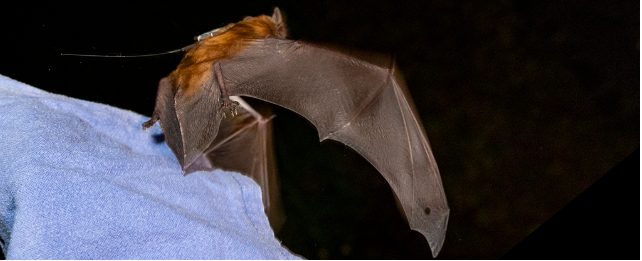
When it comes to flying long distances, bats need to overcome physics that forces the rest of us mammals right back down to Earth.
One species has a trick up its membranous sleeves, new research reveals, allowing it to surf storm fronts for hundreds of miles.
Each spring in Europe, hordes of female common noctule bats (Nyctalus noctula) wake from winter hibernation and fall pregnant with sperm that's been stored in their uteruses for months.
Carrying one or two embryos that develop into bat pups within six to eight weeks, the females set out across the continent, homing toward the maternity colony where they themselves were born, sometimes as far north as the Baltic region.
It's a difficult phenomenon for scientists to observe, and just how they manage this long-distance trek has, until now, been a mystery.
A team from the Max Planck Institute of Animal Behavior in Germany glued tiny sensors onto 71 female noctule bats during their northeast migration, tracking the animals for up to four weeks and recording an impressive range of measurements including activity levels and air temperatures.
The team expected to see the bats stopping to refuel regularly – unlike migratory birds, bats don't stock up fat reserves prior to their long trip. But they noticed an unexpected pattern each time the bats decided it was time to move on.
"On certain nights, we saw an explosion of departures that looked like bat fireworks," says behavioral ecologist Edward Hurme. "We needed to figure out what all these bats were responding to on those particular nights."
Like surfers anticipating that perfect moment when the wave's curve beckons their board, the bats wait for the warm tug of air and a drop in pressure that leads to a spring storm.
"They were riding storm fronts, using the support of warm tailwinds," Hurme says.
Paddling into this invisible crest, the bats hitch a ride toward their maternal roosts, covering astonishing distances of up to 383 kilometers (238 miles) in a single night.
And they're not just catching one wave to get there: they're riding 'sets' of storm fronts, nearing their destination with each surge of low pressure.
"There is no migration corridor," says behavioral ecologist Dina Dechmann.
"We had assumed that bats were following a unified path, but we now see they are moving all over the landscape in a general northeast direction."
The tracking devices showed the bats saved energy by catching these invisible waves, an important factor in the equation when a baby is on the way.
"The sensor data are amazing," says Hurme. "We don't just see the path that bats took, we also see what they experienced in the environment as they migrated."
"It's this context that gives us insight into the crucial decisions that bats made during their costly and dangerous journeys."
Reality Of Islam |
|

Keeping sil

Two experim

Changing a

Plants are
 9:3:43
2018-11-05
9:3:43
2018-11-05
10 benefits of Marriage in Islam
7:5:22
2019-04-08
benefits of reciting surat yunus, hud &
9:45:7
2018-12-24
advantages & disadvantages of divorce
11:35:12
2018-06-10
6:0:51
2018-10-16
2:42:26
2023-02-02
3:42:22
2021-12-24
11:34:48
2022-06-29
8:15:37
2023-02-16
2:2:13
2022-10-08
4:25:57
2023-02-11
the happy life of mankind requirement
6:36:36
2022-01-25
5:41:46
2023-03-18
| LATEST |
 HOME
HOME